
Every improvement plan starts with a quiet fiction: the belief that you already know how good your maintenance program is. Ask people in planning, operations, maintenance, and leadership and you may get very different answers. That gap is why learning how to assess maintenance maturity matters before a major tool or software purchase. Until you have a defensible picture of where the program stands, improvement spending is partly based on assumption. A useful maturity assessment replaces opinion with a repeatable mix of evidence, observation, and informed judgment.
What Maintenance Maturity Actually Measures
Maintenance maturity is not a measure of how hard your team works or how new your equipment is. A site full of expensive machines can run a weak maintenance system, and a plant full of aging assets can run a disciplined one. Maturity models vary, but they commonly examine capabilities such as work management, planned versus reactive work, preventive and condition-based practices, asset data quality, reliability engineering, leadership, and continuous improvement. A mature program is not one in which nothing breaks; it is one in which work is increasingly controlled, risks are understood, and decisions are supported by reliable information.
That distinction matters because it changes what the word “better” means. Buying a predictive tool can add alerts without adding much value if the plant lacks the planning, labor, materials, or decision process to act on them. A maturity assessment can help identify the most important current constraint, such as planning discipline, data quality, parts availability, execution capacity, or leadership support, so improvement spending is aimed at a problem the organization can actually solve.
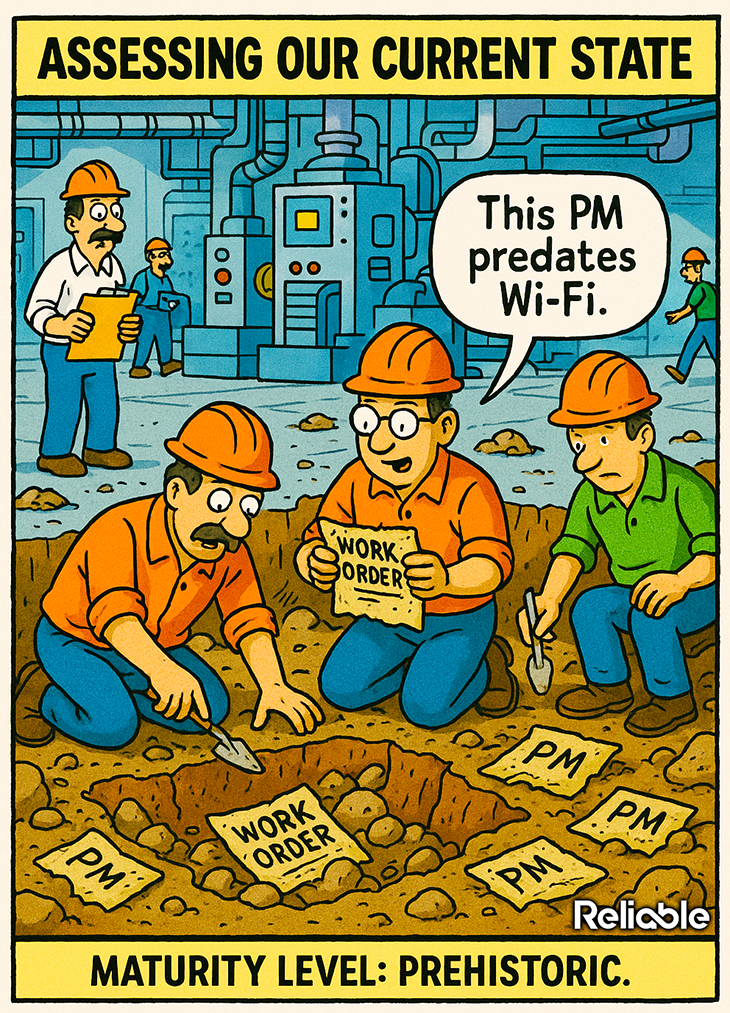
A maturity level is not a grade for how hard people work. It is a description of how much of the work gets to be a decision instead of a reaction.
How to Assess Maintenance Maturity Without Fooling Yourself
The fastest way to weaken an assessment is to let it become a self-congratulation exercise. Self-scoring alone can bias results upward, so a credible assessment should use evidence you can trace. Useful measures may include planned versus unplanned work, schedule compliance, preventive and predictive task completion, backlog age and priority, repeat failures, and whether significant failures receive documented analysis. No single metric proves maturity, but a defined set of measures makes the result more defensible.
The clearest signs of an immature maintenance program often show up in the gap between records and actual practice. Interviews still matter, but they should be used alongside work history, observations, and defined metrics rather than as the sole evidence. Ask a planner, an operator, and a technician the same simple question: “How does work get prioritized here?” Disagreement in their answers is itself useful information. When the written process and the real process have drifted apart, the assessment should reflect what actually happens. The goal is not a comfortable score; it is a score you would still defend after a genuinely bad month.
A simple scorecard keeps the exercise repeatable. Choose a small set of measures you can collect consistently, then define each metric, data source, scoring rule, and acceptable range in advance. Use the same method each cycle so that changes in the score reflect changes in the program rather than changes in the scoring. External benchmarks can help when definitions and operating contexts are comparable, but universal targets should not be forced onto unlike plants. A rough measure you actually repeat is more useful than a perfect framework you run once and abandon.
If the assessment makes everyone in the room feel good, it was a survey, not an assessment.
The Levels, From Reactive to Proactive
Maintenance maturity models do not use one universal ladder, but many describe movement from reactive work toward more controlled, planned, condition-informed, and proactive practices. In an early reactive state, the day is dominated by break-in work. As work management improves, jobs are prioritized, planned, scheduled, and supported with the right information and materials. Condition monitoring and predictive methods can then be applied where failure modes and asset criticality justify them. More advanced programs also use defect elimination, reliability engineering, and risk-based decisions to reduce recurrence.
Treat that sequence as a set of dependencies, not a rigid rule. A plant can begin condition monitoring while improving planning, but analytics has limited value if alarms cannot be converted into prioritized, executable work. In practice, reducing avoidable reactive work, improving asset and work-order data, and strengthening planning and scheduling makes condition-based and predictive programs easier to sustain.
Technology can accelerate maintenance maturity, but it does not substitute for foundational work-management and reliability practices. Some capabilities can develop in parallel; what matters is that the plant can understand the information it creates and consistently turn that information into safe, prioritized action.
How to Assess Maintenance Maturity on a Recurring Basis
An assessment done once is a photograph; an assessment repeated on a schedule becomes a trend. Reassessing the same measures every six or twelve months is a reasonable cadence for many sites, although the right interval depends on the pace of change. A stable planned-to-reactive ratio does not, by itself, prove that nothing improved, so review the whole scorecard and the underlying evidence. Comparable measurements show which capabilities are moving and keep any maintenance optimization effort tied to evidence rather than narrative.
It also helps to separate the assessment from personal performance punishment. If an unflattering maturity score becomes a grade on one supervisor, people have an incentive to defend the number rather than improve the system. Treat the baseline as a shared starting point and require evidence for each score. An uncomfortable number that can be traced to data and observed practice is more useful than a flattering number no one can reproduce.
None of this requires a consultant or a framed maturity certificate on the wall. It requires the willingness to look at your own numbers and practices and accept the baseline as a starting point. That is the discipline behind how to assess maintenance maturity: measure what you actually do, not only what the procedure says you intend to do, and let the gap between the two shape the improvement plan. A plant that can describe its gaps clearly is in a much better position to close them.