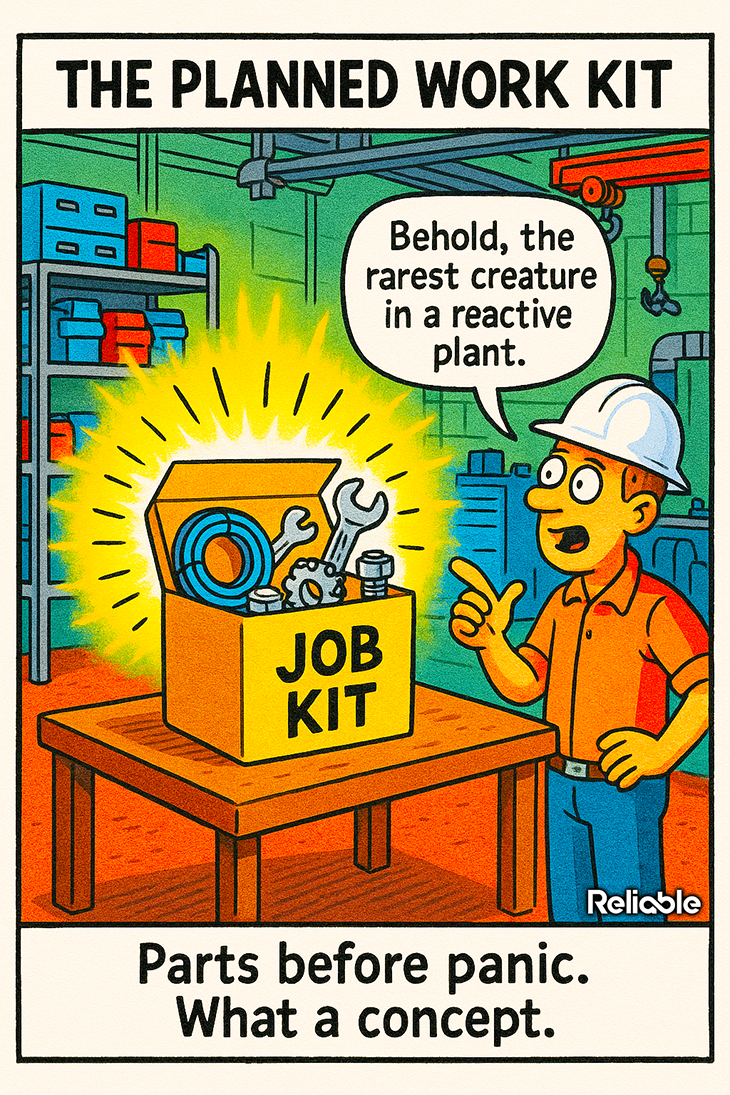

In a reactive plant, a fully kitted job is a rare sight. Parts here, tools there, the tech walking to the storeroom for the third time before lunch.
Maintenance job kitting best practices help by staging everything a job needs, including parts, tools, permits, and instructions, before the work gets scheduled.
The idea is almost insultingly simple. Gather what the job needs, put it in one place, and hand it to the tech ready to go. Plants that do it well usually see better wrench time, fewer parts-related delays, and more consistent repair execution.
The waste is invisible because it’s normal. Nobody logs the small delays spent finding a fitting or the trip back for a missing seal. Add those minutes across a crew across a year, and you’ve lost weeks of productive time to a problem a basic kit could reduce.
What Maintenance Job Kitting Best Practices Actually Cover
Kitting is the last step of good planning, where a plan becomes a physical, ready-to-execute package.
A real kit holds more than parts. It bundles everything the tech would otherwise hunt for, so the job starts the moment they reach the equipment.
Think of it as room service for maintenance. The job order is the menu, the kit is the tray, and the tech is free to focus on the work instead of foraging for ingredients.
A complete job kit includes:
- Every part and consumable, counted and confirmed in hand.
- The specific tools and any special equipment the job calls for.
- Permits, lockout steps, and safety documentation.
- Clear instructions, drawings, and torque or alignment specs.
Assembled ahead of time and staged in a marked location, the kit removes one of the most common reasons planned jobs stall: waiting on something that should already be there.
Every trip back to the storeroom is wrench time spent walking, and walking has never fixed a pump.
Strong kitting leans on accurate spare parts management, because a kit is only as good as the storeroom behind it. Miss one gasket and the whole job waits.
Decide who assembles the kit
Kitting usually falls to a dedicated kitter, a storeroom attendant, or the planner, depending on plant size.
Whoever owns it works from the planned job package, pulls the parts, gathers the tools, and stages the lot in a labeled location keyed to the work order. The tech should be able to grab a kit and go without asking a single question.
Why Maintenance Job Kitting Best Practices Pay Off
The payoff shows up in the number every maintenance manager watches.
Measured as the share of a shift spent actually turning wrenches, wrench time is often estimated in the 25% to 35% range in reactive environments, although it varies by plant, craft, and measurement method. Much of the lost time can go to traveling, searching, and waiting for parts. Kitting attacks all three at once.
Higher wrench time comes from reducing the daily scavenger hunt that eats into a tech’s shift.
The gains stack up across the operation, and most of them reinforce each other.
Kitting pays back in several directions:
- More completed jobs per week from the same crew, without assuming new hires.
- Higher schedule compliance, because jobs are less likely to stall on missing parts.
- Better repair quality, because technicians have the right parts, instructions, and specifications before work starts.
- Fewer return trips and less overtime chasing parts mid-job.
The ripple reaches the schedule directly. Jobs often stall on missing parts, so a confirmed kit reduces one of the most common reasons a planned job slips off the weekly plan. Reliable kits and reliable schedules go hand in hand.
Quality climbs for a quiet reason. A tech who has the right torque spec and the correct gasket does the job right the first time, so the same equipment stops reappearing on next month’s schedule.
There’s a morale dividend too. Techs are craftspeople, and handing them a complete kit signals that their time is valued. Crews that stop scavenging for parts stop feeling like they were set up to fail, and that change can show up in morale, schedule confidence, and output.
How to Put Job Kitting Into Practice
Kitting works when it’s built directly into the planning flow.
Treat it as a permanent process change rather than a one-off push. The goal is a standing system where every parts-dependent planned job gets kitted by default, so kitting becomes the path of least resistance rather than a special effort.
Plan the job completely before kitting it
You can’t kit what you haven’t planned.
Solid maintenance planning defines the full scope, the parts list, the tools, and the steps. Kitting then turns that plan into a physical package. Skip the planning and the kit is just a guess in a box.
Bills of materials make this repeatable. Build a parts list for each recurring job once, store it, and reuse it. The second time you kit a given pump rebuild, the list already exists and the kit comes together faster and more consistently.
The order matters. Planning defines the work, and kitting makes that work portable to the job site.
A kit is a plan you can pick up and carry to the job, which is exactly why a weak plan makes a useless kit.
Done in that order, every kit a tech picks up carries a plan they can trust.
Stage kits before the schedule locks
A parts-dependent job shouldn’t make the weekly schedule until its kit is confirmed.
This single rule changes the workflow. It forces parts checks early, surfaces shortages while there’s still time to order, and means every scheduled job is genuinely ready to run.
Watch out for the half-kit. A kit missing one part is almost worse than no kit, because the tech finds the gap at the equipment with the job already torn down. Confirm completeness before a kit gets staged, every time.
Make kitting stick with a few rules:
- No parts-dependent job enters the weekly schedule until its kit is complete and staged.
- Kits live in a dedicated, labeled staging area, one kit per job.
- The planner confirms parts availability before committing the job.
- Long-lead parts get ordered the moment the job is identified.
Measure the payoff so the program survives its first budget review. Track wrench time, schedule compliance, and parts-related delays before and after, and let the trend make your case for you.
Start with your largest or most delay-prone planned jobs, where the payoff is easiest to measure, and expand as the habit takes hold. A pilot on one crew or one area gives you a clean before-and-after to point at when you ask for the resources to scale it up.
Maintenance job kitting best practices reward the patient. The first kits take effort to assemble, and then jobs tend to go faster, schedule breaks become easier to spot, and storeroom trips fade out.
Gather the parts, stage the kit, and let the work flow. It really is that simple, and that hard to sustain.