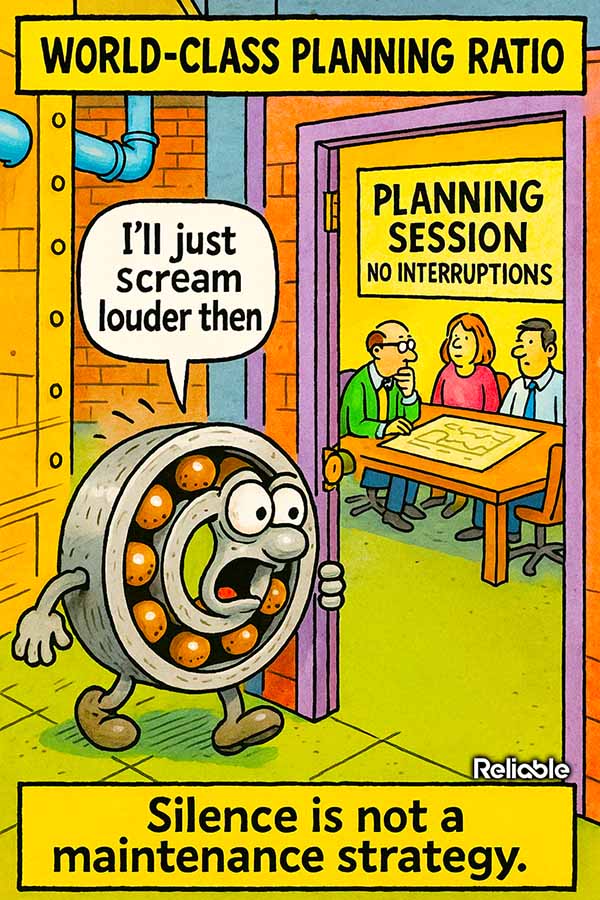

There’s a particular kind of irony that maintenance professionals know well. The team is in a conference room, whiteboards covered in schedules and priorities, debating the best way to reduce unplanned downtime. Meanwhile, out on the floor, a pump bearing is screaming for attention that nobody’s available to give it.
Planning is essential. Everyone in the reliability world agrees on that. But there’s a gap between planning maintenance and actually doing maintenance that swallows a lot of good intentions.
The Planning Paradox
Here’s the uncomfortable truth about maintenance planning: the plants that need it most are the ones least able to do it. When you’re stuck in reactive mode, every technician is fighting fires. Pulling people into a planning meeting means leaving equipment unattended. The backlog grows while the team discusses how to shrink it.
A 2022 survey by Plant Engineering found that 54% of maintenance organizations still operate in a primarily reactive mode. These same organizations reported planning meeting attendance rates below 60% because technicians kept getting pulled out to handle emergencies.
The cycle is vicious and self-reinforcing. Reactive work prevents planning. Lack of planning causes more reactive work. And the equipment keeps degrading while everyone argues about the schedule.
Reactive work prevents planning. Lack of planning causes more reactive work. The equipment keeps degrading while everyone argues about the schedule.
Breaking this cycle requires more than scheduling a weekly planning meeting and hoping people show up. It requires a fundamental shift in how the organization allocates its maintenance resources.
Why Most Planning Efforts Fail
Most plants have tried to implement maintenance planning at some point. The typical pattern goes like this: leadership announces a new commitment to planned maintenance. A planner gets hired or appointed. Meetings get scheduled. Things improve for a few weeks.
Then a major breakdown happens. The planner gets pulled into the emergency response. Meetings get cancelled. Within three months, the organization is back to full reactive mode, now with the added cynicism of a failed improvement initiative.
The Resource Allocation Problem
The root cause is almost always resource allocation. Facilities try to bolt planning onto an already overloaded maintenance team without adding capacity or (more importantly) without protecting the planning function from reactive demands.
- Planners who spend 70% of their time as reactive coordinators instead of actually planning work
- Planning meetings that get cancelled whenever a breakdown occurs
- No dedicated planning time on the weekly schedule, just meetings squeezed between emergencies
- Maintenance supervisors who treat planned work as optional when reactive needs arise
The result is a planning process that exists on paper but delivers nothing in practice. Work orders get created but never scheduled. Parts get identified but never staged. And the technicians, who’ve seen this cycle before, stop taking the planning meetings seriously.
The Communication Breakdown
There’s another failure mode that’s harder to spot: planning meetings that produce plans nobody follows. The planning team meets, builds a beautiful schedule, and distributes it. Operations ignores it because they weren’t consulted about equipment availability. The technicians ignore it because the plan doesn’t match the tools and parts actually available in the storeroom.
Planning without input from operations and without accurate inventory data is just a creative writing exercise. The prettiest Gantt chart in the world won’t fix a pump if the required seal kit is on a six-week lead time.
Planning without input from operations and without accurate inventory data is just a creative writing exercise. The prettiest Gantt chart won’t fix a pump if the seal kit is on a six-week lead time.
Effective planning requires real collaboration. The planner needs to talk to operations about when equipment will be available. The storeroom needs to confirm parts are on hand. And the supervisor needs to commit technician hours before the week starts, with a clear understanding that only genuine emergencies (not just urgent requests) will override the schedule.
Building a Planning Process That Survives Contact With Reality
The best maintenance planning processes share a few characteristics that separate them from the ones that quietly collapse after a few months.
Protect the Planner
The maintenance planner’s job is to plan. That sounds obvious, but in practice, planners routinely get reassigned to reactive coordination, parts chasing, or supervising contractors. Every hour the planner spends doing something other than planning is an hour of future work that will be done reactively.
World-class facilities enforce a simple rule: the planner doesn’t respond to breakdowns. Ever. Someone else handles reactive coordination. The planner stays focused on next week’s schedule.
- Assign a dedicated planner with a protected schedule and clear boundaries
- Establish a separate reactive coordinator role to handle emergency work
- Measure planner utilization on actual planning activities, with a target of 85% or higher
- Make the planner’s work visible to leadership through weekly schedule compliance metrics
This requires discipline, especially in the early months when reactive demands are still high. Leadership has to be willing to let some reactive work take longer in order to build the planning capacity that will eventually reduce reactive work overall.
Plan to a Realistic Capacity
A common planning mistake is scheduling 40 hours of planned work per technician per week, leaving zero buffer for reactive demands. In a plant that’s 60% reactive, that plan will fail by Tuesday morning.
Start with an honest assessment of your current reactive workload. If 50% of your labor hours go to reactive work, plan for 50% of capacity. As planning improves and reactive work decreases, you can gradually increase the planned work percentage.
The industry benchmark for world-class maintenance is 80% planned work and 20% reactive. Getting there typically takes 18 to 24 months of sustained effort. Trying to jump from 40% planned to 80% planned in a quarter will produce nothing but frustration and a planning process that nobody trusts.
Close the Feedback Loop
Every planned job that gets completed should generate feedback to the planner. Did the job take as long as estimated? Were the right parts available? Was the procedure accurate? This information makes the next plan better.
Without this feedback, planners keep making the same estimation errors. Jobs consistently take longer than planned, which throws off the weekly schedule, which erodes confidence in the planning process, which makes it easier to justify cancelling the next planning meeting.
Without feedback from completed jobs, planners keep making the same estimation errors. The schedule drifts, confidence erodes, and the planning process slowly dies.
Track schedule compliance weekly. The target is 90% or higher: meaning 90% of planned jobs get completed during the week they’re scheduled. Below 80%, something is fundamentally broken in either the planning process, the execution, or the relationship between maintenance and operations.
The Operations Partnership
Maintenance planning doesn’t happen in isolation. Every planned job requires equipment access, which means operations has to agree to take equipment offline at specific times. Without that agreement, the plan is just wishful thinking.
The most effective facilities hold a joint scheduling meeting each week where maintenance and operations sit at the same table. They review the upcoming week’s planned work, confirm equipment availability windows, and negotiate priorities. Both sides walk away with a commitment.
- Weekly joint scheduling meetings between maintenance and operations (30 to 60 minutes)
- Agreed-upon equipment access windows documented and communicated to shift teams
- A shared definition of what constitutes a genuine emergency that can override planned work
- Monthly review of schedule compliance with both maintenance and operations leadership present
This partnership is where planning either succeeds or fails. If operations views maintenance as a service provider to be called when things break, planning will never take hold. If both departments view reliability as a shared responsibility, planning becomes the mechanism through which that responsibility is exercised.
Start Small, but Start Now
You don’t need a perfect planning process to start getting results. Pick five jobs for next week. Plan them properly: scope the work, identify parts, estimate labor, and confirm equipment availability with operations. Execute them as planned.
Then do it again the following week, with seven jobs. Then ten. Build the muscle gradually. Track what works and what doesn’t. Adjust the process based on actual results.
The alternative is another year of reactive firefighting, another year of emergency parts orders at premium prices, another year of burning out your best technicians on midnight call-outs that could have been prevented with a wrench and two hours of planned downtime during the day shift.
Your equipment doesn’t care about your planning meeting schedule. It’s going to fail on its own timeline, regardless of what’s on the whiteboard. The question is whether your team will be ready when it does, or still sitting in the conference room debating priorities.