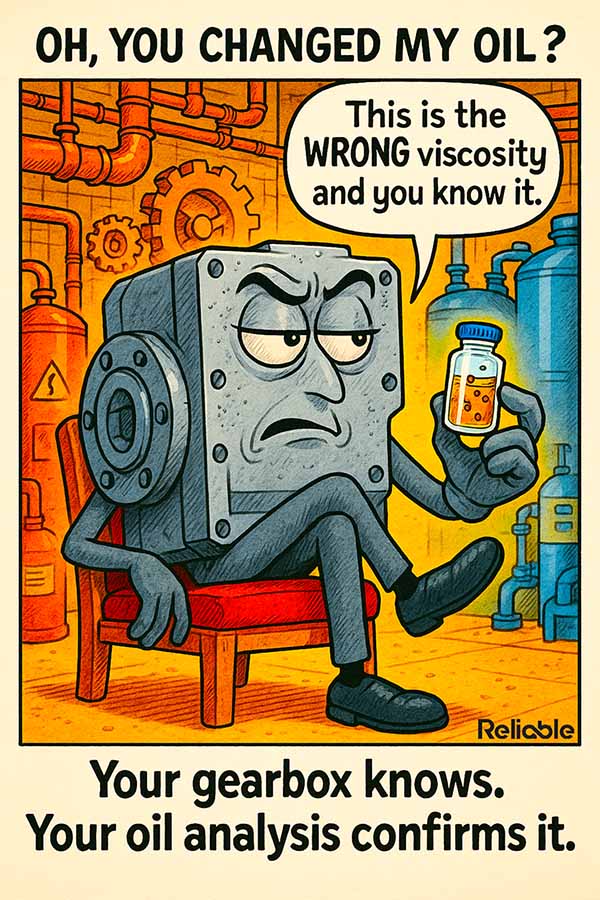

A gearbox doesn’t care whether you changed its oil. It cares whether you put the right oil in.
That distinction trips up maintenance teams more often than anyone likes to admit. A tech grabs the nearest drum, checks that it’s gear oil, and fills the sump. The viscosity grade is wrong, but the gearbox doesn’t throw an error code. It just starts wearing faster.
By the time someone notices (usually when the gearbox starts running hot or making noise), the damage to gear teeth and bearings is already significant. An oil analysis report would have flagged the problem in days. Without one, you’re flying blind until the failure is obvious.
Why Viscosity Matters So Much
Viscosity is the single most important property of a lubricant. It determines the thickness of the oil film that separates metal surfaces inside the gearbox. Too thin, and the gears operate in boundary lubrication, metal-on-metal contact that accelerates wear exponentially. Too thick, and the oil can’t flow into tight clearances, generating excess heat from fluid friction.
Viscosity is the single most important property of a lubricant. Get it wrong and everything else about your lubrication program becomes irrelevant.
Gear manufacturers specify viscosity grades based on operating speed, load, and temperature. An ISO VG 320 oil isn’t interchangeable with an ISO VG 220, even though they’re both gear oils from the same product line. The difference in film thickness at operating temperature can be 30% or more. That’s the difference between a gearbox that lasts 15 years and one that fails in three.
How the Wrong Oil Gets In
Cross-contamination and misapplication happen for predictable reasons. The most common:
- Unlabeled or poorly labeled storage. Drums sitting in a lube room with faded tags or handwritten labels that don’t match the current product line. Someone grabs VG 150 instead of VG 320 because the drums look identical.
- Product consolidation gone wrong. A well-intentioned effort to reduce the number of lubricants in the plant leads to substituting a “close enough” product for the OEM-specified grade. Close enough isn’t.
- Knowledge gaps during turnover. The tech who knew which oil went in which gearbox retired. The replacement follows the procedure sheet, but the procedure sheet was last updated in 2017 and references a product that’s been reformulated since then.
Every one of these scenarios is preventable with basic lube management practices. Color-coded labels, dedicated fill points, and a current lubrication schedule solve 90% of the problem. The remaining 10% requires oil analysis to catch.
What Oil Analysis Tells You
A routine oil analysis sample costs $20 to $40 and takes about a week to process. For that price, you get a complete picture of what’s happening inside the gearbox.
The viscosity measurement on the report is your first line of defense against wrong-oil errors. If the sample comes back at ISO VG 220 and the gearbox spec calls for VG 320, you’ve caught the mistake before it caused serious damage. Drain the sump, flush it, and refill with the correct product. Total cost: a few hundred dollars and an hour of labor.
A $30 oil sample catches a wrong-viscosity fill that would otherwise cost you a $15,000 gearbox rebuild. The math isn’t complicated.
Beyond viscosity, oil analysis reveals wear metal concentrations (telling you which internal components are degrading), contamination levels (water, dirt, and cross-contamination from other lubricants), and additive depletion (whether the oil’s protective chemistry is still active).
Trending this data over time transforms oil analysis from a snapshot into a diagnostic tool. A gradual increase in iron particles tells a different story than a sudden spike. Steady water contamination points to a seal problem. Rising silicon levels suggest the breather is failing or the fill process is introducing dirt.
Building a Lubrication Program That Works
Effective lubrication management doesn’t require expensive technology. It requires discipline and consistency.
- Maintain a current lubrication schedule that specifies the exact product, viscosity grade, and volume for every lubricated asset in the plant. Update it whenever products change.
- Label everything: drums, storage locations, fill points on equipment. Use color coding so the match between container and fill point is visual and immediate.
- Sample on a schedule. Quarterly oil analysis for gearboxes is a reasonable starting point. High-criticality or high-cost units may justify monthly sampling.
Train every technician who handles lubricants on the basics: why viscosity matters, how to read a label, and how to take a clean oil sample. Contaminated samples produce bad data, which produces bad decisions. Proper sampling technique takes 10 minutes to teach and prevents a cascade of wasted effort.
Color-coded labels and dedicated fill points solve 90% of wrong-oil problems. Oil analysis catches the rest before the gearbox does.
The gearboxes in your plant are running right now on whatever someone poured into them last. If you don’t know exactly what that was, and you don’t have oil analysis data confirming it’s correct, you’re trusting luck over process. Luck runs out. Oil analysis doesn’t.