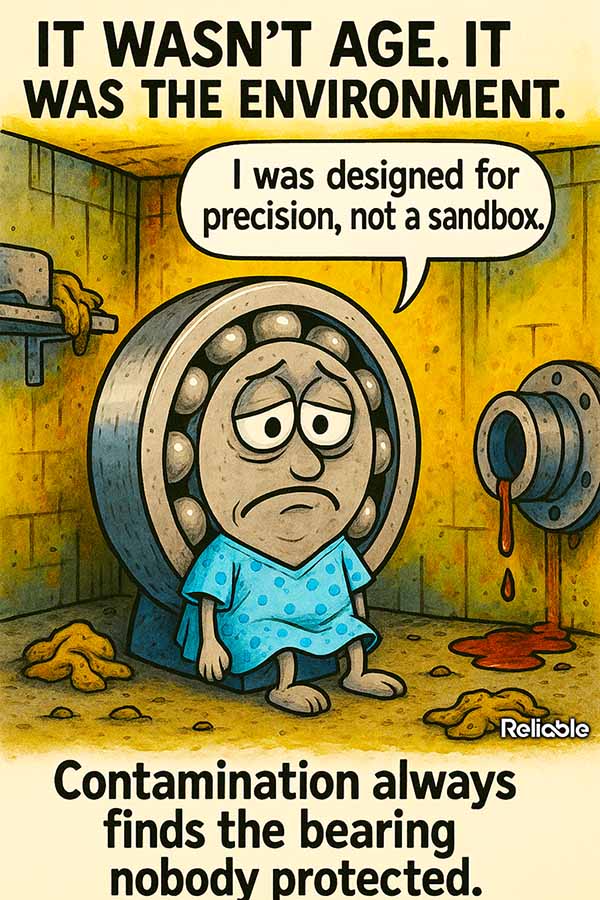

Contamination is the quiet killer of rolling-element bearings. Dirt, water, metal fines, and the wrong grease creep past the seals and grind a precision component into scrap. If you have pulled a bearing at half its rated life and found a gritty, discolored mess, you already know why learning how to prevent bearing contamination matters more than chasing a longer catalog rating.
A bearing is built to tight tolerances. The working clearances and lubricant film can be measured in microns, and hard particles in that contact zone can turn a smooth rolling surface into an abrasive one.
The frustrating part is how preventable most of it is. Contamination shows up through bad storage, sloppy installation, tired seals, and grease that picked up dirt on its way into the housing. Every one of those has a fix.
Where Contamination Actually Comes From
Before you can keep bearings clean, you have to know how the dirt gets in. Most contamination traces back to a handful of repeatable failure points.
- Storage: bearings left unwrapped on a shelf, exposed to humidity and airborne dust.
- Installation: dirty hands, dirty tools, and a workbench that doubles as a parts graveyard.
- Grease handling: open buckets, shared paddles, and nozzles that touch the floor.
- Seals and shields: worn lip seals that let moisture wick in during washdown.
- Operating environment: process dust, coolant spray, and pressure washing aimed straight at the housing.
Each of these leaves a signature. Water etching, corrosion, and abrasive scoring often leave different evidence, and a good bearing failure analysis can usually point to the most likely contamination path.
Bearing damage can begin the day contamination gets in, even though the symptoms may take months to show up on a vibration chart.
That delay is what makes contamination so dangerous. The damage starts immediately, then hides until the spall is big enough to feel on a route.
How to Prevent Bearing Contamination During Storage and Installation
The cleanest bearing you will ever handle is the one still sealed in its factory wrapper. The goal is to keep it that close to clean right up to the moment it seats on the shaft.
Storage discipline
Keep bearings in their original packaging until you need them. Store them flat, indoors, away from temperature swings and humidity that can compromise packaging or promote corrosion. Use first in, first out, so inventory does not age past supplier guidance.
Clean installation
Open the bearing last. Wipe the shaft and housing, use clean gloves, and skip the habit of spinning a dry bearing with shop air. Heat it with an induction heater instead of a torch, and mount it with the right tool so you are not driving grit in through brute force.
A lot of dirt in failed bearings gets introduced during handling and installation.
That is a hard thing to hear on the shop floor, but it points at the cheapest fix you have. Better habits at the bench cost very little and often save the most.
Sealing, Lubrication, and the Operating Environment
Once the bearing is running, your defense shifts to seals and lubricant. This is where preventing bearing contamination becomes an ongoing job instead of a one-time install step.
Match the seal to the threat. A simple shield may be enough in a clean, dry room. A washdown line in a food plant may need a contact lip seal, a flinger, a labyrinth arrangement, or positive pressure where appropriate to reduce contamination ingress.
- Use sealed or shielded bearings where the environment is dirty and access is tough.
- Add labyrinth or taconite seals on equipment that sees water, slurry, or heavy dust.
- Keep grease clean: sealed cartridges, dedicated guns, capped fittings, color-coded by lubricant.
- Filter oil to the target cleanliness code for the bearing, and keep it there.
Lubricant is a contamination vector and a contamination defense at the same time. Clean grease helps maintain the lubricant film and can help purge contaminants. Dirty grease can deliver particles straight to the raceway.
Re-grease on a schedule that matches the duty, and use the right amount. Over-greasing can overpressurize seals and run the bearing hot, which can open the very path you were trying to close.
Grease is either flushing contaminants out or carrying them in, and the difference is whether you kept the bucket closed.
Set up a simple lube room with sealed containers and labeled transfer equipment, and you remove one of the biggest sources of bearing damage in the plant.
Catch the Damage Early
Even a clean program lets a few particles through. The trick is spotting the damage while it is still cheap to fix, which is where monitoring earns its keep.
Vibration trending picks up the high-frequency signature of early raceway damage long before a bearing gets loud. Pair it with regular sampling, and an oil analysis report will flag rising particle counts and water ingress while you still have time to plan the swap.
Watch temperature too. A bearing that suddenly runs hotter is often a bearing whose lubricant film is breaking down under contamination.
Set thresholds and act on them. A monitoring program pays off only when someone owns the alarms and turns a rising trend into a scheduled work order while there is still time to act.
The Real Cost of a Contaminated Bearing
A replacement bearing might cost forty dollars. The failure that bearing causes rarely stops there.
Add the labor to tear down and rebuild, the collateral damage to the shaft and seals, and the production you lost while the line sat dark. A forty-dollar part can trigger a five-figure event.
- Direct parts: the bearing, plus the seals, shaft, or housing it took out on the way down.
- Labor: teardown, cleanup, rebuild, and alignment, often on overtime.
- Downtime: lost production while the asset is offline, which usually dwarfs the repair bill.
- Knock-on risk: a seized bearing that wrecks a gearbox or grenades a coupling.
Run those numbers once and the business case for clean handling writes itself. Every hour spent keeping bearings clean can buy back hours you would otherwise spend fixing what contamination destroyed.
Build the Habit, Keep the Bearings
Track which assets keep eating bearings. A machine that goes through three bearings a year is telling you its environment or its seals need attention, and that pattern is easy to miss without simple records.
Knowing how to prevent bearing contamination comes down to a chain of small, boring disciplines: clean storage, clean hands, the right seal, clean grease, and eyes on the data.
Every piece of it is cheap, and every piece is easy to skip on a busy day. The plants that protect their bearings are the ones that made the clean way the easy way, so the right habit happens without a second thought.
Do that, and your bearings have a much better chance of approaching the life numbers the catalog promised. That is the whole return: fewer surprise failures, longer runs, and a maintenance team that gets to plan its day instead of reacting to the next seized shaft.