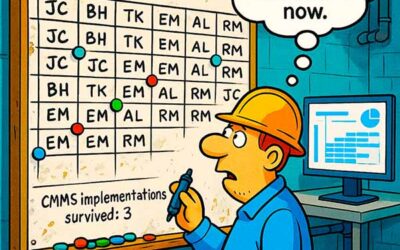
Every maintenance professional has faced it: a vague work order that simply says, “Fix motor,” with no asset number, no description, and no clue where to begin. It’s the perfect setup for frustration. The cartoon of the technician peering through a magnifying glass at a blank work order captures this daily reality with painful accuracy.
When communication breaks down, so does maintenance efficiency. A maintenance work order is supposed to be the backbone of your operation; the structured link between planning and execution. Yet too often, it becomes a guessing game. The result? Wasted time, miscommunication, and delayed repairs.
Every unclear maintenance work order steals time, trust, and performance. Clarity gives all three back.
Clarity isn’t just a convenience. It’s a performance multiplier. Improving how your organization writes and manages maintenance work orders is one of the most immediate ways to improve wrench time, reduce downtime, and elevate overall reliability performance.
Why the Maintenance Work Order Is the Foundation of Maintenance Efficiency
A maintenance work order is the DNA of execution. It contains instructions, materials, safety requirements, and contextual details that technicians need to do their jobs correctly. But when that DNA is incomplete or corrupted, the entire system suffers.
Think of a work order as a contract between planning and execution. It defines expectations and provides accountability. Without it, maintenance becomes reactive, undocumented, and inconsistent.
A precise maintenance work order transforms an organization’s reliability maturity. It ensures:
- Predictability: Technicians know what to expect before arriving on-site.
- Safety: Procedures and lockout/tagout requirements are clearly communicated.
- Accuracy: CMMS records stay clean, supporting data-driven decisions.
- Efficiency: Less time is wasted asking questions, hunting for parts, or clarifying tasks.
The best work orders anticipate confusion before it happens. They provide direction that empowers technicians to act confidently and correctly.
The Hidden Cost of a Poor Maintenance Work Order
It’s easy to underestimate the damage caused by vague or incomplete work orders. But the ripple effect can be enormous.
A single maintenance work order that lacks clarity can lead to:
- Lost wrench time: Studies show that 30–50% of a technician’s day can be wasted searching for missing details or waiting for clarification.
- Safety incidents: Missing instructions, incorrect isolation points, or absent PPE notes increase the likelihood of accidents.
- Equipment downtime: When technicians arrive unprepared, troubleshooting takes longer, and failures last longer.
- Corrupted data: Inaccurate entries in your CMMS lead to unreliable KPIs, distorted asset histories, and poor planning for future work.
- Cultural decay: Over time, technicians lose faith in the system. When trust erodes, shortcuts become normalized, and improvement stalls.
A maintenance work order may seem like paperwork, but it’s actually the foundation for every reliability metric you track. Without precision here, improvement anywhere else becomes impossible.
The Anatomy of a High-Quality Maintenance Work Order
Creating a great maintenance work order isn’t about bureaucracy. It’s about communication and structure. Every effective work order shares five core traits: clarity, completeness, consistency, context, and feedback.
Clarity: Make it specific and observable
Replace assumptions with observations. Instead of writing “Pump is noisy,” say “Pump 4B emitting grinding noise from motor coupling area.” These distinctions allow technicians to act instead of investigate.
Completeness: Capture critical information
A maintenance work order should include:
- Asset ID and precise location
- Problem description and observed symptoms
- Estimated labor and required skill
- Materials, parts, and tools needed
- Safety requirements (LOTO, confined space, PPE, etc.)
- Priority level and estimated duration
Without these, you’ve handed your technician a mystery, not an assignment.
Consistency: Standardize your fields
Work order quality improves dramatically when you define required fields in your CMMS. Missing entries should prevent release. Templates create discipline, making accuracy non-negotiable.
Context: Link data to history
Attach photos, vibration data, oil sample results, or prior work orders when possible. A technician’s understanding improves exponentially when they can see the broader picture. Context turns tasks into diagnoses.
Feedback: Close the loop
Once the work is complete, technicians should be encouraged—and expected—to record what they found, what they fixed, and what they recommend. These insights are the lifeblood of continuous improvement.
Every maintenance work order is both a communication tool and a data point. Each one feeds the next, refining your process over time.
Using Technology to Strengthen the Maintenance Work Order Process
Technology is not a replacement for discipline; it’s a multiplier. When paired with sound process design, modern CMMS and EAM tools make improving maintenance work orders easier than ever.
- Automated validation: Systems can check that required fields (like asset ID or safety instructions) are completed before release.
- AI text analysis: Some platforms use natural language processing to flag ambiguous or incomplete descriptions automatically.
- Mobile integration: Technicians can access photos, schematics, and asset history directly from tablets or smartphones, reducing time spent searching for context.
- Data analytics: Work order data can be aggregated to identify trends—like repeat failures or chronic work order errors—allowing proactive process improvement.
These digital enhancements ensure that quality control happens before a technician ever picks up a wrench. It’s not about policing; it’s about enabling accuracy at scale.
The Payoff: Turning Work Orders into Performance Engines
When done right, the maintenance work order becomes an engine of reliability. It drives alignment between departments and creates measurable value every day.
Organizations that master this discipline consistently report:
- 20–30% gains in wrench time
- Shorter mean time to repair (MTTR)
- Fewer emergency breakdowns
- More accurate CMMS data
- Better technician engagement and morale
In essence, every good maintenance work order reduces friction. It allows people to focus on execution, not guesswork. It’s the difference between a reactive firefighting culture and a proactive reliability system.
From Guessing to Guiding
The next time a technician holds up a vague work order and jokes about playing detective, remember that it’s not funny if it’s normal. Confusion costs money.
Fixing the maintenance work order process doesn’t require a massive investment or a new technology stack. It requires discipline, accountability, and a commitment to precision. Start small: standardize your templates, train requestors, and reward clarity.
When every maintenance work order tells the whole story, your team doesn’t just perform maintenance; they perform with purpose. Clarity replaces chaos, communication replaces confusion, and reliability becomes the outcome, not the goal.
Because in maintenance, success isn’t a mystery. It’s written in the work order.