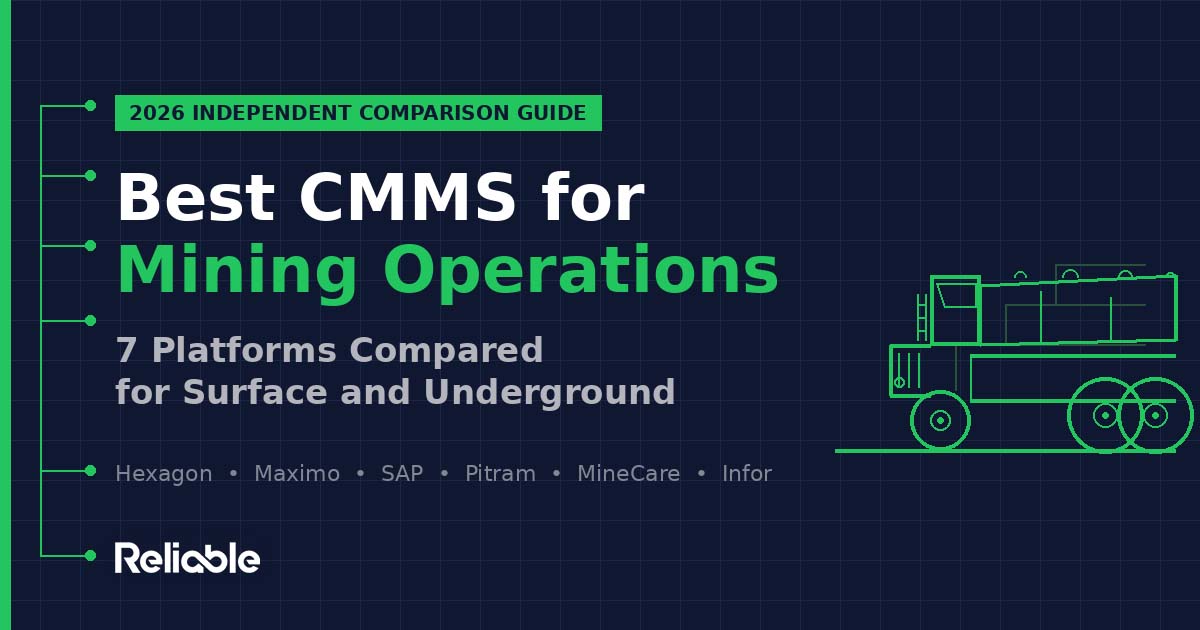

TL;DR: Mining is one of the most operationally extreme industrial CMMS verticals because heavy mobile equipment fleets, remote and harsh operating environments, MSHA compliance under 30 CFR, and OEM telematics ecosystems (Cat MineStar, Komatsu KOMTRAX, Sandvik My Sandvik) all change vendor selection meaningfully. General-purpose CMMS platforms rarely succeed in mining at scale. Hexagon EAM (formerly Mincom Ellipse) leads the category overall through dominant deployments across mining majors. IBM Maximo is the strongest pick for IBM-standardized operators. SAP S/4HANA fits SAP-standardized mining majors. Pitram serves fleet management and short-interval control. MineCare leads mobile equipment health and condition monitoring. Cat MineStar Health is the best choice for Caterpillar-equipped operations. Infor EAM serves smaller mining operations and aggregate producers. Choose based on operation type (surface, underground, aggregate), OEM equipment profile, ERP standardization, and operational scale rather than horizontal CMMS rankings.
How We Evaluated
This guide is independent editorial analysis based on publicly available product documentation, verified customer reviews across G2 and Capterra, hands-on product demonstrations, and conversations with reliability engineers, fleet maintenance managers, and operations leaders across copper, gold, iron ore, coal, lithium, and aggregate operations. Reliable Magazine does not sell CMMS or EAM software and has no commercial interest in routing buyers toward any particular platform. Reliable does not accept payment for rankings. Vendors may sponsor enhanced listings with additional detail, but editorial rankings are independent. Read our editorial policy.
We evaluated each platform across six criteria that matter most for mining CMMS decisions:
- Heavy mobile equipment integration – depth of support for haul trucks, shovels, dozers, drills, and LHDs, including OEM-specific maintenance workflows
- OEM telematics handshakes – integration quality with Cat MineStar, Komatsu KOMTRAX, Sandvik My Sandvik, and Epiroc telematics platforms
- MSHA compliance support – pre-shift inspection workflows, defect documentation, mechanical integrity, and 30 CFR audit readiness
- Remote and offline capability – mobile usability at remote pit locations, underground operations, and arctic or desert sites with limited connectivity
- ERP integration – handshake quality with SAP S/4HANA, Oracle EBS, and other ERPs common in mining majors
- Track record at scale – proven deployments across mining majors, intermediate operators, and aggregate producers
Why Mining CMMS Is Different
Mining CMMS selection differs fundamentally from general industrial CMMS evaluation. Four characteristics drive the differences.
First, heavy mobile equipment dominates the asset base in ways uncommon outside the industry. A typical open-pit copper or iron ore operation runs fleets of haul trucks (Caterpillar 793/797, Komatsu 930E/980E, Liebherr T 282), shovels and excavators (Caterpillar 7495, Komatsu PC8000, Hitachi EX5600), wheel loaders, dozers, drills, and graders. Underground operations add LHDs (load-haul-dump units), jumbos, scalers, and underground haul trucks. Each piece of equipment has manufacturer-specific maintenance workflows, OEM-supplied parts catalogs, factory-recommended PM intervals, and warranty considerations that fixed-plant CMMS handles poorly. Platforms with mining-specific equipment masters and OEM workflow support save substantial configuration overhead.
Second, remote and harsh operating environments make mobile capability operationally non-negotiable. Open-pit mines often span thousands of acres with intermittent cellular coverage. Underground operations operate beyond cellular range entirely. Arctic and desert mines face extreme temperatures that punish device hardware. CMMS platforms that require continuous connectivity for work order execution fail in these environments. Offline mobile capability with reliable sync – including photo capture, GPS tagging, and electronic signatures – is operationally critical, not optional.
Third, MSHA compliance under 30 CFR governs U.S. mining operations with documentation requirements that horizontal CMMS rarely supports natively. Pre-shift inspections of mobile equipment must be documented before each shift. Defects must route to maintenance work orders with chain-of-custody tracking. Mechanical integrity on safety-critical components – brakes, fire suppression, lights, backup alarms – must be tracked against MSHA intervals. Coal mines face additional electrical equipment inspection requirements under 30 CFR Part 75. International operations face equivalent regulatory frameworks: Canadian provincial mining regulations, Australian state mining acts (NSW Work Health and Safety Act, Queensland Coal Mining Safety and Health Act), and similar frameworks globally.
Fourth, OEM telematics ecosystems are deeply integrated with mining operations in ways uncommon elsewhere. Cat MineStar Health and VisionLink provide real-time engine data, fault codes, fluid analysis results, and component lifecycle tracking for the full Cat mining equipment population. Komatsu KOMTRAX and KOMTRAX Plus serve similar functions for Komatsu equipment. Sandvik My Sandvik covers Sandvik underground equipment. Epiroc operates similar platforms for drills. CMMS integration with these systems converts time-based PMs into usage-based PMs triggered by actual operating data, dramatically improving maintenance accuracy. Platforms with mature OEM integrations win on operational fit; platforms without them require fragile custom integrations that frequently produce data quality problems.
The 7 Best CMMS Platforms for Mining in 2026
1. Hexagon EAM – Best for Mining Overall
Hexagon EAM (formerly Mincom Ellipse) leads the mining CMMS category through depth, scale, and track record that no competitor approaches. The platform’s mining lineage dates back to Mincom in the 1990s, with decades of refinement through real production deployments at every major mining operation. Hexagon acquired Mincom in 2010 and integrated Ellipse into the broader Hexagon Mining portfolio, which includes Hexagon Mining (formerly Leica Geosystems Mining) operational technology, fleet management, and surveying systems. The integration creates an ecosystem advantage no other CMMS or EAM vendor can match in mining specifically.
Major mining operators – BHP, Rio Tinto, Anglo American, Newmont, Barrick, Freeport-McMoRan, Vale, Glencore, Antofagasta, First Quantum – overwhelmingly run Hexagon EAM as their primary asset management platform. The deployment depth means Hexagon’s mining-specific functionality has been refined through decades of real production use rather than designed for theoretical scenarios. Documentation, training resources, mining-specialized implementation partners, and reference customer access are all stronger for mining than any alternative platform.
The platform handles heavy mobile equipment as a first-class asset class, with deep integration into Cat MineStar, Komatsu KOMTRAX, and other OEM telematics. MSHA workflows and equivalent international compliance frameworks are pre-configured. Mobile capability handles offline work order execution at remote pit locations and underground operations. The trade-off is implementation complexity and total cost of ownership. Hexagon EAM deployments at mining scale typically run nine to twenty-four months with implementation costs in the high six figures to seven figures or more.
Best for: Mining majors, intermediate operators, and large national mining companies across surface, underground, and integrated operations.
Pricing: Custom enterprise pricing. Per-user costs typically run $200 to $400 per user per month for full Hexagon EAM deployments. Implementation costs range from high six figures to seven figures or more.
2. IBM Maximo Application Suite – Best for IBM-Standardized Operators
IBM Maximo is the strongest mining CMMS alternative to Hexagon, with a proven mining industry solution and the broadest deployment scale outside Hexagon’s mining footprint. Maximo for Mining includes pre-configured workflows for heavy mobile equipment, MSHA compliance frameworks, OEM telematics integration through PI Connector and direct APIs, and integration with mining operational systems. Major Maximo mining deployments include Newmont (alongside Hexagon in some operations), Barrick, Teck Resources, and several large coal and iron ore operators.
The platform’s strength outside mining specifically is its breadth – Maximo serves manufacturing, oil and gas, utilities, transportation, and other heavy industries with the same core platform plus industry-specific solutions. For mining operators that are part of larger industrial groups standardized on Maximo across multiple businesses, the enterprise consistency advantage often outweighs Hexagon’s mining-specific depth. Implementation timelines and costs are comparable to Hexagon, with similar deployment overhead.
The trade-off compared to Hexagon is in mining-specific operational technology integration. Hexagon’s ownership of Hexagon Mining gives it ecosystem advantages – fleet management, dispatch, surveying – that Maximo approaches through integration rather than ownership. For operators where the mining OT integration matters most, Hexagon usually wins. For operators where enterprise standardization across multiple businesses matters most, Maximo often wins.
Best for: Mining operators standardized on IBM Maximo across multiple businesses, mining operators in larger industrial conglomerates, and operations where Maximo is the corporate standard.
Pricing: Custom enterprise pricing. Per-user costs typically run $150 to $300 per user per month. Implementation costs range from mid six figures to seven figures or more.
3. SAP S/4HANA Asset Management – Best for SAP-Standardized Mining Majors
SAP S/4HANA Asset Management is the strongest mining CMMS for operators standardized on SAP across ERP, supply chain, finance, and procurement. The native integration with SAP S/4HANA modules eliminates middleware overhead that Hexagon and Maximo require for ERP handshakes, and the integration with SAP procurement handles the high-value parts and consumables purchasing that dominates mining operations economically.
Major mining SAP deployments include Vale, Newmont (mixed Hexagon and SAP), parts of Anglo American, and several large gold and copper operators. The platform handles mining operations at scale and includes mining industry framework support for heavy mobile equipment, MSHA compliance, and OEM telematics integration through SAP MII or direct connectors. The depth of mining-specific configuration is meaningful though generally less out-of-the-box than Hexagon’s industry solution.
The trade-off is implementation complexity comparable to Hexagon and Maximo, with longer deployment timelines for operators not already running SAP. For operators where SAP is not the corporate standard, the integration advantage disappears and Hexagon or Maximo usually deliver better mining-specific value. For operators where SAP is already deeply embedded across the enterprise, SAP S/4HANA Asset Management often wins on integration depth.
Best for: Mining majors standardized on SAP S/4HANA across ERP, supply chain, finance, and procurement, where native integration outweighs mining-specific feature depth.
Pricing: Custom enterprise pricing as part of SAP S/4HANA licensing. Asset Management is typically licensed alongside Plant Maintenance, Supply Chain, and Procurement modules.
4. Pitram – Best for Fleet Management and Short-Interval Control
Pitram (Micromine) occupies a distinct position in the mining software market. The platform handles fleet management, short-interval control, production tracking, and equipment utilization in real time — capabilities that primary CMMS platforms approach but rarely match for mining-specific workflows. Pitram is typically deployed alongside Hexagon EAM or IBM Maximo rather than replacing them, with the primary CMMS handling work orders, parts inventory, and asset history while Pitram handles real-time operations.
For mining operations where short-interval control is the operational priority – dispatch decisions made at fifteen-minute intervals or shorter, real-time equipment utilization tracking, production reconciliation against plan – Pitram’s purpose-built capabilities outperform general CMMS modules. Major Pitram deployments span surface and underground operations across the gold, copper, and iron ore sectors. The platform’s integration with Hexagon EAM, IBM Maximo, and SAP is mature.
The trade-off is operational scope. Pitram is not a primary CMMS replacement – operations need a separate platform for work order management, parts inventory, and asset lifecycle. Buyers who evaluate Pitram as a CMMS will find it incomplete for that purpose. The right operational architecture is usually Hexagon or Maximo as primary CMMS plus Pitram for fleet management and short-interval control.
Best for: Mining operations prioritizing real-time fleet management, short-interval control, and production tracking, deployed alongside primary CMMS rather than replacing it.
Pricing: Custom enterprise pricing typically based on equipment count and operational scale.
5. MineCare – Best for Mobile Equipment Health and Condition Monitoring
MineCare (Modular Mining, a Komatsu company) occupies a similar adjacent position to Pitram. The platform specializes in mobile equipment health and condition monitoring, with real-time fault code routing, integrated dispatch handshakes, and predictive maintenance triggers from telematics data. MineCare is typically deployed alongside primary CMMS for fleet equipment health management and condition-based maintenance triggering.
For operations running large mobile equipment fleets where condition-based maintenance is operationally important, MineCare delivers depth in equipment health analytics that primary CMMS platforms approach through integration rather than match natively. The platform’s Modular Mining lineage gives it strong integration with Komatsu equipment specifically, though MineCare also handles mixed-OEM fleets with appropriate integration. Major deployments span surface operations across copper, gold, and iron ore sectors.
The trade-off is the same architectural reality as Pitram: MineCare is not a primary CMMS, and operations need Hexagon EAM, IBM Maximo, or similar platforms for work order management and asset lifecycle. The right operational architecture deploys both – primary CMMS plus specialty equipment health platform – rather than expecting either to replace the other.
Best for: Mining operations with large mobile equipment fleets prioritizing condition-based maintenance and equipment health analytics, deployed alongside primary CMMS.
Pricing: Custom enterprise pricing typically based on equipment count and integration scope.
6. Cat MineStar Health – Best for Caterpillar-Equipped Operations
Cat MineStar Health is Caterpillar’s mining equipment health platform, providing native OEM integration with the full Cat mining equipment population. For mining operations standardized on Caterpillar equipment – common in surface mining where Cat haul trucks, shovels, dozers, and graders dominate – MineStar Health delivers factory-grade fault diagnostics, component lifecycle tracking, fluid analysis integration with SOS Services, and warranty management that no third-party platform can match.
The integration depth comes from Caterpillar’s position as both equipment OEM and software vendor – fault codes, ECM data, and component genealogy flow through proprietary Cat protocols that third-party platforms can integrate with but cannot match natively. For Cat-equipped operations, MineStar Health typically deploys alongside primary CMMS, with MineStar handling Cat equipment specifically and the primary CMMS handling cross-OEM work orders, parts, and asset records.
The trade-off is OEM specificity. Operations running mixed fleets – Caterpillar plus Komatsu plus Liebherr plus Hitachi — find MineStar Health unhelpful for non-Cat equipment. The right architecture for mixed-OEM operations is primary CMMS plus the specific OEM platforms for each equipment class (MineStar Health for Cat, KOMTRAX for Komatsu, My Sandvik for Sandvik, etc.). This is operationally complex but reflects how mining operations actually run mixed fleets.
Best for: Mining operations with substantial Caterpillar mining equipment populations seeking factory-grade equipment health and warranty integration alongside primary CMMS.
Pricing: Custom pricing typically tied to Caterpillar equipment financing and service contracts.
7. Infor EAM – Best Mid-Market Choice for Mining
Infor EAM is the strongest mid-market option for smaller mining operations and aggregate producers that need genuine industry capability without Tier 1 enterprise complexity. The platform includes mining industry references and supports heavy mobile equipment, MSHA compliance workflows, and OEM telematics integration through configuration. Major Infor EAM mining references include several intermediate gold and copper operators, aggregate producers, and underground equipment-focused operations.
Implementation timelines run faster than Hexagon, Maximo, or SAP – typical deployments complete in three to nine months versus nine to twenty-four for Tier 1 platforms. Per-user costs are meaningfully lower while feature depth remains adequate for operations under approximately 5,000 assets per asset register. Mobile usability is solid, and the platform supports OEM telematics integration through standard connectors though not as natively as Hexagon’s mining-specific functionality.
The trade-off compared to Tier 1 platforms is in the largest deployments. Operators with 25,000+ assets, complex multi-mine global operations, or strict requirements for vendor mining specialization sometimes find Infor’s mining-specific depth less reassuring than Hexagon’s Mincom heritage. For mid-market operators in the 500 to 10,000 asset range – aggregate producers, single-mine operations, mid-tier metals operators – Infor often delivers the best balance of capability, cost, and deployment speed.
Best for: Mid-market mining operations between 500 and 10,000 assets, aggregate producers, single-mine operations, and intermediate metals operators where deployment speed and cost matter alongside mining capability.
Pricing: Custom enterprise pricing. Per-user costs typically run $75 to $150 per user per month. Implementation in the low to mid six figures for typical mid-market deployments.
Mining CMMS Comparison Table
| Platform | Best For | Mining-Specific | OEM Telematics |
|---|---|---|---|
| Hexagon EAM | Mining overall | Native, deepest | All major OEMs |
| IBM Maximo | IBM-standardized | Industry solution | PI Connector, APIs |
| SAP S/4HANA | SAP-standardized | Configurable | SAP MII, connectors |
| Pitram | Fleet management | Mining-specific | Adjacent to CMMS |
| MineCare | Equipment health | Mining-specific | Adjacent to CMMS |
| Cat MineStar | Cat-equipped ops | OEM-native | Native (Cat only) |
| Infor EAM | Mid-market mining | Configurable | Standard connectors |
Choosing by Mining Type: Surface, Underground, Aggregate
Mining CMMS selection differs meaningfully across the three primary operation types. Each has distinct operational realities that change the platform fit.
Surface Mining Operations
Surface mining covers open-pit operations across copper, gold, iron ore, coal, lithium, and other commodities. Asset bases are dominated by ultra-class haul trucks, large electric and hydraulic shovels, drills, dozers, graders, and mobile crushers. CMMS requirements emphasize heavy mobile equipment fleet management, OEM telematics integration with Cat MineStar and Komatsu KOMTRAX, tire program management (single tires can cost $40,000+ and represent significant lifecycle cost), and integration with dispatch systems for real-time operations. Major surface mining operators run Hexagon EAM (BHP, Rio Tinto), IBM Maximo (Newmont, Teck), or SAP S/4HANA (Vale).
Underground Mining Operations
Underground mining covers hard-rock metals (gold, copper, nickel, zinc), coal mining (longwall and continuous miner), and specialty operations (uranium, salt, potash). Asset bases include LHDs (load-haul-dump units), jumbos, scalers, raise borers, ventilation equipment, underground haul trucks, and electrification infrastructure. CMMS requirements emphasize Sandvik My Sandvik and Epiroc telematics integration, MSHA Part 75 compliance for coal operations, ventilation system reliability tracking, and offline mobile capability for underground operations beyond cellular range. Underground operations often deploy Hexagon EAM as primary CMMS alongside specialty platforms for specific equipment classes.
Aggregate Operations
Aggregate operations – sand, gravel, crushed stone, limestone – differ substantially from metals and energy mining. Operations are typically smaller scale, more distributed (regional networks of pits and quarries), and more cost-sensitive. Asset bases include mobile crushers, screens, conveyor systems, loaders, and trucks rather than the ultra-class equipment of metals mining. CMMS requirements emphasize cost control, faster deployment, multi-site coordination across pit networks, and lighter compliance burden than MSHA-regulated metals mining. Infor EAM and mid-market platforms generally deliver better value for aggregates than Tier 1 mining-specific platforms.
How to Choose the Right Mining CMMS
Beyond mining type, four questions determine the right platform for a specific operation.
1. What is your OEM equipment profile?
Operations standardized on Caterpillar mining equipment should evaluate Cat MineStar Health alongside primary CMMS for native equipment health and warranty integration. Operations standardized on Komatsu should integrate KOMTRAX Plus with primary CMMS. Mixed-OEM operations should prioritize platforms with mature OEM-agnostic telematics integration – Hexagon EAM and IBM Maximo both qualify. The OEM ecosystem decision is one of the most consequential mining CMMS variables and one of the most often underestimated during procurement.
2. What is your ERP standardization?
Mining majors standardized on SAP across ERP, supply chain, and finance should evaluate SAP S/4HANA Asset Management as the default choice because the integration eliminates middleware overhead. Operators standardized on Oracle EBS, IBM, or other ERPs should evaluate IBM Maximo or Hexagon EAM with proven integration to their ERP. Mid-market operators without strong ERP standardization should evaluate Infor EAM or Hexagon EAM at appropriate tier.
3. What is your operational scale?
Major mining operators with 25,000+ assets across multiple mines should evaluate Hexagon EAM, IBM Maximo, or SAP S/4HANA as the default choices. Intermediate operators with 5,000 to 25,000 assets should evaluate Hexagon SaaS, scaled Maximo, or Infor EAM depending on operation type and OEM profile. Smaller operators with under 5,000 assets – aggregate producers, single-mine operations, intermediate metals operators – should evaluate Infor EAM or scaled-down Hexagon deployments. Trying to deploy enterprise platforms at smaller scale frequently produces overengineered implementations.
4. What is your fleet management architecture?
Operations where short-interval control and real-time fleet management are operationally critical should plan to deploy Pitram or MineCare alongside primary CMMS rather than expecting primary CMMS to handle these functions. The integration overhead is real but smaller than the gap between primary CMMS fleet capabilities and dedicated fleet management depth. Operations where fleet management is less time-sensitive can rely on primary CMMS fleet capabilities with telematics integration.
The Honest Middle Ground
Mining CMMS is a category where the wrong choice creates significant operational and financial risk because the operations are large, capital-intensive, and unforgiving of system failures. A few honest assessments worth flagging.
Operations sometimes try to use general CMMS platforms. Mid-market mining operators occasionally deploy MaintainX, Limble, or similar general-purpose CMMS because they’re more visible in the broader CMMS market. The deployments typically fail or remain shallow because the platforms lack mining-specific equipment masters, OEM telematics integration, MSHA workflows, and the depth needed for heavy mobile equipment maintenance. Hexagon, Maximo, SAP, and Infor EAM are the right candidates for serious mining operations regardless of their lower visibility in horizontal CMMS rankings.
Operations sometimes underbuy on specialty platforms. The architectural reality of mining operations is that primary CMMS plus specialty platforms (Pitram, MineCare, Cat MineStar Health) often deliver better operational outcomes than primary CMMS alone. Operations that try to make primary CMMS handle everything — fleet management, equipment health, work orders, parts, asset lifecycle — typically end up with shallow capabilities across multiple functions rather than deep capabilities in each. The right architecture invests in primary CMMS plus the specialty platforms operational reality requires.
OEM platform integration is consistently underestimated. Cat MineStar Health, Komatsu KOMTRAX, Sandvik My Sandvik, and similar OEM platforms generate operational data that should flow into CMMS for usage-based maintenance triggering. Operations that don’t invest in this integration end up with calendar-based PMs that are dramatically less accurate than usage-based PMs. The integration is operationally complex but the ROI is substantial.
Aggregates need a different conversation. Most “best CMMS for mining” content focuses on metals and energy mining and ignores aggregate operations. Aggregate producers – sand, gravel, crushed stone – have operational realities much closer to mid-market manufacturing than metals mining. The right platforms for aggregates are usually Infor EAM, scaled-down Hexagon, or even MaintainX Premium for smaller operations. Tier 1 mining-specific platforms are usually over-scoped for aggregates.
Frequently Asked Questions
What is the best CMMS for mining in 2026?
Hexagon EAM (formerly Mincom Ellipse) leads the mining CMMS category in 2026 with the deepest industry track record and dominant deployments across BHP, Rio Tinto, Anglo American, Newmont, Barrick, and most other mining majors. IBM Maximo Application Suite is the strongest choice for mining operators standardized on IBM. SAP S/4HANA Asset Management fits SAP-standardized mining majors. Pitram serves fleet management and short-interval control. MineCare leads mobile equipment health and condition monitoring. Cat MineStar Health is the best choice for Caterpillar-equipped operations. Infor EAM serves smaller mining operations and aggregate producers as the strongest mid-market option.
How is mining CMMS different from general industrial CMMS?
Mining CMMS layers four requirements on top of general industrial CMMS: heavy mobile equipment fleet management for haul trucks, shovels, dozers, drills, and LHDs; remote and harsh operating environments requiring offline mobile capability; MSHA compliance under 30 CFR with pre-shift inspection and mechanical integrity workflows; and OEM ecosystem integration with Cat MineStar, Komatsu KOMTRAX, Sandvik My Sandvik, and Epiroc telematics. General CMMS platforms rarely include these capabilities natively.
What is MSHA compliance and how does CMMS support it?
The Mine Safety and Health Administration regulates U.S. mining operations under 30 CFR. Equipment inspection requirements include pre-shift inspections of mobile equipment, defect documentation and repair certification, mechanical integrity for safety-critical components, and electrical equipment inspections in coal mines under 30 CFR Part 75. CMMS supports MSHA compliance by structuring pre-shift inspection workflows, routing defects to maintenance work orders, tracking mechanical integrity against MSHA intervals, and producing audit-ready inspection records.
How does mining CMMS integrate with OEM telematics platforms?
Mining OEMs provide telematics platforms that integrate with CMMS for equipment health monitoring and usage-based maintenance. Caterpillar operates Cat MineStar Health and VisionLink. Komatsu operates KOMTRAX and KOMTRAX Plus. Sandvik operates My Sandvik. Epiroc operates similar platforms for drills. CMMS integration with these systems converts time-based PMs into usage-based PMs triggered by actual operating hours and component data. Hexagon EAM and IBM Maximo have the most mature OEM integrations.
Is Pitram or MineCare a CMMS replacement?
Generally no. Pitram is primarily a fleet management and short-interval control platform. MineCare is primarily a mobile equipment health platform. Both integrate with primary CMMS rather than replacing it. Mining operations typically deploy Hexagon EAM, IBM Maximo, or SAP S/4HANA as the primary CMMS for work order management, parts inventory, and asset history, then layer Pitram or MineCare alongside for fleet operations and equipment health.
Should surface and underground mining operations use the same CMMS?
Major mining operators with both surface and underground operations typically standardize on one platform – usually Hexagon EAM or IBM Maximo – for enterprise consistency and shared asset master data. The same platform handles both segments through configuration. Specialty platforms occasionally deploy alongside primary CMMS for segment-specific workflows.
How much does mining CMMS software cost?
Tier 1 platforms (Hexagon EAM, IBM Maximo, SAP S/4HANA) typically run $150 to $400 per user per month with implementation costs ranging from mid six figures for single-mine deployments to seven figures or more for multi-mine global rollouts. Specialty platforms (Pitram, MineCare, Cat MineStar Health) use custom pricing typically based on equipment count. Mid-market platforms (Infor EAM) run $75 to $150 per user per month with implementation in the low to mid six figures.
Related Guides
- Best CMMS Software 2026: Independent Comparison of 7 Platforms
- Best CMMS for Oil and Gas 2026
- Best CMMS for Manufacturing Plants 2026
- Best CMMS for Fleet Management 2026
- CMMS vs EAM: What’s the Difference, and Which One Do You Need?
Sources
- Hexagon EAM product documentation – hexagon.com
- IBM Maximo Application Suite product documentation – ibm.com
- SAP S/4HANA Asset Management documentation – sap.com
- Pitram (Micromine) product documentation – micromine.com
- MineCare (Modular Mining) product documentation – modularmining.com
- Cat MineStar Health product documentation – cat.com
- Infor EAM product documentation – infor.com
- Mine Safety and Health Administration regulations – 30 CFR
- 30 CFR Part 75 – Mandatory Safety Standards, Underground Coal Mines
- 30 CFR Part 56 – Safety and Health Standards, Surface Metal and Nonmetal Mines
- 30 CFR Part 57 – Safety and Health Standards, Underground Metal and Nonmetal Mines
- Komatsu KOMTRAX product documentation – komatsu.com
- Sandvik My Sandvik product documentation – sandvik.com
- G2 and Capterra verified customer reviews from mining industry users (April 2026)
- Reliable Magazine independent product demos and editorial analysis
Last updated: April 29, 2026. This guide is editorial analysis by Reliable Magazine. No vendor paid for ranking consideration or editorial input.