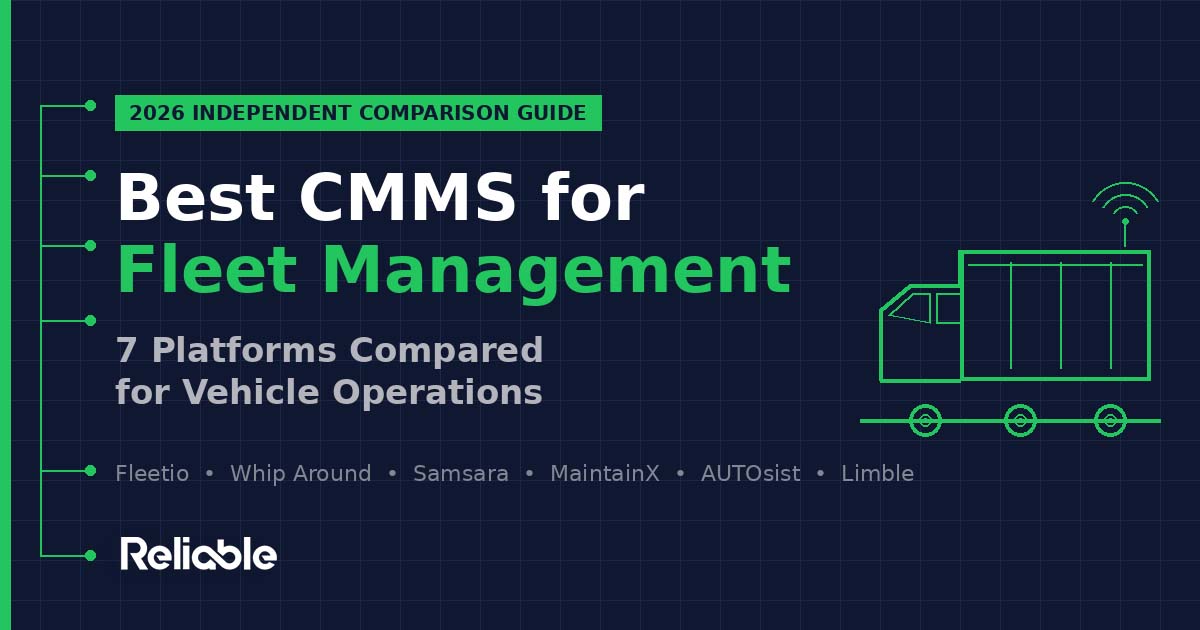

TL;DR: Fleet CMMS is a distinct category from facility or production CMMS, with specific requirements around DOT and FMCSA compliance, telematics integration for usage-based PMs, and per-vehicle total cost of ownership tracking. Fleetio leads the category overall as the strongest fleet-native CMMS, with the deepest TCO analysis and an outsourced maintenance network of 100,000+ shops. Whip Around wins for inspection-driven fleets where DVIR compliance is the priority. Samsara is the leader for telematics-driven predictive maintenance, with PMs triggered by live engine data. For mixed operations that maintain both vehicles and facility equipment, MaintainX or Limble CMMS are stronger choices. AUTOsist offers the best value for small fleets transitioning from spreadsheets. RTA Fleet360 leads for enterprise and municipal fleets needing full FMIS-grade lifecycle management. Choose based on fleet scale, regulatory exposure, telematics environment, and whether vehicles share an asset base with facility equipment rather than horizontal CMMS rankings.
How We Evaluated
This guide is independent editorial analysis based on publicly available product documentation, verified customer reviews across G2 and Capterra, hands-on product demonstrations, and conversations with fleet managers in logistics, utilities, and field service operations. Reliable Magazine does not sell CMMS or fleet maintenance software and has no commercial interest in routing buyers toward any particular platform. Reliable does not accept payment for rankings. Vendors may sponsor enhanced listings with additional detail, but editorial rankings are independent. Read our editorial policy.
We evaluated each platform across six criteria that matter most for fleet maintenance decisions:
- DOT and FMCSA compliance – native Driver Vehicle Inspection Reports, defect-to-repair certification chains, and audit-ready documentation
- Telematics integration – depth and breadth of integrations with Samsara, Geotab, Motive, Verizon Connect, and other major providers
- Total cost of ownership tracking – per-vehicle cost modeling including fuel, maintenance, parts, depreciation, and downtime
- Fuel and inventory management – fuel card integrations, parts inventory, and supplier workflows specific to fleet operations
- Mobile and field experience – usability for drivers completing DVIRs and technicians completing work orders in the field
- Implementation and total cost of ownership – realistic deployment timelines and full-lifecycle costs at fleet scale
Why Fleet CMMS Is Different
Fleet maintenance is one of the most regulated environments in CMMS deployment, and the requirements differ substantially from facility or production maintenance. Three characteristics drive the differences. First, DOT and FMCSA regulations hang over every commercial fleet decision. Commercial motor carriers subject to FMCSA Part 396 are required to perform Driver Vehicle Inspection Reports before and after each trip, document defects, and certify repairs before the next driver operates the vehicle. CMMS platforms that produce FMCSA-compliant DVIR documentation by default save fleet operations significant time during audit cycles and reduce the risk of out-of-service violations.
Second, vehicles do not run on calendar schedules. An over-the-road truck might accumulate 10,000 miles in a month while a parts delivery van covers 800 miles in the same period. Time-based preventive maintenance fails for fleets because actual usage varies dramatically per vehicle. Fleet CMMS platforms integrate with telematics providers – Samsara, Geotab, Motive, Verizon Connect – to pull live odometer and engine-hour data, then trigger PMs at exactly the right service interval. This single capability is the most consequential difference between fleet-ready and fleet-native CMMS.
Third, fleet operators need to answer questions a general CMMS rarely surfaces: which vehicles are costing the most per mile, which models have the highest repair frequency, and which units are candidates for replacement rather than continued repair. Fleet-native platforms model TCO at the vehicle level, including fuel, maintenance, parts, depreciation, and downtime. General CMMS platforms model cost at the work order or asset level but rarely roll cost up into the per-mile or per-hour metrics that fleet decisions actually require.
The 7 Best CMMS Platforms for Fleet Management in 2026
1. Fleetio – Best Fleet-Native CMMS Overall
Fleetio leads the fleet CMMS category through a combination of fleet-native depth and operational reach that no other platform fully matches. The platform centralizes vehicle records, fuel data, work orders, parts inventory, and inspection history with a per-vehicle total cost of ownership view that surfaces the questions fleet managers actually ask: which trucks cost the most per mile, which models break down most frequently, which units are replacement candidates. The Fleetio Go mobile app forces drivers to complete digital DVIRs with photo capture and timestamps before vehicle release, and defect reports route directly to the maintenance team’s work order queue without manual intervention.
Fleetio’s outsourced maintenance network of more than 100,000 service shops is uniquely valuable for fleets without in-house maintenance capability – the platform handles authorization, invoicing, and warranty workflows across the network rather than leaving fleet managers to coordinate vendor relationships individually. Telematics integration is similarly broad, with native connections to Samsara, Geotab, Verizon Connect, Motive, and most major providers, plus fuel card integrations including Comdata, FLEETCOR, WEX, and Voyager. The trade-offs are typical of mid-market fleet platforms: implementation complexity grows with fleet size, work order functionality requires the Professional tier or above, and very small fleets under 5 vehicles often find the per-vehicle pricing model less economical than per-user general CMMS alternatives.
Best for: Mid-size fleets between 25 and 500 vehicles, logistics operations, field service companies, utilities, construction fleets, and any operation where vehicle TCO drives replacement decisions.
Pricing: $4/vehicle/month (Essential), $7/vehicle/month (Professional), $10/vehicle/month (Premium), with minimum 5 vehicles and annual billing.
2. Whip Around – Best for Inspection-Driven Fleets
Whip Around was built around one specific problem: getting drivers to complete proper inspections quickly and routing defects to repair without paper handoffs. The platform’s narrow focus is genuinely a feature rather than a limitation. The driver app is simple enough that adoption is rarely a fight – drivers complete inspections in 5 to 10 minutes versus the 15 to 30 minutes typical with paper, and faults appear on the manager dashboard with photos and GPS coordinates the moment they are reported. For fleets where inspection compliance is the dominant operational risk – DOT audits, insurance documentation, defect-to-repair traceability – Whip Around’s inspection-first design fits the operational priority directly.
Whip Around integrates with Fleetio, Samsara, Geotab, and Motive for the broader fleet management layer, which is the right architecture for fleets that want best-in-class inspection workflow alongside other fleet management capabilities. The trade-off is depth in maintenance functionality. The maintenance module is more limited than Fleetio’s, with less flexibility in PM scheduling logic, parts inventory management, and reporting. The manager-facing interface has been described as dated, particularly in maintenance scheduling views. For fleets that primarily need clean inspection workflows with basic PM tracking, Whip Around fits well. For fleets needing comprehensive TCO analysis or sophisticated work order workflows, Fleetio is generally the better choice.
Best for: Trucking and logistics operations, school bus fleets, utility fleets, construction equipment fleets, and any DOT-regulated operation where inspection compliance is the primary operational risk.
Pricing: Free (Basic, 1 vehicle), $5/asset/month (Standard), $9/asset/month (Pro, includes maintenance module), with custom flat-fee FixedUnlimited tier for larger fleets.
3. Samsara – Best for Telematics-Driven Predictive Maintenance
Samsara is fundamentally different from the other platforms in this guide. It is a telematics-first Connected Operations platform that includes a maintenance module – not a CMMS that integrates with telematics. The distinction matters because maintenance triggers in Samsara are driven by live vehicle data: fault codes, engine hours, mileage, battery voltage, and AI-based diagnostic alerts. Maintenance is reactive to actual vehicle condition rather than to calendar estimates or driver-reported issues. For fleets where downtime reduction is the dominant priority and telematics hardware is already in place or being deployed, Samsara’s integrated approach eliminates the integration layer entirely.
Maintenance work orders generate automatically from fault codes. Predictive alerts flag battery degradation, brake wear, and engine issues before they cause roadside breakdowns. ELD compliance, hours of service, and DVIR workflows are integrated with the same telematics data, which means drivers, dispatchers, and maintenance teams all work from one source of truth. The trade-off is cost. Samsara is meaningfully more expensive than fleet-native maintenance software because it bundles hardware (vehicle gateways, AI dash cams) with software. The all-in cost typically runs $25 to $40 per vehicle per month versus $4 to $10 for fleet-native maintenance software. The premium is justified for fleets that genuinely need real-time telematics and AI dashcam coverage. For fleets that primarily need maintenance management with telematics as a supporting capability, integrating Fleetio with a less expensive telematics provider is often more economical.
Best for: Long-haul trucking, regional logistics, last-mile delivery, and any fleet where real-time visibility and driver safety drive ROI.
Pricing: Custom hardware-plus-software bundles. All-in cost typically $25 to $40 per vehicle per month including vehicle gateways. AI dash cams add additional per-vehicle cost. Three-year contracts are standard.
4. MaintainX – Best for Mixed Facility-and-Fleet Operations
MaintainX is the strongest general CMMS for operations that maintain both vehicles and facility equipment under one team. Field service companies, utilities, manufacturing plants with on-site fleets, and municipal departments often have a mix of trucks, plant equipment, HVAC systems, and tooling that all need maintenance tracking. Running a fleet-native platform alongside a general CMMS for facility assets means duplicate work order systems, duplicate parts inventory, and duplicate technician training. MaintainX consolidates the workflow into a single platform, with vehicles handled as an asset class alongside facility equipment.
The platform handles vehicles with PM scheduling by mileage, engine hours, or time, plus meter readings, parts tracking, and work orders that route to the same technicians who service plant equipment. Mobile usability is a meaningful strength – MaintainX’s reputation in the broader CMMS market is built on technician adoption, and that translates to drivers and shop technicians as well. The trade-off compared to fleet-native platforms is in the fleet-specific depth: VIN decoding, fuel card integrations, and FMCSA-structured DVIR workflows are not native. Custom inspection forms can approximate DVIR requirements, but commercial motor carrier fleets subject to FMCSA Part 396 audits should evaluate whether configured forms meet the regulatory bar in their jurisdiction.
Best for: Field service operations, utilities, manufacturing with on-site fleets, municipal fleets co-located with facility maintenance, and any operation maintaining vehicles and physical assets under a unified team.
Pricing: Free (Basic, limited work orders), $20/user/month (Essential), $65/user/month (Premium), with custom Enterprise pricing.
5. AUTOsist – Best Value for Small Fleets
AUTOsist is purpose-built for the spreadsheet-to-software transition. The platform focuses on the core fleet maintenance workflow – PM scheduling, parts management, custom DVIR digital inspection forms, and basic work order tracking – without the configurability or telematics depth of larger platforms. The result is a system that small fleet managers can deploy in days rather than weeks, with minimal training overhead for drivers and technicians. For small trucking companies, family-owned logistics operations, and small municipal fleets, AUTOsist’s narrow focus and low complexity are genuine advantages.
The All-in Maintenance package starts at $5 per vehicle per month with a $59 monthly minimum, which is cost-effective for fleets between 12 and 25 vehicles. Below 12 vehicles, the minimum makes the per-vehicle cost less competitive than Whip Around’s free Basic plan or Fleetio’s Essential tier. Above 25 vehicles, the feature gap with Fleetio and Whip Around becomes more visible – TCO analytics, advanced reporting, and outsourced maintenance networks are not part of AUTOsist’s offering. The platform does what small fleets actually need without the surface area of platforms designed for larger operations.
Best for: Small fleets between 12 and 25 vehicles, family-owned trucking companies, contractor fleets, small municipal departments, and operations transitioning from spreadsheets and paper records.
Pricing: $5/vehicle/month (All-in Maintenance) with a $59 monthly minimum.
6. Limble CMMS – Best for Industrial Operations with Vehicles
Limble is featured prominently in our main CMMS guide for its full-lifecycle asset management depth and reporting strength. For fleet-only operations it is less competitive than fleet-native platforms, but for industrial operations where vehicles are part of a broader asset base — mining haul trucks alongside crushers and conveyors, refinery yard trucks alongside process equipment, utility line trucks alongside substation assets – Limble’s asset hierarchy and parent-child relationships handle vehicles as well as production equipment. The key advantage is unified analytics. Limble can compare downtime, maintenance cost, and reliability across vehicle and equipment classes in the same reporting framework, which is operationally important when fleet decisions and equipment decisions compete for the same maintenance budget.
The platform also handles meter-based PMs cleanly, with mileage and engine hours as standard meter types. The fleet-specific gaps are similar to MaintainX: no native FMCSA-structured DVIR, no fuel card integration, no VIN decoding. For industrial fleets that operate primarily on private property – mine sites, refineries, utility yards – the FMCSA gap is often non-binding because the vehicles are not subject to FMCSA Part 396. For over-the-road fleets, fleet-native software remains the better fit.
Best for: Mining operations, refineries, utilities, large industrial operations with on-property vehicle fleets, and organizations where vehicles share an asset base with production or facility equipment under unified maintenance reporting.
Pricing: Free (Basic) and custom quoting for premium tiers, typically starting around $40/user/month.
7. RTA Fleet360 – Best for Enterprise and Municipal Fleets
RTA Fleet360 is a Fleet Management Information System (FMIS) rather than a maintenance-focused CMMS. The platform is positioned for the upper end of the fleet market – large municipal fleets, transit agencies, school districts with hundreds of buses, and private fleets with complex lifecycle management requirements. Where Fleetio handles maintenance management with TCO analysis layered on top, RTA Fleet360 handles full vehicle lifecycle including procurement, capital planning, replacement scheduling, motor pool management, and fuel island integration. For organizations with formal capital planning processes, multi-year vehicle replacement schedules, and the operational complexity of running shared vehicle fleets across departments, RTA’s depth justifies the implementation overhead.
The platform is meaningfully more configurable – and consequently more complex to deploy – than the maintenance-focused platforms ranked above. For private mid-market fleets, RTA is generally over-scoped. Fleetio handles the core maintenance and TCO requirements with significantly less implementation complexity, and the FMIS-grade capabilities of RTA – capital planning, motor pool, formal lifecycle modeling – are typically not the operational drivers. The platforms serve different segments of the fleet market.
Best for: Municipal fleets, transit agencies, school districts, large enterprise fleets above 500 vehicles, and public sector operations needing FMIS-grade lifecycle management.
Pricing: Custom enterprise pricing. Implementation typically requires multiple months of configuration.
Fleet CMMS Comparison Table
| Platform | Best For | FMCSA / DVIR | Telematics |
|---|---|---|---|
| Fleetio | Fleet-native overall | Native | Broad integrations |
| Whip Around | Inspection-driven fleets | Native, core product | Major providers |
| Samsara | Telematics-driven PdM | Native | Native (is telematics) |
| MaintainX | Mixed facility + fleet | Configurable | Open API |
| AUTOsist | Small fleets | Custom forms | Limited |
| Limble CMMS | Industrial with vehicles | Configurable | Open API |
| RTA Fleet360 | Enterprise / municipal | Native, deep | Native integrations |
How to Choose the Right Fleet CMMS
Fleet CMMS selection comes down to four questions that matter more than feature comparison:
1. Is your operation fleet-only or mixed?
Fleet-only operations almost always benefit from fleet-native software. Fleetio, Whip Around, AUTOsist, and Samsara are the strongest candidates depending on operational priority. Mixed operations that maintain both vehicles and facility or production equipment under one team typically benefit from a strong general CMMS with fleet capability – MaintainX or Limble – rather than running two platforms. The duplicate work order systems, duplicate parts inventory, and duplicate technician training that come from running both are usually more expensive than the fleet-specific feature gap in a general CMMS.
2. What is your FMCSA compliance exposure?
Commercial motor carriers subject to FMCSA Part 396 should prioritize platforms with native DVIR workflows – Fleetio, Whip Around, AUTOsist, Samsara, and RTA Fleet360 all qualify. General CMMS platforms can be configured to approximate DVIR workflows, but configuration quality varies and audit findings are not the time to discover gaps. Operations using vehicles outside FMCSA jurisdiction – light-duty service trucks, off-road equipment, on-property utility vehicles – have more flexibility and can use general CMMS platforms with custom inspection forms.
3. What is your telematics environment?
Fleets with telematics already in place should prioritize CMMS platforms with native integrations to their telematics provider – Fleetio integrates with Samsara, Geotab, Motive, Verizon Connect, and most major providers. Fleets considering telematics for the first time should evaluate whether to integrate two platforms (Fleetio plus a separate telematics provider) or unify on a telematics-first platform like Samsara that includes maintenance natively. The integrated approach is typically simpler operationally; the separate-platform approach is typically less expensive at scale.
4. What is your fleet size and lifecycle complexity?
Small fleets under 25 vehicles should evaluate AUTOsist, Whip Around, and Fleetio Essential as the best balance of capability and cost. Mid-size fleets between 25 and 500 vehicles should evaluate Fleetio, Whip Around Pro, and Samsara as the strongest candidates. Enterprise and municipal fleets above 500 vehicles or with formal capital planning requirements should evaluate RTA Fleet360 alongside Fleetio Premium. Trying to deploy enterprise platforms in small fleet settings, or small-fleet platforms in enterprise settings, almost always results in operational mismatch.
The Honest Middle Ground
Fleet CMMS is a category where overbuying is common. Small operations sometimes deploy enterprise platforms because their parent organization standardized on them, ending up with implementations that take months and consume resources disproportionate to the operational value. Mid-size fleets sometimes deploy telematics-first platforms like Samsara because that’s what the largest carriers use, even when their actual operational needs would be served better by a less expensive Fleetio plus telematics integration.
The opposite mistake is real. Large fleets that try to use small-business platforms typically end up with separate systems for maintenance, telematics, fuel cards, and compliance – fragmenting data that should live in one place and creating reporting burdens during DOT audits. The cost of that fragmentation is invisible until audit time, when it becomes very visible. Operations under FMCSA Part 396 that use general CMMS platforms with configured DVIR forms also take on regulatory risk that fleet-native platforms eliminate by default.
The right answer is honest assessment of fleet scale, regulatory exposure, telematics environment, and whether vehicles share an asset base with facility equipment. Talk to peer fleet operations of similar size and operational profile, not just the largest fleets in your industry. The buyer who selects fleet CMMS based on what major national carriers use will frequently select an overengineered platform for their actual operation.
Frequently Asked Questions
What is the best CMMS for fleet management in 2026?
The best fit depends on whether your operation is fleet-only or mixed. For fleet-only operations, Fleetio leads with the deepest fleet-native features including total cost of ownership tracking, fuel card integrations, and a 100,000+ shop outsourced maintenance network. Whip Around wins for inspection-driven fleets where DVIR compliance is the priority. Samsara is the strongest pick for telematics-driven predictive maintenance. For mixed operations, MaintainX and Limble are stronger choices because they handle vehicles alongside facility equipment under one platform. AUTOsist offers the best value for small fleets transitioning from spreadsheets. RTA Fleet360 leads for enterprise and municipal fleets needing FMIS-grade lifecycle management.
How is fleet CMMS different from facility or production CMMS?
Fleet CMMS emphasizes DOT and FMCSA compliance with native Driver Vehicle Inspection Reports (DVIRs), telematics integration for usage-based preventive maintenance, fuel card integration, VIN decoding, and per-vehicle total cost of ownership tracking. Facility and production CMMS emphasize asset hierarchies, work order workflows for fixed equipment, parts inventory across asset classes, and integration with ERP, MES, or building automation systems. The same vendors sometimes serve both, but the configurations and feature depth differ significantly. Pure fleet operations should evaluate fleet-native platforms with proven vehicle deployments rather than horizontal CMMS offerings without fleet track records.
Does fleet CMMS software handle DOT compliance and DVIRs?
Fleet-native platforms handle DOT compliance natively. Fleetio, Whip Around, AUTOsist, Samsara, and RTA Fleet360 all support FMCSA-compliant Driver Vehicle Inspection Reports including required fields, prior-inspection acknowledgment chains, and defect-to-repair certification workflows out of the box. General CMMS platforms such as MaintainX and Limble support custom inspection forms that can be configured for DVIR workflows, but the FMCSA-specific structure is generally only native to fleet software. For commercial motor vehicle fleets subject to FMCSA Part 396 inspection requirements, fleet-native software is generally the safer choice. Operations using vehicles outside FMCSA jurisdiction have more flexibility.
Should I integrate fleet CMMS software with my telematics provider?
In most cases, yes. Telematics integration converts time-based preventive maintenance into usage-based maintenance, which significantly improves accuracy. Instead of triggering an oil change every 90 days, the CMMS pulls live odometer or engine-hour data and triggers the work order at exactly 5,000 miles or 250 engine hours. This reduces both over-maintenance and missed services. Fleetio integrates with Samsara, Geotab, Verizon Connect, Motive, and other major providers. Whip Around integrates with Samsara, Geotab, and Motive. Samsara is itself a telematics platform with native maintenance, eliminating the integration. The exception is small fleets with low-mileage service vehicles where the value is often outweighed by the cost.
How much does fleet CMMS software cost per vehicle?
Fleet maintenance software typically runs $4 to $15 per vehicle per month at the entry level, with enterprise tiers reaching $20 to $40 per vehicle per month. Fleetio starts at $4 per vehicle per month for its Essential plan, $7 for Professional, and $10 for Premium. Whip Around starts at $5 per asset per month for Standard and $9 for Pro. AUTOsist starts at $5 per vehicle per month with a $59 monthly minimum. Samsara is priced higher because it bundles telematics hardware with software, typically running $25 to $40 per vehicle per month all-in with three-year contracts standard. General CMMS platforms like MaintainX and Limble price per user rather than per vehicle, which can be more economical for small teams managing larger vehicle counts.
Should small fleets use the same CMMS as enterprise fleets?
Generally no. Enterprise and municipal fleets typically need FMIS-grade platforms with capital planning, motor pool management, and complex multi-department workflows – RTA Fleet360 or upper-tier Fleetio configurations are typical choices. Small fleets under 25 vehicles are usually better served by AUTOsist, Whip Around, or Fleetio Essential, which provide core maintenance and inspection functionality without enterprise complexity. Trying to deploy enterprise-class fleet platforms in small fleet settings often results in overengineered implementations that cost more than the operational value justifies. Fleets under 5 vehicles frequently get more value from a general CMMS like MaintainX, which prices per user rather than per vehicle.
Related Guides
- Best CMMS Software 2026: Independent Comparison of 7 Platforms
- Best CMMS for Healthcare Facilities 2026
- Best EAM Software 2026: Independent Comparison of 6 Platforms
- CMMS vs EAM: What’s the Difference, and Which One Do You Need?
- MaintainX vs Limble: Which CMMS Wins in 2026?
Sources
- Fleetio product documentation and published pricing – fleetio.com
- Whip Around product documentation and published pricing – whiparound.com
- Samsara product documentation and Connected Operations platform details – samsara.com
- MaintainX product documentation and published pricing – getmaintainx.com
- AUTOsist product documentation and published pricing – autosist.com
- Limble CMMS product documentation – limblecmms.com
- RTA Fleet360 product documentation – rtafleet.com
- FMCSA Part 396 – Inspection, Repair, and Maintenance regulations
- G2 and Capterra verified customer reviews from fleet maintenance users (April 2026)
- Reliable Magazine independent product demos and editorial analysis
Last updated: April 29, 2026. This guide is editorial analysis by Reliable Magazine. No vendor paid for ranking consideration or editorial input.