
Maintenance has a translation problem. The crew sees evidence that the pump may be on borrowed time; finance hears a request to spend money on something that hasn’t broken yet. Learning how to justify preventive maintenance means learning to speak the language of the people holding the budget.
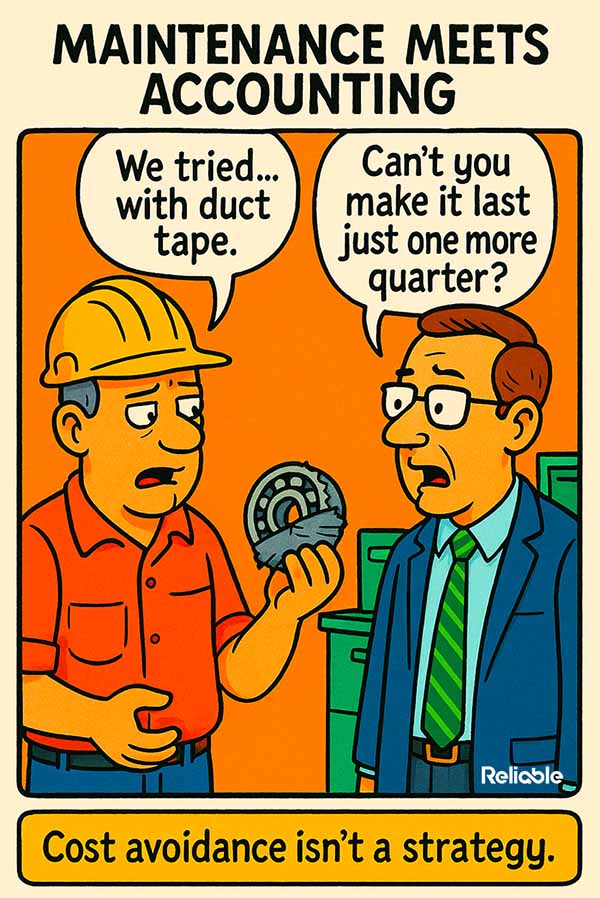
Duct-tape fixes and one-more-quarter thinking feel responsible in the moment. They push a known cost into the future, where it grows. The bill always arrives, usually larger, often at the worst possible time.
Cost avoidance buys time at a steep interest rate.
The fix is translation. A repair request framed as a failing bearing lands as noise. The same request framed as, for example, 12,000 dollars and eight hours of lost production lands as a decision someone can actually make.
This works with numbers a plant already tracks. The job is collecting two or three of them and putting them where the budget actually gets decided, in language a controller reads every day.
How to Justify Preventive Maintenance in Numbers Finance Trusts
Finance lives in dollars and risk, so translate the work into both. Every high-value preventive task should connect to a number a controller recognizes: avoided downtime, reduced secondary damage risk, extended asset life, or reduced safety exposure.
A bearing replaced on condition may cost the part and an hour of planned labor. The same bearing run to failure can take the shaft, the seal, and the coupling with it, plus unplanned downtime at full production rate. The gap between those two numbers can be enormous.
Run that exercise across the PM program and a pattern often appears. The handful of assets that drive most of the downtime are usually the ones where a small planned spend prevents a large unplanned one. Those are the easy yeses, so lead with them.
- Downtime cost per hour for the asset, measured in lost production or throughput.
- Secondary damage risk: what else fails when this one component lets go.
- Planned versus unplanned labor and parts cost for the exact same repair.
- Safety and compliance exposure if the failure happens while the asset is in service.
Lay those four numbers next to the cost of the preventive task and the case becomes clearer. The planned repair is often the smaller number, by a wide margin.
A controller is more likely to fund a repair that prevents a 40,000 dollar failure. Your job is to make the 40,000 dollars visible.
Most of those numbers already live in the work-order history and the production log, waiting to be pulled into one place. Justifying preventive maintenance gets a lot easier once they’re sitting on a single page.
Put it on one page. A controller wants the asset, the failure mode, the cost of acting, the cost of waiting, and the recommendation, in that order. One page, four numbers, a clear recommendation, and the meeting moves fast.
The same page works at any level. A frontline supervisor uses it to win a single work order; a maintenance manager stacks a dozen of them into an annual plan. The format scales because the logic scales: name the asset, price the risk, show the cheaper path.
Move the Conversation From Cost to Risk
Cost-cutting framing puts maintenance on defense every budget cycle. Risk framing changes the question from why spend this to what are we accepting if we wait, and that’s a question finance is trained to answer.
A risk frame also spreads the responsibility. Once the cost of waiting is written down, the choice to defer belongs to whoever signs off on it, and many managers would rather fund a known repair than own an avoidable failure.
Tie the risk to a date whenever you can. A bearing with condition evidence suggesting roughly eight to twelve weeks before likely failure gives finance a planning horizon they can work with. An open-ended it will break someday gives them a reason to keep waiting.
- What does this asset cost us per hour when it goes down unexpectedly?
- How many other components does this failure take with it?
- What’s the lead time on the parts if we wait until it breaks in service?
A predictive maintenance strategy can help provide risk language. Condition data can show a component trending toward failure, which turns an abstract it might break into measured evidence that the condition is degrading.
When you can show a measured trend, the budget request is less of a hunch. It becomes a documented risk with a price tag, which is exactly what helps support requests to justify maintenance budget increases when every line is under pressure.
There is a credibility dividend, too. The first time you identify a developing failure and the evidence holds, finance starts treating your next request as a forecast worth funding. That earned trust outlasts any single approval, and it compounds the same way the avoided failures do.
Make the Default Decision the Documented One
Set the system so the scheduled repair is the path of least resistance. Document the risk of waiting on the work order itself, so skipping the job becomes a decision someone has to sign for and own.
Track the wins, too. When a planned repair prevents or likely avoids a failure, log the estimated cost avoided and the actual outcome. A year of those logged saves turns next year’s budget conversation from a debate into a track record, and a track record is one of the strongest ways to justify preventive maintenance.
Review those logged saves out loud once a quarter. A number a manager repeats in a budget meeting carries far more weight than one buried in a spreadsheet, so keep the wins where leadership can see them.
Cost avoidance, by itself, is a holding pattern. Plants that win the budget argument show the math, name the risk, and bring the condition data to the table. That’s how to justify preventive maintenance to a finance team that has heard trust me one too many times.