

Every maintenance manager has had the same conversation with finance at least once. You need a new tool, a training program, a contractor, or an overhaul of your parts inventory. The money isn’t there. The budget is tight. Come back next quarter.
But what if you could walk your own facility for a single shift and come back with a list of recoverable losses worth more than what you’re asking for? Not theoretical savings. Not projections from a vendor’s slide deck. Actual, quantifiable waste happening right now, on your watch, that nobody has bothered to look for.
That’s the walk-down. And for plants that have never done one systematically, the results are almost always shocking.
The Invisible Losses Hiding in Your Facility
Most plants are bleeding money in ways that are invisible to the naked eye and inaudible to the human ear. Compressed air leaks are the classic example. The U.S. Department of Energy estimates that the average industrial facility loses 20 to 30 percent of its compressed air to leaks. For a mid-sized plant running a few hundred horsepower of compressor capacity, that can easily translate to $30,000 to $50,000 per year in wasted electricity – sometimes much more.
Nobody is intentionally ignoring $50,000 in waste. They just don’t know it’s there because they’ve never had a fast, practical way to find it.
The insidious part is that these leaks develop gradually. A fitting loosens slightly. A hose ages and cracks. A quick-connect valve wears out. No single leak is catastrophic, so none of them get flagged as urgent. Meanwhile, the compressors run harder, cycle more frequently, and wear out faster to compensate for demand that doesn’t actually exist.
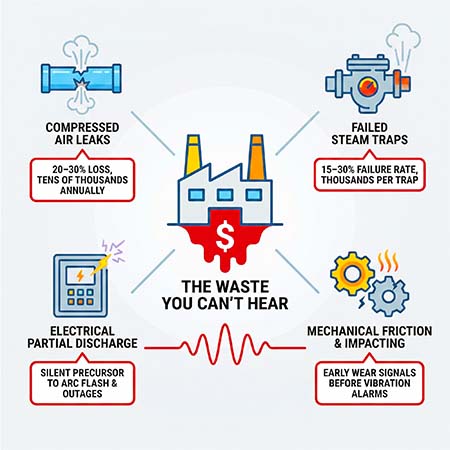
- Compressed air leaks – The average plant loses 20–30% of its compressed air supply, costing tens of thousands annually in wasted electricity and accelerated compressor wear.
- Failed steam traps – Industry estimates put the failure rate at 15–30% at any given time. A single failed-open trap can waste thousands of dollars in steam energy per year.
- Electrical partial discharge – Corona, tracking, and arcing develop silently in switchgear, transformers, and bus ducts long before they cause an outage or arc flash event.
- Mechanical friction and impacting – Bearings, gears, and valves generate high-frequency stress signals well before the damage is severe enough to appear on a vibration route.
All of these conditions share one thing in common: they produce ultrasonic signals that are completely undetectable without the right instrumentation.
What a Proper Walk-Down Looks Like
A walk-down isn’t an audit in the traditional sense. It’s not a month-long consulting engagement or a formal condition assessment with a 200-page deliverable. It’s a focused, systematic sweep of your facility with the right tools, looking for the low-hanging fruit that’s costing you money every day.
The ideal walk-down covers four categories: pneumatic losses, electrical reliability, steam system integrity, and mechanical asset health. A single technician with the right equipment can cover a surprising amount of ground in one shift, because modern acoustic imaging technology has fundamentally changed the speed equation.
Traditional ultrasound inspection is a point-by-point process. You hold a contact sensor or aim a parabolic dish at a single location, take a reading, and move to the next one. It works, but it’s slow.
Acoustic imagers – like the CRY8128 Industrial Acoustic Imager from LUDECA – have changed this entirely. These devices use an array of 200 microphones to create a real-time visual overlay of ultrasonic activity.

Photo courtesy LUDECA
Compressed Air: The Fastest Win
Start with compressed air – though it’s worth noting that acoustic imaging isn’t limited to air. These imagers detect any pressurized gas leak, including ammonia, oxygen, methane, argon, and helium. Some of those gases are expensive; others are genuinely dangerous to be around. Finding them fast matters for the budget and for keeping people safe.
Walk the distribution system from the headers down to the point-of-use connections. With an acoustic imager, you’re not guessing. Leaks appear on the display as bright spots, and the device estimates the leak rate and associated annual cost right on screen – no need to go back to the office and run calculations.
The built-in leak cost estimator gives the inspector an immediate dollar figure for each leak found, which speeds up documentation and makes the business case practically build itself. Tag each leak, record it, and move on. A typical first-time survey in a facility that has never been systematically checked will uncover dozens of leaks, and the aggregate cost is almost always enough to make someone in finance sit up straight.
The repair side is often anticlimactic – tighten a fitting, replace a coupler, swap a worn valve. Most of these are low-cost, low-skill fixes that can be knocked out during normal production. The savings start the moment the wrench turns. No capital investment, no downtime, no engineering study required. Just found money.
Electrical Systems: Catching What Thermography Misses
Most plants with predictive maintenance programs already use infrared thermography on their electrical systems. That’s good – thermal imaging catches a lot. But used alone, it has a gap: not all electrical faults produce significant heat in their early stages. Partial discharge – the precursor to arcing, tracking, and eventually catastrophic failure – generates ultrasonic emissions long before it generates a thermal signature.
By the time a thermal image alone shows it, you’ve already lost your best window to act.
During your walk-down, aim the acoustic imager at switchgear, transformers, bus ducts, and motor control centers. Partial discharge, corona, and arcing all produce distinctive ultrasonic patterns. Modern acoustic imagers can display Phase Resolved Partial Discharge charts in real time, which helps classify the type and severity of the discharge.
And with an optional integrated IR module, the same imager gives you both the acoustic and thermal picture on one screen – ultrasound to catch what’s developing early, thermography to confirm what’s already generating heat. No need to carry two instruments or make two passes. Finding a developing electrical fault before it becomes an arc flash event or an unplanned outage will save you money, sure – but more importantly, it’s the kind of safety finding that gets every level of leadership paying attention.
Steam Traps: The Forgotten Money Pit
If your plant uses steam, you have failed traps. It’s practically a law of nature. Industry estimates suggest that 15-30% of steam traps in a typical facility are malfunctioning at any given time. A single failed-open trap can waste thousands of dollars in steam energy per year, and most plants have hundreds or even thousands of traps.
The walk-down approach applies here, too. Acoustic imaging identifies traps that are blowing through or cycling abnormally. For plants using an imager with an integrated thermal module, you get both the acoustic signature and the temperature reading on a single screen, which speeds diagnosis and eliminates the need to carry two separate instruments. Mark the failures, estimate the losses, and you’ve added another line item to your recoverable savings total.
Mechanical Assets: The Early Warning You’re Not Getting
While compressed air, electrical, and steam systems are the highest-dollar targets on a walk-down, don’t overlook the opportunity to scan mechanical assets along the way. Bearings, gears, couplings, and valves all produce ultrasonic signatures that change as friction increases or components begin to deteriorate.
These signals appear well before the damage is severe enough to show up on a vibration route or trigger a temperature alarm – which means you’re catching problems in a window where intervention is cheap and planned rather than expensive and reactive.
During your walk-down, take a few minutes in each area to sweep nearby rotating equipment and valve stations. You won’t get the depth of a dedicated vibration analysis route, but you’ll flag assets that warrant closer inspection. It’s a bonus layer of insight that costs you nothing but a few extra minutes per area, and the findings add another line to your recoverable savings list when you sit down with leadership.
Building the Business Case on the Walk Back
Here’s where the walk-down becomes a strategic tool rather than just a maintenance exercise. When you come back from that survey with documented findings – tagged locations, estimated costs, photographs, and a prioritized repair list – you’re not asking for budget anymore. You’re presenting a return on investment.
Stop asking for budget. Start presenting a payback period.
The conversation with leadership changes completely. Instead of “We need $15,000 for a new tool,” it becomes “We identified $47,000 in annual recoverable losses in a single shift. Here’s the list. Here’s what it costs to fix. Here’s the payback period.” That’s a conversation that gets approved.
And the walk-down isn’t a one-time event. The most effective plants build it into a recurring schedule – quarterly or semi-annually – because leaks reappear, new traps fail, and electrical systems degrade continuously. Each survey reinforces the value of the program and keeps the savings compounding.
The Real Takeaway
The biggest barrier to better maintenance funding isn’t that the money doesn’t exist. It’s that the waste is invisible. Nobody is intentionally ignoring $50,000 in compressed air leaks or $20,000 in failed steam traps. They just don’t know it’s there because they’ve never had a fast, practical way to find it all at once.
A single walk-down with the right technology changes the narrative. It turns maintenance from a cost center into a profit recovery function. It gives reliability leaders the evidence they need to justify programs, tools, and headcount. And it usually pays for itself before the first repair order is even closed.
If you’ve never done a systematic acoustic survey of your facility, you’re leaving money on the floor. Probably a lot of it. The only question is how long you want to keep stepping over it.
See It in Action
Want to see what an acoustic walk-down looks like in the field? LUDECA has published short demos covering leak detection, electrical inspection, and mechanical assessment.
Leak Detection
Electrical Inspections
Mechanical Inspections