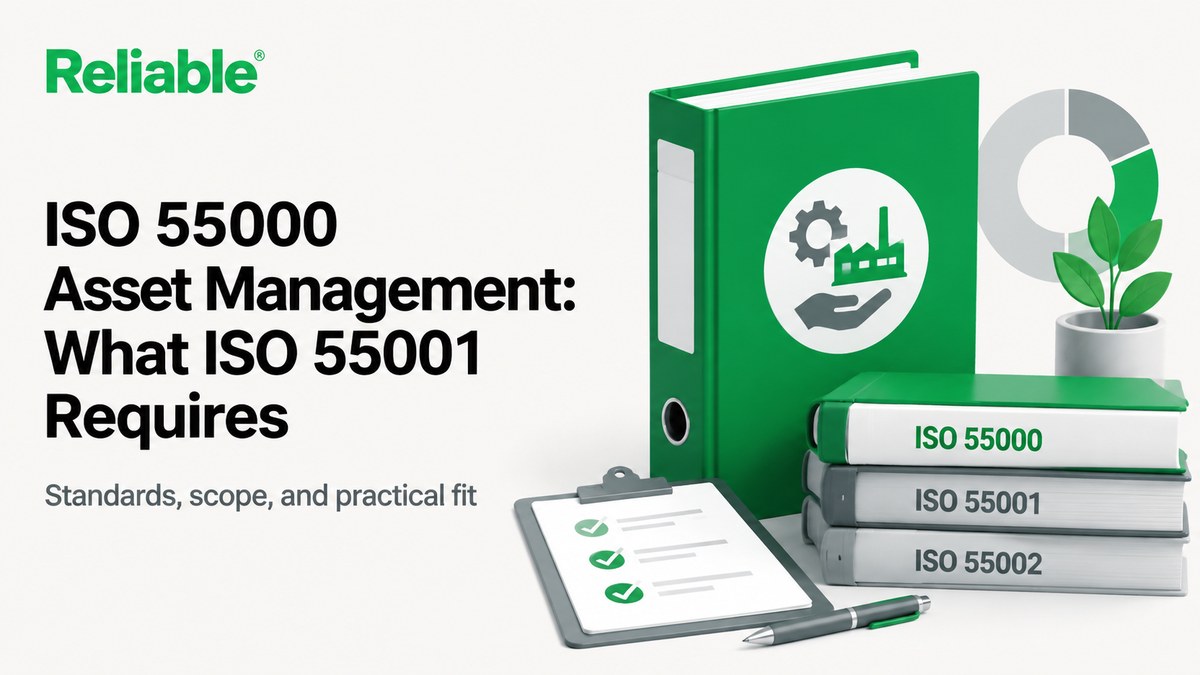

The Short Version: ISO 55000, ISO 55001 and ISO 55002 are three separate documents that do three separate jobs. ISO 55000:2024 covers vocabulary, overview and principles. ISO 55001:2024 is the requirements document for an asset management system, the document an organization is assessed against. ISO 55002:2018 is guidance for applying ISO 55001, and it is still the 2018 edition.
ISO/TC 251 launched the new editions of ISO 55000 and ISO 55001 on 3 July 2024. Both are now Edition 2, dated 2024-07, published at stage 60.60. The 2014 editions of ISO 55000 and ISO 55001 are withdrawn. ISO 55002 remains the 2018 edition and is marked to be revised.
This guide works from the public ISO catalogue pages and the ISO/TC 251 project pages and briefing notes. The full standard texts sit behind a paywall and are not reproduced here. Where a fact comes from a TC 251 project page or briefing note, the guide says so. Use this to sort out which document does what, then take the fit questions below to your own leadership or auditor.
Independence and scope
Reliable Magazine does not sell CMMS or EAM software, consulting, or certification. This guide is independent editorial analysis. It is not an ISO or SMRP publication.
The aim here is narrow and honest: explain what each public page for the ISO 55000 family actually says, keep the three documents distinct, and give a plant a set of grounded questions to ask. This guide does not reproduce paywalled clause text, does not perform an audit, and does not predict a certification result.
What the names refer to
Four names come up constantly, and they are easy to blur together. Here is what each one is.
ISO 55000:2024 is the vocabulary and overview document. Its ISO catalogue title covers asset management vocabulary, overview and principles. It is Edition 2, dated 2024-07, published at stage 60.60, and it replaces the withdrawn ISO 55000:2014.
ISO 55001:2024 is the requirements document. Its ISO catalogue title covers the requirements for an asset management system. It is Edition 2, dated 2024-07, published at stage 60.60, and it replaces the withdrawn ISO 55001:2014.
ISO 55002:2018 is the guidance document for applying ISO 55001. Per its ISO catalogue abstract, it gives guidelines for the application of an asset management system in accordance with the requirements of ISO 55001, and it can be applied to all types of assets and by all types and sizes of organizations. It sits at stage 90.92 and is marked to be revised. It is the 2018 edition, not a 2024 edition.
ISO/TC 251 is the ISO technical committee responsible for asset management standards. It launched the new ISO 55000 and ISO 55001 editions on 3 July 2024. Per the TC 251 home page, the committee also launched three new guidance standards, ISO 55011 (public policy), ISO 55012 (people involvement and competence) and ISO 55013 (data for asset management), and updated ISO/TS 55010, which offers more guidance on alignment between financial and non-financial asset management functions.
The ISO catalogue committee listing confirms the state of play: ISO 55000:2014 and ISO 55001:2014 are withdrawn, ISO 55000:2024 and ISO 55001:2024 are published, and ISO 55002:2018 is current and to be revised.
What ISO 55000:2024 covers on the public pages
ISO 55000 is the concepts document. Per the ISO/TC 251 project page for ISO 55000, this International Standard provides an overview of asset management and asset management systems, meaning management systems for the management of assets, and it provides the context for ISO 55001 and ISO 55002. Per the TC 251 home page, ISO 55000 describes the core concepts and benefits of asset management.
The public pages describe several things the 2024 edition addresses at the concept level. Per the TC 251 home page, the 2024 edition includes a stronger focus on the outcomes of asset management activities, and the benefits were rephrased and expanded. Per the ISO/TC 251 project page for ISO 55000, the 2024 key changes are: principles evolved; outcomes introduced; benefits rephrased and extended; integration of management systems introduced; maturity of an asset management organization introduced; and definitions adapted.
Read ISO 55000 for the shared vocabulary and the framing. It is where terms are defined, where the principles and outcomes are set out, and where the idea of maturity of an asset management organization is introduced, per the TC 251 project page. It does not carry the auditable requirements. Those live in ISO 55001.
What ISO 55001:2024 is for on the public pages
ISO 55001 is the requirements document. Per the ISO/TC 251 project page for ISO 55001, this International Standard specifies the requirements for the establishment, implementation, maintenance and improvement of a management system for asset management, referred to as an asset management system. Per the TC 251 home page, the ISO 55001 management system provides a framework to establish asset management policies, objectives, processes and governance.
Per the ISO/TC 251 project page for ISO 55001, the standard can be used by any organization, and the organization determines to which of its assets the standard applies. The same page names who it is primarily intended for: those involved in the establishment, implementation, maintenance and improvement of an asset management system; those involved in delivering asset management activities and service providers; and internal and external parties who assess the organization’s ability to meet legal, regulatory and contractual requirements and the organization’s own requirements.
Per the TC 251 home page, the 2024 version incorporates clearer and more specific requirements on decision-making, realizing value from assets, asset management planning, how to address risk and opportunities, managing data and knowledge, and life cycle operations. The same page notes that ISO 55001 was first published in 2014.
The ISO/TC 251 project page for ISO 55001 publicly names the additions and revisions in the 2024 edition. Attributed to that page, they are:
- 4.5 decision-making and value (new)
- 6.1.2 risk (new)
- 6.1.3 opportunities (new)
- 6.2.1 Strategic Asset Management Plan (new)
- 6.2.2 asset management objectives (revised)
- 6.2.3 planning to achieve asset management objectives (revised)
- 7.6 Data and Information (project page: NEW; TC 251 briefing: REVISED)
- 7.7 knowledge (new)
- 8.1 operational planning and control including life cycle management (revised)
- 8.3 Externally provided processes, products, technologies and services (revised)
- 9.3 Management review (revised)
- 10.3 Predictive action (new)
The same project page states there is greater emphasis on life cycle management.
The ISO/TC 251 public briefing note for ISO 55001:2024 adds detail on several of these items. Attributed to that briefing note: the 2024 changes reflect the ISO 55000:2024 key principles of value, alignment and leadership, and the named outcomes of assurance, adaptability and sustainability. The briefing describes clause 4.5 as a framework for asset management decision-making, criteria, and the selection of methods, processes and tools, with alignment from the strategic level down to the operational level, which the briefing calls line of sight. It describes 6.1.2 and 6.1.3 placing risk and opportunities in separate subclauses, 6.2.1 requiring development of the Strategic Asset Management Plan (SAMP), 7.6 distinguishing data from information in an asset management context, and 7.7 requiring the organization to determine the knowledge needed to operate the asset management system and keep it current. Per the briefing, 8.1 names the life cycle processes as creation, acquisition, utilization, maintenance, improvement, renewal, and disposal of assets, and 8.3 changes the earlier outsourcing language to externally provided processes, products, technologies and services.
Per the same briefing note, a new subclause 10.3 titled Predictive Action replaces the 2014 preventive-action subclause. The briefing describes predictive actions as actions that predict the future behavior of a parameter required to support decision-making, says 10.3 requires processes for those actions, and says they should help an organization anticipate future occurrences and impacts and determine optimal intervention points.
How ISO 55002:2018 relates
ISO 55002:2018 is the guidance layer. Per the ISO/TC 251 project page for ISO 55002, it provides guidance for the application of an asset management system in accordance with ISO 55001, using explanatory text and examples, and it does not provide guidance for managing specific asset types. Per the same page, the 2018 edition is the published guidance document. The requirements themselves sit in ISO 55001.
The ISO catalogue abstract for ISO 55002:2018 adds three notes. NOTE 1 says the document is intended to be used for managing physical assets in particular, but it can also be applied to other asset types. NOTE 2 says it does not provide financial, accounting or technical guidance for managing specific asset types, and that Annex F has information on the relationship between the financial and non-financial asset management functions. NOTE 3 says that, for ISO 55000, ISO 55001 and ISO 55002, the term asset management system refers to a management system for asset management.
Per the ISO/TC 251 project page for ISO 55002, the 2018 guidance uses four fundamentals: value, alignment, leadership and assurance. Keep that set separate from the ISO 55000:2024 key principles named in the ISO 55001 briefing (value, alignment, leadership) and the 2024 briefing’s outcomes (assurance, adaptability, sustainability). They overlap in wording and they are not the same list. Per the ISO/TC 251 project page for ISO 55002, the page names the SAMP as a key component and says ISO 55002 explains the purpose of the SAMP.
One timing note matters for anyone buying documents. ISO 55002 is still the 2018 edition and is marked to be revised, per the ISO catalogue committee listing. A plant reading the 2018 guidance alongside the 2024 requirements should expect the guidance to catch up to the 2024 requirements in a future revision.
Fit questions a plant can ask
After reading those public pages, a plant can ask a set of grounded questions before spending money on documents, consultants or an audit. Each question below ties to a public-page fact, not to an invented industry average.
Who is in scope. The ISO/TC 251 project page for ISO 55001 names the primary intended users, including people who establish and run the asset management system, people who deliver asset management activities, service providers, and internal and external parties who assess the organization. Ask which of these roles your plant is filling and who would sit on the assessment side.
Which assets are in scope. Per the same project page, the organization determines to which of its assets the standard applies. Ask your leadership to state, in writing, which assets the asset management system will cover before anything else is scoped.
The SAMP. Per the ISO/TC 251 briefing note, 6.2.1 requires development of the Strategic Asset Management Plan, and per the ISO/TC 251 project page for ISO 55002, ISO 55002 explains the purpose of the SAMP. Ask whether your plant has a SAMP, what it would contain, and who owns it.
The decision-making framework. Per the ISO/TC 251 briefing note, clause 4.5 asks for a framework for asset management decision-making, with criteria and selection of methods, processes and tools, and alignment from the strategic level to the operational level. Ask how decisions about assets are made today and whether that line of sight from strategy to the shop floor exists.
Life cycle processes. Per the ISO/TC 251 briefing note, clause 8.1 names the life cycle processes as creation, acquisition, utilization, maintenance, improvement, renewal, and disposal of assets. Ask which of those seven your plant already manages deliberately and which are ad hoc.
Data and knowledge. Per the ISO/TC 251 briefing note, 7.6 separates data from information and 7.7 asks the organization to determine and maintain the knowledge needed to run the asset management system. Ask where your asset data lives, who maintains it, and what happens to institutional knowledge when people leave.
How ISO 55002 would be used. Per the ISO/TC 251 project page for ISO 55002, the 2018 document gives explanatory text and examples for applying ISO 55001. Ask whether your team would use ISO 55002 as the working companion while reading the ISO 55001 requirements, and budget for both documents rather than one.
A worked example
The names below are examples, not a real plant.
Northgate Bottling is a fictional mid-size beverage plant. Its maintenance lead, using the example name Dana, has been asked by leadership to find out what ISO 55000 involves before the plant commits any budget. Dana reads only the public pages.
From the public pages, Dana works out the three-document split. ISO 55000:2024 gives the vocabulary and the principles. ISO 55001:2024 is the requirements document the plant would be assessed against. ISO 55002:2018 is the guidance for applying ISO 55001, still the 2018 edition. Dana notes that the 2014 editions of ISO 55000 and ISO 55001 are withdrawn, so any older internal reference the plant has on file needs checking against the 2024 editions.
Dana then builds a short list to take to leadership. First, a scope decision: per the ISO/TC 251 project page for ISO 55001, Northgate determines which of its assets the system covers, so leadership needs to name the asset boundary. Second, a SAMP question: per the ISO/TC 251 briefing note, 6.2.1 requires a Strategic Asset Management Plan, and Northgate does not have one, so Dana flags that as a gap to discuss. Third, a life cycle question: per the ISO/TC 251 briefing note, 8.1 names creation, acquisition, utilization, maintenance, improvement, renewal, and disposal, so Dana maps which of those Northgate manages deliberately today.
Dana also drafts questions for a future external auditor rather than answering them internally. Per the ISO/TC 251 project page for ISO 55001, internal and external parties assess the organization’s ability to meet requirements, so Dana keeps a short list of 2024 change topics (4.5, 6.1.2, 6.1.3, 6.2.1, 6.2.2, 6.2.3, 7.6, 7.7, 8.1, 8.3, 9.3, and 10.3) as topics to raise with whoever performs the assessment.
Dana does not conclude whether Northgate would pass or fail anything. The public pages do not support that conclusion, and Dana stops at reading, sorting and questioning. The plan Dana takes upstairs is a list of documents to buy and questions to answer, not a verdict.
Honest limitations
The full texts of ISO 55000, ISO 55001 and ISO 55002 are paywalled and are not reproduced in this guide. All standards-related factual claims here come from public ISO catalogue pages, the public ISO/TC 251 home page, public ISO/TC 251 project pages, a public ISO/TC 251 briefing note, and the public ISO/TC 251 catalogue listing.
The explainer copy on the ISO.org catalogue pages is catalogue marketing copy, not the standard itself. This guide leans on the ISO/TC 251 project-page wording rather than the catalogue blurbs. The briefing note is a public TC 251 briefing, and this guide labels every fact taken from it as such rather than presenting it as clause text.
Reliable Magazine has not performed an independent audit of any organization against ISO 55001, has not seen inside the paywalled clauses, and does not certify anyone. Clause numbers and named additions here are the ones the ISO/TC 251 project page and briefing note make public. They are not a reconstruction of the standard’s full clause structure, and no one should treat them as one.
FAQ
What is the difference between ISO 55000 and ISO 55001?
ISO 55000:2024 is the vocabulary, overview and principles document. ISO 55001:2024 is the requirements document for an asset management system. Per the ISO/TC 251 project pages, ISO 55000 provides the overview and context, and ISO 55001 specifies the requirements an organization can be assessed against.
Is ISO 55002 updated for 2024?
No. Per the ISO catalogue committee listing, ISO 55002 is still the 2018 edition and is marked to be revised. Of ISO 55000, ISO 55001 and ISO 55002, only ISO 55000 and ISO 55001 received 2024 editions, launched by ISO/TC 251 on 3 July 2024.
Are the 2014 editions still current?
No. ISO lists both as withdrawn and revised by the 2024 editions.
What clauses changed in ISO 55001:2024?
Per the ISO/TC 251 project page for ISO 55001, the publicly named changes are 4.5 decision-making and value (new); 6.1.2 risk (new); 6.1.3 opportunities (new); 6.2.1 Strategic Asset Management Plan (new); 6.2.2 asset management objectives (revised); 6.2.3 planning to achieve asset management objectives (revised); 7.6 Data and Information (project page: NEW; TC 251 briefing: REVISED); 7.7 knowledge (new); 8.1 operational planning and control including life cycle management (revised); 8.3 Externally provided processes, products, technologies and services (revised); 9.3 Management review (revised); and 10.3 Predictive action (new). These are the publicly named items, not the full clause structure.
What is a SAMP?
SAMP stands for Strategic Asset Management Plan. Per the ISO/TC 251 briefing note, clause 6.2.1 in ISO 55001:2024 requires its development, and per the ISO/TC 251 project page for ISO 55002, ISO 55002 explains the purpose of the SAMP.
Does ISO 55000 only apply to physical assets?
Per the ISO/TC 251 home page, the committee says these standards apply to all types of assets and to all organizations. The ISO 55002:2018 catalogue abstract adds that the guidance is intended for physical assets in particular but can also be applied to other asset types.
What are ISO 55011, ISO 55012 and ISO 55013?
Per the ISO/TC 251 home page, these are three new guidance standards the committee launched: ISO 55011 (public policy), ISO 55012 (people involvement and competence) and ISO 55013 (data for asset management).
Can this guide tell me whether my plant will pass certification?
No. The full standard texts are paywalled and not reproduced here, and Reliable Magazine has not performed an audit. This guide sorts out which document does what and lists grounded questions to take to your own leadership or auditor.
Related Guides
- CMMS vs EAM
- How to Calculate Asset Criticality
- How to Start a PdM Program
- How to Perform RCM
- How to Perform FMEA
- How to Calculate MTBF and MTTR
- Preventive Maintenance
- Maintenance and Reliability Glossary
Sources
- ISO catalogue, ISO 55000:2024
- ISO catalogue, ISO 55001:2024
- ISO catalogue, ISO 55002:2018
- ISO/TC 251 home
- ISO/TC 251 project page, ISO 55000
- ISO/TC 251 project page, ISO 55001
- ISO/TC 251 briefing note, ISO 55001:2024
- ISO/TC 251 project page, ISO 55002
- ISO/TC 251 catalogue listing
Last updated: August 18, 2026. This guide is editorial analysis by Reliable Magazine.