
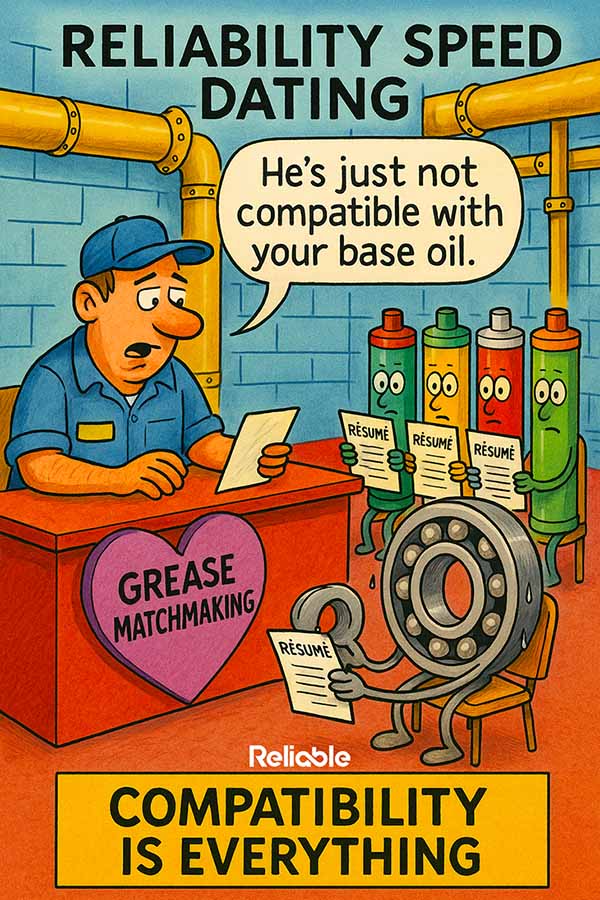

A grease can have a beautiful spec sheet and still be wrong for the bearing in front of you. Application fit, not price or brand, determines whether it can lubricate reliably. The right grease has a base oil, thickener system, additive package, and consistency suited to the bearing type, speed, load, operating temperature, relubrication method, and environment, not simply the product closest on the shelf.
Start With Base Oil Viscosity
Base oil viscosity is one of the first properties to check because it strongly influences the lubricating film in the rolling contact. Bearing manufacturers typically determine a required viscosity at operating temperature from bearing size and speed, then the grease’s base oil is selected so it provides adequate viscosity at that temperature. Too little viscosity can reduce surface separation; excessive viscosity, especially at higher speeds or low temperatures, can increase friction and operating temperature. Load and bearing type also affect the lubrication requirement, so use the bearing manufacturer’s method rather than a generic high-speed/low-speed rule.
Getting viscosity wrong can undermine an otherwise good grease, but additives, thickener, oil release, contamination resistance, and consistency still matter. Start with the bearing or equipment manufacturer’s lubrication guidance, then confirm the grease supplier’s data for the actual operating conditions.
In a grease-lubricated rolling bearing, the base oil provides much of the elastohydrodynamic lubricating film, while the thickener helps retain and replenish lubricant and can also contribute to boundary film formation. That is why base oil viscosity matters, but it is not the whole selection.
Match the Thickener to the Conditions
The thickener gives grease its structure and affects properties such as mechanical stability, oil release, water resistance, and temperature performance, but those properties depend on the full formulation. Lithium and lithium-complex greases cover many industrial applications; polyurea formulations are common in electric-motor and long-life bearing service; calcium sulfonate complex greases are often selected where water resistance, corrosion protection, and load-carrying performance are important. Use those as starting points, not universal rules.
Compatibility with the grease already in the bearing matters too. Mixing incompatible greases can cause excessive softening or hardening, or separation of thickener and oil. Compatibility cannot be predicted with certainty from thickener type alone. If changing products, follow equipment and lubricant supplier guidance; when mixing cannot be avoided and the consequences matter, ASTM D6185-24 provides a protocol for testing binary mixtures. A purge or cleanout may be required.
Temperature influences both viscosity and grease life. At high temperature, oxidation and other aging processes accelerate and grease life shortens; at low temperature, starting torque and lubricant flow can become limiting. Select within the grease’s published performance limits at the bearing’s actual operating temperature, not just ambient temperature, and adjust relubrication practices as the equipment or bearing manufacturer recommends.
How to Select Bearing Grease for the Real Environment
Beyond viscosity and thickener, the operating environment drives additive and performance requirements. Wet or washdown service calls for verified water resistance and corrosion protection. High or shock loads may call for suitable antiwear or extreme-pressure performance, subject to bearing and equipment manufacturer guidance. Small oscillatory motion or vibration can produce false brinelling; grease formulation can influence protection, but grease alone is not a universal fix. Consider the movement pattern, bearing design, operating conditions, and lubricant recommendations together.
Consistency is classified by NLGI grade, which is based on worked penetration at 25 C (77 F). NLGI grade is useful, but it does not by itself define pumpability. Centralized systems must be checked against the pump, line length, temperature, and the grease’s actual flow characteristics. Likewise, shaft orientation, seals, and bearing geometry can affect leakage and relubrication needs. Match consistency and pumpability to both the bearing and the delivery system rather than standardizing on one grade by habit.
Do Not Default to What Is on the Shelf
The common selection error is defaulting to a stocked grease without checking the application. Consolidating the plant’s grease inventory can be useful, but only after each lubrication point has been screened for its actual requirements. A general-purpose grease may cover many assets, while exceptions for speed, temperature, water, load, compatibility, or special materials need to be identified explicitly.
Selection and relubrication have to be considered together. Grease quantity and interval depend on factors including bearing type and size, speed, operating temperature, load, contamination, shaft orientation, grease performance, and the lubrication system. Use the bearing or equipment manufacturer’s calculation, guidance, or lubrication tool rather than guessing frequency or fill quantity.
After a grease change, monitor the bearing against a known baseline. Temperature, vibration, and acoustic or ultrasonic trends can help identify lubrication or bearing-condition changes. A rise in temperature or noise does not prove the grease is wrong; overgreasing, contamination, changed load, installation issues, and developing bearing damage can produce similar symptoms. Treat the signal as a reason to investigate.
The data sheet tells you whether a grease is a candidate. Controlled application records and condition trends tell you whether the change is behaving as expected in that machine.
Selecting bearing grease is not about finding one universally best product. It is about matching base oil viscosity, thickener system, additives, consistency, and oil-release behavior to the bearing, operating conditions, and lubrication method. Start with manufacturer guidance, verify compatibility before changeover, and then monitor the result. That is a more defensible selection process than defaulting to whatever is nearest.
Technical Sources
- SKF, Selecting a suitable grease: https://www.skf.com/il/products/rolling-bearings/principles-of-rolling-bearing-selection/bearing-selection-process/lubrication/selecting-a-suitable-grease
- SKF Evolution, Grease lubrication mechanisms in rolling bearing systems: https://evolution.skf.com/grease-lubrication-mechanisms-in-rolling-bearing-systems/
- ASTM International, ASTM D6185-24: Standard Practice for Evaluating Compatibility of Binary Mixtures of Lubricating Greases: https://store.astm.org/standards/d6185
- NLGI, NLGI Grade: https://www.nlgi.org/grease-glossary/nlgi-grade/
- Timken Engineering, Grease Lubrication Calculator: https://engineering.timken.com/engineering-tool/grease-lubrication-tool/
- SKF Evolution, How to understand ISO 15243: https://evolution.skf.com/us/bearing-damage-analysis-iso-15243-is-here-to-help-you/