
Every maintenance manager has lived this moment. A machine is running fine, the lubrication route is doing its quiet work, and then finance asks why the grease line jumped four percent. Knowing how to justify preventive maintenance costs is the difference between a funded program and one that gets cut the first time margins tighten.
The problem is structural. Preventive work succeeds by making nothing happen, so it leaves no dramatic evidence behind. That invisibility makes it the easiest line to question when somebody goes hunting for savings.
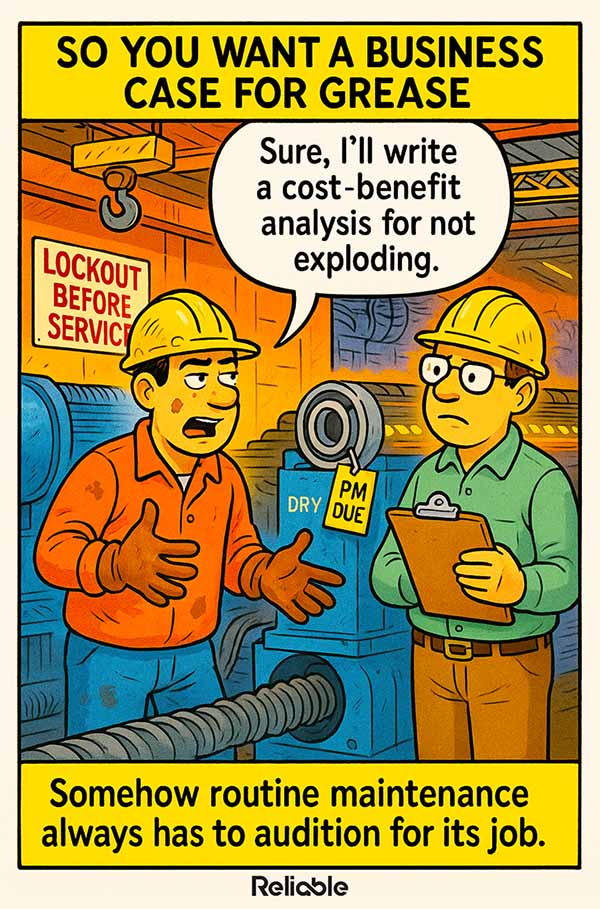
So routine maintenance ends up auditioning for its job, year after year, while the failures it quietly prevents never show up to defend it.
Why Routine Maintenance Always Gets Questioned
Reactive repairs come with a story. A bearing seizes, the line stops, people scramble, and the cost lands in red on a report everyone reads.
Preventive maintenance has no such story. The pump that kept running produced no headline, no work order drama, no number anyone can point at. Finance sees the spend without ever seeing the loss it bought down.
So the burden of proof lands on you. The spending that shows up on a ledger always draws more scrutiny than the failure that quietly never happened.
The spending you can see always gets scrutinized harder than the failure nobody ever had to live through.
That dynamic traps a lot of good programs. The way out runs through numbers rather than appeals to good engineering practice.
Finance responds to risk, cost, and return, expressed in the same units it uses everywhere else in the business. Speak that language and the lubrication budget becomes just another line it can evaluate on its merits.
That is good news, because it means the argument is winnable. You are bringing your case into the language leadership already speaks instead of asking them to learn yours.
How to Justify Preventive Maintenance Costs With Hard Numbers
Start with the cost of the failure you are preventing. Pull the maintenance history for the asset and find what an unplanned failure actually costs when it happens.
Add up the parts, the labor, the overtime, and the production you lose while the line sits idle. For a critical asset, lost production can exceed the direct repair cost, sometimes substantially.
- Repair labor, including overtime and emergency contractor callouts
- Replacement parts, often expedited at premium freight
- Lost production for every hour the asset sits down
- Collateral damage to connected components when one part lets go
- Quality scrap and rework from the unplanned restart
Now compare that figure to the annual cost of the preventive program protecting the asset: the lubrication, the inspections, the condition monitoring. The comparison may favor the preventive program, but the ratio depends on failure probability, asset criticality, and the assumptions used.
For example, a few hundred dollars of grease and inspection time may reduce the likelihood of a failure costing tens of thousands. Present the example as a risk-adjusted estimate, not a guaranteed saving.
When you frame the request that way, you stop asking for money and start showing a return. Learning how to justify preventive maintenance costs really means learning to translate technical work into financial terms a CFO already trusts.
Put both numbers on one line. The annual program cost on the left, the modeled failure cost on the right, and the difference circled. Leaders can assess that comparison quickly when the failure-cost and probability assumptions are also shown.
Price the Downtime Honestly
Downtime is often one of the largest factors in a budget case, and it is easy to calculate incompletely. Count the full recovery period, not only the hours the line sat dark.
Add the ramp back to rated speed, the first-pass quality losses, and the orders you shipped late. A four-hour stop can affect more than four hours of saleable output once ramp-up, scrap, and missed orders are included.
Use real events from your own plant rather than industry averages. Your own failure history carries far more weight in a budget meeting than a number from a conference slide.
Tie It to a Metric Finance Already Tracks
Executives think in ratios. If you can connect your program to one they already report, your case gets stronger overnight.
A useful anchor is return on net assets, because preventing premature failures can improve asset availability and defer replacement capital. Use it only when your company tracks the metric and the connection can be demonstrated.
From there, point to the operating metrics that prove the program is working:
- Mean time between failures, trending up as preventive coverage improves
- Schedule compliance, showing the planned work actually gets done
- Downtime hours avoided, converted to dollars at your real production rate
Each of these gives finance a number it can track quarter over quarter, helping show whether the program is contributing measurably to the plant’s results.
Make the Business Case Impossible to Ignore
A strong proposal does three things. It quantifies the risk, prices the protection, and shows the gap between them in plain dollars.
Document the failure modes you are guarding against and what each one has cost historically. Specific events beat general claims every time.
Specifics win budget meetings. ‘This pump failed twice last year and cost us thirty-one thousand each time’ beats any slide about best practice.
Then show how a disciplined program shrinks both the odds and the consequences of those failures. Every line of the proposal should answer the same quiet question a CFO is asking, which is how to justify preventive maintenance costs against everything else competing for the same dollar.
This is also where you build the case to reduce reactive maintenance, because shifting suitable work from firefighting to planned execution can free labor capacity and reduce avoidable disruption across the year.
Some companies frame this spending as risk management, similar to insurance. A year without a major failure does not, by itself, prove that the protective work had no value.
Anticipate the Pushback
Finance may ask whether you can trim the program without unacceptable consequences. Have an answer ready that shows what risk each proposed cut could expose.
If you defer lubrication on a critical gearbox to save a little this quarter, identify the failure modes that may become more likely and estimate their potential financial consequences. Make the trade visible so the decision is informed rather than assumed.
A clear plan to justify maintenance budget increases pays off here, because you have already connected every dollar requested to a specific, priced risk on the floor.
Turn the Audition Into a Renewal
Preventive maintenance will always have to earn its place in the budget. That is the nature of work that prevents problems instead of fixing them in front of an audience.
Your job is to make the audition easy to pass. Bring the modeled failure costs, the program costs, the assumptions behind both, and the risk-adjusted comparison between them.
Do that consistently and the conversation can change. Knowing how to justify preventive maintenance costs makes the annual review more evidence-based and strengthens the case for continued funding.