
Every plant has lived through the shutdown that ran long. The crew walks in Monday with a three-day plan and clocks out the following Thursday, squinting at the daylight. Maintenance shutdown planning best practices exist to stop that slide, and many of them come down to honest scope, realistic constraints, and disciplined math before anyone lifts a wrench.
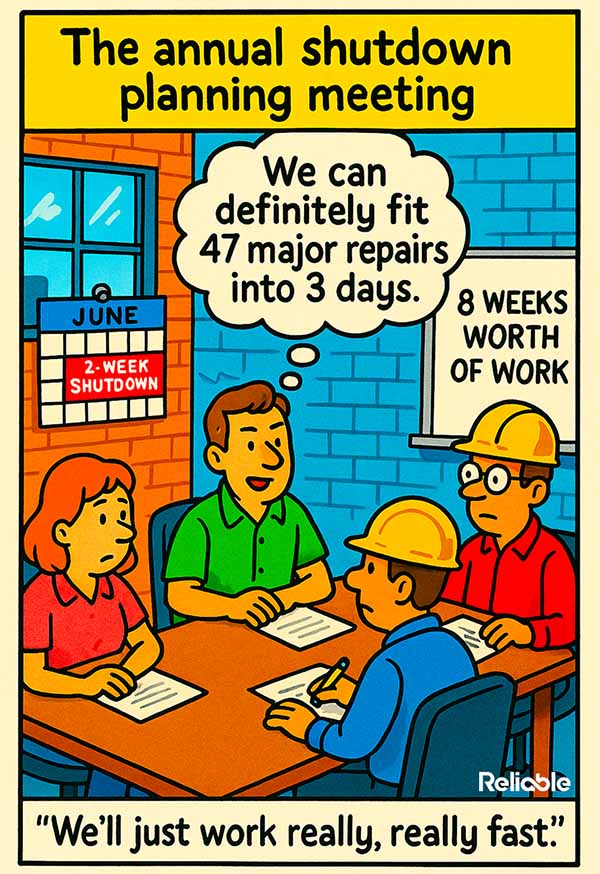
The pressure is always the same. A team stares at a long list of jobs, feels the outage window closing, and quietly assumes the work will compress to fit. Labor hours do not disappear because the calendar is tight. Forty-seven major repairs that require eight weeks of craft time still require roughly that much craft time; the real levers are scope, resources, sequencing, and duration.
Maintenance Shutdown Planning Best Practices Start With Scope
Scope is one of the places the whole turnaround is won or lost. Before anyone talks about duration, the planning team needs a controlled list of approved outage work, with each job estimated in real craft hours by the people who’ll actually do it.
The best estimates come from crews and planners who’ve done the job before, ideally after a physical walkdown of the asset. A planner who walks the unit spots the scaffold that has to go up first, the valve that has to be isolated, the access that one job quietly steals from another. Those details stay invisible on a desk estimate.
Build the estimate in labor-hours by trade, then convert it to a duration based on how many people can physically work the job at once. Ten welders can’t stand in the same one-meter space. Crew density caps how fast even a well-staffed job can move, and ignoring it is how a three-day plan quietly becomes a week.
A solid scope review answers three questions for every job on the list:
- What’s the actual labor estimate, in hours, by trade? Guesses inflate or deflate, and both wreck the schedule.
- Does this job truly require the asset to be down, or can it run online? Pulling non-outage work out of the window is one of the cheapest ways to recover outage time.
- What has to happen before this job can start, and what waits on it to finish? Those dependencies define the critical path.
Controlling the scope matters as much as building it. Every late addition, the while-we’re-in-there job, can carry hidden hours and fresh dependencies. Strong maintenance planning and scheduling treats every post-freeze change as an exception that needs a sign-off before it joins the list.
A shutdown schedule built on hope is a budget overrun with a start date.
Good shutdown planning refuses to begin with a duration. It begins with a scope the crew believes, then asks whether that scope honestly fits the window in front of it. When it doesn’t fit, that’s information the team can act on.
Build the Schedule Backward From the Restart
The restart date is usually the fixed constraint that matters most. Work backward from it. Lay out the critical path, the longest chain of dependent jobs, and use that chain to test whether the window is realistic.
When the critical path runs longer than the outage window, you have three honest options: add resources to the bottleneck jobs, move work out of the window, or extend the window. Turnaround planning often succeeds or fails based on which of those you pick, and how early you pick it.
Resource leveling comes next. A schedule can look clean on paper and still demand thirty electricians on Tuesday when you have eighteen. Smooth the labor across the window so no single shift is impossible, and the plan starts matching the crew you actually have on the ground.
The critical path is only as short as the chain of dependent jobs allows.
Sequencing flows from the critical path. Work off that path becomes lower-priority fill or parallel work, scheduled to keep crews productive without crowding the jobs that set the clock.
Sequence the Critical Path First
Once the critical path is set, schedule everything else around it. Critical-path jobs should get qualified crews, staged parts, and early-shift attention. Non-critical jobs flex when reality shifts, because reality always shifts.
Float is the cushion that lets a plan survive contact. A job with two days of float can slip a day without touching the restart. A critical job with zero float gets the supervision and the pre-staging, because there’s no room to absorb a surprise.
Plan down to the level of individual shifts. A 72-hour outage is six 12-hour shifts, and the handoffs between them are where momentum leaks. Decide in advance which jobs run on nights, which need daylight, and which crews carry a job across a shift change so it keeps moving the whole time.
Stage Parts, Tools, and People Before Day One
A turnaround stalls fastest when a crew opens an asset and the gasket, the bearing, or the special tool is three buildings away or three weeks out. Disciplined spare parts management closes that gap before the outage starts.
Pre-staging is unglamorous and decisive. Kit every critical-path and high-risk job: parts, consumables, gaskets, fasteners, and the specific tools, bagged and tagged by work order, staged where the crew will need them.
Pre-staging turns the first hour of a shift from a scavenger hunt into productive work.
People belong in the staging plan too. A crew that hears its assignment for the first time at the morning toolbox talk burns the first hour getting oriented. A crew that walked the job a week earlier starts cutting metal at shift start.
Contractor crews often deserve special attention because idle contractor time can be especially expensive. A contract crew standing around waiting on a permit, a confined-space entry, or a lockout is the most expensive coffee break in the plant. Sequence their arrival to the moment the asset is actually ready for them.
- Required parts for each critical-path job confirmed on-site and in hand before day one.
- Specialty tools and rental equipment delivered, tested, and reserved for the window.
- Contractor crews briefed on scope, permits, and safety expectations before they arrive.
- Lockout and permit packages prepared in advance so crews start working instead of waiting on paperwork.
Run that checklist for every critical-path job and the outage opens with momentum instead of a hunt for parts.
Where Maintenance Shutdown Planning Best Practices Break Down
Many maintenance shutdown planning best practices that prevent overruns share one trait: they front-load the hard thinking. The failures share a trait too. They all push the hard thinking into the outage itself, where there’s no time for it.
Many overruns trace back to a short list of repeatable mistakes. Naming them helps a planning team catch the pattern early.
- Optimistic estimates. Hours get shaved to make the list fit the window, and the gap reappears as overtime.
- Scope creep after approval. Small adds can pile up into days.
- Hidden dependencies. A job no one sequenced ends up blocking three others.
- Thin contingency. Discovery work, the corrosion you find once you open the vessel, has nowhere to go.
Contingency deserves its own line in the plan. Open an asset and you’ll find conditions the inspection missed. Depending on uncertainty, some teams build a 10 to 15 percent contingency allowance into the schedule to absorb discovery work without immediately threatening the restart.
The other quiet killer is a weak shift handoff. When the night crew can’t tell the day crew exactly where a job stands, work gets redone or stalls. A short structured handoff can protect hours every shift.
Estimate quality sits underneath most of these. A plant that tracks estimated against actual hours over several outages learns where its numbers run hot or cold, and the estimates tighten with every cycle. The first honest turnaround is rough. The fifth one is sharp.
Measure the Turnaround So the Next One Is Better
The shutdown ends, the plant restarts, and the planning binder usually hits a drawer. That’s the moment the most valuable data goes cold.
Capture estimated versus actual hours for every job while memory is fresh. Track how many jobs started on time, which dependencies surprised you, and where the schedule slipped. That record is the seed of better maintenance scheduling next cycle, and it’s how on-time performance climbs from one outage to the next.
Hold the review within two weeks, while the crews still remember the details. Walk the schedule line by line: what landed on time, what slipped, and what caught everyone off guard. Capture it in writing and feed it straight into the next scope.
The best time to plan the next shutdown is the week the current one ends.
Mature maintenance shutdown planning best practices build that review into the schedule as its own line item, with an owner and a due date. The plants that skip it relive the same overrun every cycle and call it bad luck.
All of this runs on controlled scope, an honest critical path, parts staged before day one, and the habit of measuring what actually happened. Often the biggest gains come from discipline applied early, before new software or a bigger budget are the answer.
Eight weeks of work will never fit into three days by working faster. Scope those same jobs honestly, sequence them tightly, stage them completely, and the turnaround has a much better chance of running the way it was promised.