
A vibration analyst can walk the same route every month for years and still miss developing faults if the data collection itself is sloppy. Sensor placement, measurement consistency, route sequencing, and environmental awareness all affect whether the numbers on the screen mean anything useful. Good vibration route data collection best practices separate programs that catch faults early from programs that generate binders full of noise.
The technology has gotten remarkably good. Portable collectors are faster, more intuitive, and more capable than anything available a decade ago. But the hardware is only as reliable as the person holding it and the process they follow. A $40,000 analyzer in the hands of someone rushing through a route with inconsistent sensor mounting produces data that’s worse than useless; it’s misleading.
Why Vibration Route Data Collection Best Practices Start with Consistency
Trending is the backbone of route-based condition monitoring. A single vibration reading tells you what’s happening right now. A trend of readings taken under the same conditions, at the same locations, with the same sensor orientation tells you what’s changing over time. That trend line is where the diagnostic power lives.
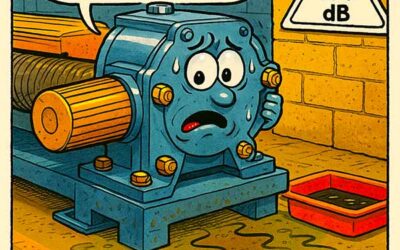
When collection practices vary from route to route (or analyst to analyst), the trend becomes contaminated with measurement noise. A 2 dB jump in a bearing frequency band might signal a developing inner race fault, or it might mean the sensor was placed an inch to the left of the usual spot. Without consistency, you can’t tell the difference.
A 2 dB jump in a bearing frequency band might signal a developing fault, or it might mean the sensor was placed an inch to the left. Consistency in collection is what separates diagnosis from guesswork.
This is why the best vibration programs invest heavily in standardization. They mark measurement points with engraved tags or paint pens. They document sensor orientation (radial, axial, vertical) for every point. They train every analyst to mount the sensor the same way, every time.
Sensor Mounting: The Single Biggest Variable
The difference between a magnetic mount placed firmly on a clean, flat surface and one balanced on a curved, paint-covered housing can easily be 6 to 10 dB of signal loss above 2 kHz. That’s the frequency range where early bearing defects and gear mesh problems show up. Sloppy mounting effectively blinds the program to exactly the faults it’s designed to catch. Understanding vibration analysis fundamentals makes this tradeoff clear.
Flat mounting pads (sometimes called measurement pads or accelerometer pads) solve most of these problems. A small, machined stainless steel disk epoxied or stud-mounted to the bearing housing gives every analyst the same flat, repeatable surface. The upfront cost is trivial compared to the data quality improvement.
- Prepare the surface: grind or file a flat spot if the housing is curved. Clean off paint, rust, and grease before bonding.
- Use a two-part epoxy rated for the operating temperature. Quick-set adhesives fail in hot environments.
- Orient pads consistently: mark the 12 o’clock position and document whether the measurement is radial horizontal, radial vertical, or axial.
- Inspect pads during each route. Replace any that are loose, cracked, or corroded.
For points where permanent pads aren’t practical (temporary equipment, confined spaces), establish and document a repeatable procedure. Specify the exact location, surface preparation steps, and magnet pull-off force required.
Route Design and Sequencing for Better Vibration Data Collection
How you sequence the route matters more than most programs acknowledge. Equipment operating conditions change throughout a shift. A motor surveyed at 7:00 AM during a cold start behaves differently than the same motor at 10:00 AM under full load. If the route sequence varies randomly, those load-dependent differences contaminate the trend.
Design routes so that each machine is measured at roughly the same point in its operating cycle. For process plants, this usually means collecting data during steady-state production, avoiding startup and shutdown windows. Document the expected operating conditions (load, speed, temperature) for each route point so the analyst can verify conditions before collecting.
- Group route points by area to minimize travel time and encourage completion of the full route in a single session.
- Place critical assets (high-consequence-of-failure equipment) early in the route, when the analyst is fresh and focused.
- Include a warm-up point: take the first reading on a non-critical asset to verify instrument function and sensor coupling before the data matters.
- Build in checkpoints: if the route takes longer than 90 minutes, build a natural pause point where the analyst can review data quality before continuing.
Route length matters, too. A four-hour route invites fatigue and shortcuts. Splitting long routes into 60-to-90-minute segments with clear start and stop points improves both data quality and completion rates.
Environmental and Operational Awareness During Collection
Vibration data collected next to a running jackhammer or during a nearby equipment washdown carries noise that can mask or mimic real faults. Analysts need to note (and ideally flag in the collector) any unusual ambient conditions during the route.
Temperature matters, too. Bearing temperatures affect clearances, lubrication viscosity, and vibration amplitudes. Collecting data on a machine that’s been sitting idle for four hours and comparing it to a trend built on measurements taken at full operating temperature introduces systematic error. The numbers look different, but the bearing is fine.
Pairing route-based vibration collection with online vibration monitoring on the most critical assets gives programs the best of both worlds: continuous coverage where consequence of failure is highest, and periodic route coverage everywhere else.
Data Quality Review: Catching Problems Before They Become Trends
The best route programs build a data quality review into the workflow. Before uploading route data to the analysis database, a senior analyst (or the collector themselves) reviews a short checklist.
- Are overall vibration levels consistent with previous routes? Any readings that jump or drop by more than 50% warrant a recheck before accepting.
- Are there obvious signs of sensor mounting issues? A dramatic rolloff above 2 kHz across multiple points on the same route suggests the magnet wasn’t coupling properly.
- Were any points skipped? Missing data points create gaps in trends that complicate long-term analysis.
- Did operating conditions match expectations? If a machine was at half-load during collection, that context needs to travel with the data.
This review step adds 10 to 15 minutes per route. The payoff is clean trend data that analysts can trust when making maintenance recommendations. Programs that skip this step accumulate questionable data points that erode confidence in the entire condition monitoring effort over time.
A 15-minute data quality review per route prevents months of questionable trend data from eroding confidence in the entire program.
When vibration trends do reveal a developing fault, the next step is diagnosis. Strong data collection practices make that diagnosis faster and more confident. Weak practices force the analyst to question whether the change is real or an artifact. And that uncertainty delays action, which is exactly what a predictive maintenance strategy is designed to prevent.
Training and Competency for Route Collectors
Vibration route data collection best practices fall apart without trained people executing them. A written procedure is necessary, but insufficient. New collectors need hands-on mentoring from an experienced analyst who can demonstrate proper sensor mounting, verify coupling quality in real time, and explain why consistency matters at each point.
Competency checks should be periodic, not one-time. Even experienced collectors develop shortcuts over months and years. A quarterly ride-along where a senior analyst accompanies the collector on a route and reviews technique keeps standards from drifting.
The route itself should evolve, too. As equipment changes, operating conditions shift, or new assets come online, the route needs updating. Stale routes collect data on decommissioned machines while ignoring new critical assets. A semiannual route review, informed by the maintenance team and reliability engineer, keeps the program aligned with actual plant risk.
Getting More from Every Route
A well-executed vibration route is one of the highest-value activities a maintenance organization performs. Each data point, collected consistently and reviewed carefully, extends the window of time between fault initiation and functional failure. That window is where planned repairs happen instead of emergency breakdowns.
The discipline of good vibration route data collection practices compounds over time. After 12 months of clean, consistent data, trend analysis becomes genuinely predictive. After 24 months, the program has enough history to set meaningful alarm thresholds tailored to each machine’s baseline behavior. After 36 months, the vibration database becomes one of the most valuable assets the reliability program owns.
Every shortcut taken during collection erodes that value. Every route completed with care builds it.