
Every motor gives fair warning before it quits. The problem is that most plants aren’t listening. The early warning signs of motor failure show up weeks, sometimes months, before the catastrophic event that triggers a midnight phone call and an emergency purchase order. Catching those signals requires a mix of the right tools, trained people, and a willingness to act on data that doesn’t yet look urgent.
This article breaks down the signals your motors are sending right now, why those signals get ignored, and what to do about it.
What the Early Warning Signs of Motor Failure Actually Look Like
Motors rarely fail without a prologue. The sequence is predictable: a subtle change in vibration, a slight bump in operating temperature, a bearing that starts drawing a fraction more current than usual. Individually, these shifts seem minor. Together, they tell a story.
Vibration changes are usually the first chapter. A motor running at 1,780 RPM develops a slight imbalance. The spectral signature shows a 1x peak growing by a few microns. A week later, harmonics start appearing. A month later, the bearing is spalling and the maintenance team is scrambling for a replacement that’s on a 12-week lead time.
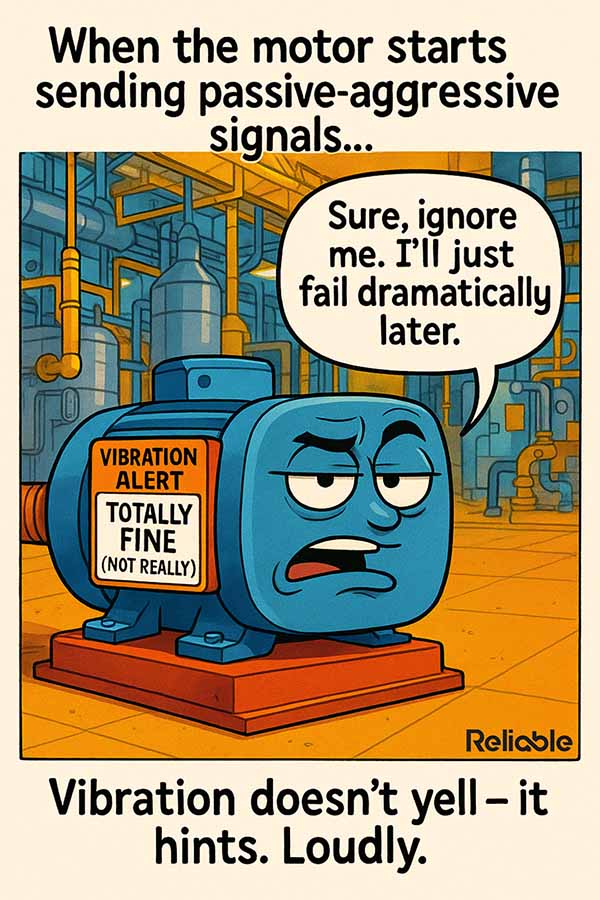
A vibration trend doesn’t need to hit an alarm threshold to be telling you something. The slope of the change matters more than the absolute number.
Temperature is the second reliable indicator. Infrared scans that show a winding running 15 degrees hotter than its twin on the same process line aren’t showing normal variation. They’re showing insulation degradation, a ventilation blockage, or an overloaded circuit.
Current signature analysis rounds out the early detection triad. Motor current signature analysis (MCSA) can detect rotor bar cracks, air gap eccentricity, and bearing defects from the motor control center. No scaffolding, no confined space entry, no shutdown required.
Why Early Warning Signs of Motor Failure Get Overlooked
The technology to catch these signals has existed for decades. So why do plants still run motors to failure? Three reasons come up repeatedly.
- Alert fatigue: condition monitoring systems generate data. Lots of it. Without clear escalation rules, analysts drown in green-yellow-red dashboards and stop trusting the output.
- Lack of ownership: vibration data lands in the predictive group’s inbox, but the production schedule belongs to operations. If nobody owns the decision to pull a motor offline for inspection, the data just sits there.
- Short-term math: pulling a motor for a planned repair costs production time today. Running it to failure costs more overall, but that bill arrives later, and often on someone else’s shift.
That last point deserves emphasis. The math on planned versus unplanned downtime is settled. Unplanned failures cost four to ten times more than planned interventions when you factor in expedited parts, overtime labor, collateral damage to driven equipment, and lost production. The obstacle to action is almost always organizational.
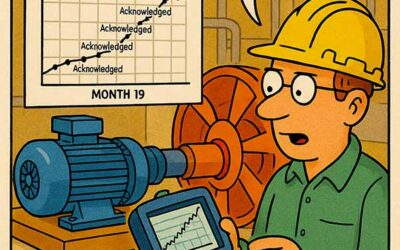
The gap between collecting vibration data and acting on it is where most predictive maintenance programs quietly die.
This organizational gap shows up in predictable ways. The predictive analyst flags a developing bearing defect. The work order goes into the queue. Operations pushes it back because the line is running. Three weeks later, the bearing seizes, the motor is down for four days, and the repair costs five times what the planned intervention would have.
The Threshold Trap
Many plants set alarm thresholds based on ISO standards or equipment manufacturer recommendations. Those numbers are useful starting points. They are terrible endpoints.
A motor running at 4.2 mm/s overall vibration might be well within the ISO 10816 “satisfactory” band. But if that same motor ran at 1.8 mm/s for the past three years and jumped to 4.2 in the last six weeks, the trend is screaming. Threshold-based alerting alone will miss this entirely.
Effective programs track rate of change, not just absolute values. A 30% increase in vibration amplitude over 60 days is actionable regardless of where the number sits on an ISO chart.
Building a Response System That Actually Works
Spotting the early warning signs of motor failure solves half the problem. The other half is converting that information into timely action. Here’s what that looks like in practice.
Tiered Escalation
Assign clear response timelines to different severity levels. A motor showing a gradual bearing defect frequency might get a 30-day work order. A motor showing rapid amplitude growth with sideband development gets a 72-hour window. Define these tiers in writing and get operations leadership to sign off.
- Tier 1 (Watch): new spectral peak identified, no significant amplitude growth. Re-measure in 30 days.
- Tier 2 (Plan): confirmed defect frequency with moderate amplitude growth. Schedule repair within 30 days.
- Tier 3 (Act): rapid amplitude increase, sideband development, or multiple defect indicators. Repair within 72 hours.
The tiers only matter if they come with authority. The predictive team needs the organizational backing to escalate a Tier 3 finding directly to the operations manager, bypassing the normal work order queue.
A condition monitoring program without escalation authority is just an expensive way to document the failures you already knew were coming.
That authority has to be real, tested, and visible. If the first time a vibration analyst escalates a Tier 3 finding, operations overrides it without consequence, the program loses credibility overnight.
Cross-functional Reviews
Weekly or biweekly reliability meetings where predictive analysts present findings to maintenance planners and operations supervisors close the communication gap. Keep these meetings short (30 minutes max), focused on equipment that has changed status since the last meeting, and action-oriented.
The deliverable from each meeting should be a short list: which motors moved up a tier, which work orders need scheduling priority, and which repairs were completed. Post it where the crews can see it.
Condition Monitoring Technologies Worth the Investment
The core technologies for detecting early motor problems are mature and proven. The question for most plants is coverage: getting enough data points on enough motors to catch problems before they cascade.
- Online vibration monitoring: continuous sensors on critical motors (100+ HP, single-point-of-failure applications) feed data to a centralized platform. Costs have dropped significantly with MEMS-based wireless sensors.
- Portable route-based vibration collection: an analyst with a handheld collector covers the balance of the motor population on a 30 to 90 day route cycle.
- Infrared thermography: monthly or quarterly scans of motor frames, junction boxes, and cable terminations catch thermal anomalies early.
- Motor current signature analysis: periodic or continuous monitoring from the MCC. Especially valuable for motors in hard-to-reach locations.
The plants that catch problems early are the ones layering multiple technologies and correlating the findings. A vibration analyst who also reviews IR scans and MCSA data has a three-dimensional view of motor health that a single-technology approach will never replicate.
The Bottom Line
Motors communicate before they fail. The vibration shifts, the temperature climbs, the current signature warps. Every one of these changes is an invitation to intervene on your own terms, during a planned outage, with the right parts on hand, using your best technicians.
Ignoring those signals means surrendering control to the equipment. And equipment, given the chance, will always choose the worst possible moment to fail. The early warning signs of motor failure are there. The only question is whether your organization is structured to hear them and empowered to respond.