
Gearboxes are among the most complex rotating assets to monitor, and among the most expensive to replace. A single industrial gearbox can run well into six figures, with lead times stretching past 20 weeks for custom units. Following gearbox vibration analysis best practices gives your reliability team the ability to detect gear mesh problems, bearing wear, and misalignment months before a catastrophic failure.
The payoff is simple: planned repairs on your schedule versus emergency rebuilds on the gearbox’s schedule.
Why Gearboxes Demand Specialized Vibration Analysis
A gearbox generates a more complex vibration signature than a simple motor-pump combination. Multiple shafts spinning at different speeds, gear mesh frequencies and their harmonics, rolling element bearings at every shaft support point, and the potential for resonance interactions between the housing and foundation all contribute to a dense spectrum.
This complexity means that general vibration screening techniques (overall velocity readings, simple alarm thresholds) miss most gearbox problems until they’re well advanced. By the time overall vibration on a gearbox trips an alarm, you’re often weeks away from a failure that could have been caught months earlier with the right analysis approach.
Gearbox defects hide in the spectral details. Overall vibration readings will flag trouble long after a trained analyst would have caught it.
Proper gearbox vibration analysis best practices require frequency-domain analysis, time waveform review, and in many cases, specialized techniques like cepstrum analysis or time synchronous averaging.
Gearbox Vibration Analysis Best Practices: The Fundamentals
Establish Clean Baselines
Baseline data collection on a known-good gearbox is essential. Without it, you’re guessing at what’s normal. Collect high-resolution spectra (at least 1,600 lines, preferably 3,200 or higher) at each measurement point during steady-state operation at typical load.
Document the operating conditions at the time of the baseline: load percentage, oil temperature, input speed. A gearbox at 40% load produces a very different vibration signature than the same unit at 90% load. Comparing data collected at different operating states leads to false alarms and missed defects.
- Collect baselines at all measurement points (horizontal, vertical, and axial at each bearing location).
- Use a minimum of 1,600 lines of resolution. For gearboxes with closely spaced frequencies, use 3,200 or more.
- Record RPM, load, and oil temperature with every measurement.
- Take time waveform captures (at least 10 shaft revolutions of the slowest shaft) alongside the spectra.
Know Your Frequencies
Before you can diagnose a gearbox, you need to calculate every significant frequency it generates. Start with the shaft speeds: input, intermediate (if any), and output. Then calculate gear mesh frequency (number of teeth multiplied by shaft RPM) for each mesh. Finally, calculate bearing defect frequencies (BPFO, BPFI, BSF, FTF) for every bearing in the assembly.
Build a frequency chart and keep it with the asset’s monitoring file. When a new peak appears in the spectrum, you can immediately check it against known frequencies. A peak at gear mesh frequency with sidebands spaced at input shaft speed tells a very different story than a peak at the same frequency with sidebands spaced at output shaft speed.
A gearbox frequency chart takes an hour to build and saves hundreds of hours of guesswork over the life of the asset.
Most CMMS and condition monitoring software platforms allow you to store calculated frequencies and overlay them on spectral data. If yours does, use it. If yours doesn’t, a laminated chart taped to the gearbox housing works too.
Common Gearbox Faults and How They Show Up
Each gearbox fault type has a characteristic vibration signature. Knowing what to look for is the core of effective analysis.
Gear Mesh Problems
Healthy gears produce a gear mesh frequency peak with low-level sidebands. As wear progresses, sideband amplitudes grow. Broken or chipped teeth produce sharp impacts visible in the time waveform, often before the spectrum shows significant changes.
Misalignment between gears shifts the load distribution across the tooth face and shows up as elevated 2x and 3x gear mesh harmonics. Tooth wear tends to raise the fundamental gear mesh amplitude along with broadband noise around the mesh frequency.
- Monitor gear mesh frequency amplitude and sideband patterns at every collection interval.
- Review time waveforms for impacting that might indicate cracked or chipped teeth.
- Watch for rising harmonics of gear mesh frequency, which suggest misalignment or excessive backlash.
Bearing Defects
Gearbox bearings operate under high radial and thrust loads, and they tend to fail progressively. Early-stage bearing defects (Stage 1 and 2) appear in the high-frequency enveloping or demodulation spectrum before they’re visible in the velocity spectrum. By the time bearing defect frequencies show up in the velocity spectrum with harmonics and sidebands (Stage 3), you typically have weeks to plan the repair.
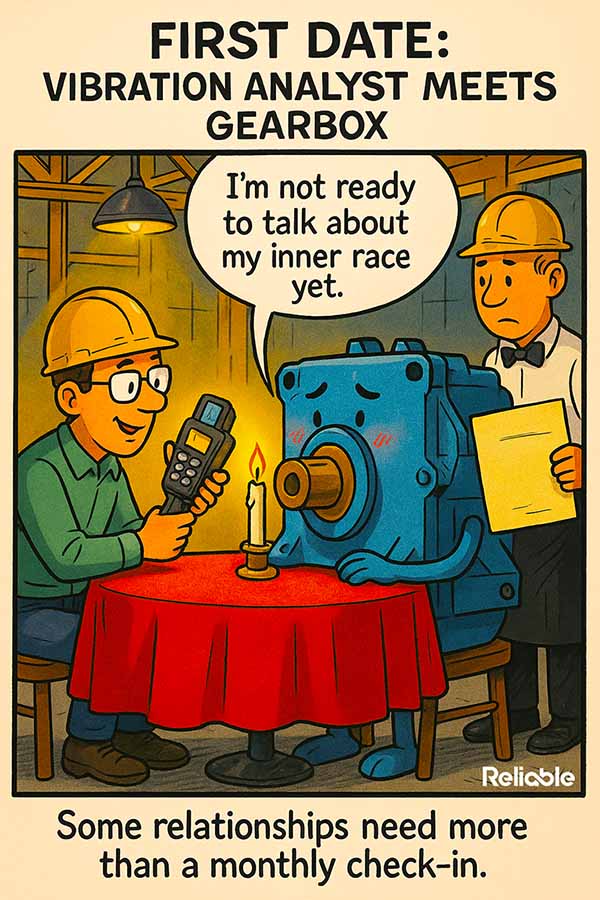
Inner race defects are particularly common on gearbox shafts because of the heavy loads and the difficulty of achieving perfect fits during assembly. These produce a characteristic BPFI frequency modulated by shaft speed.
Shaft and Alignment Issues
Parallel and angular misalignment between the driver and gearbox input shaft produce elevated 1x and 2x vibration with strong axial components. Internal shaft misalignment (between gear stages) is harder to detect externally but shows up as unusual sideband patterns around gear mesh frequencies.
- Always check axial vibration at gearbox input and output bearings. Elevated axial vibration often points to misalignment or thrust bearing problems.
- Compare vibration phase between bearing locations to distinguish imbalance from misalignment.
- After any gearbox reinstallation, verify alignment with laser tools and collect new baseline vibration data within the first week of operation.
Putting It All Together
Effective gearbox monitoring combines regular data collection (monthly for critical gearboxes, quarterly for general population), disciplined frequency analysis, and a willingness to open the box when the data says something is changing. Oil analysis complements vibration data well for gearboxes: rising iron counts and particle shape analysis confirm what the vibration data is suggesting.
The plants that get the most value from gearbox vibration analysis best practices are the ones that invest in analyst training specific to gear analysis, maintain accurate frequency charts, and review trend data consistently rather than waiting for an alarm to trigger attention.
A gearbox will tell you everything you need to know about its condition. You just have to collect the right data, in the right way, often enough to catch the changes while there’s still time to act.
Gearboxes are among the most complex rotating assets to monitor, and among the most expensive to replace. A single industrial gearbox can run well into six figures, with lead times stretching past 20 weeks for custom units. Following gearbox vibration analysis best practices gives your reliability team the ability to detect gear mesh problems, bearing wear, and misalignment months before a catastrophic failure.
The payoff is simple: planned repairs on your schedule versus emergency rebuilds on the gearbox’s schedule.
Why Gearboxes Demand Specialized Vibration Analysis
A gearbox generates a more complex vibration signature than a simple motor-pump combination. Multiple shafts spinning at different speeds, gear mesh frequencies and their harmonics, rolling element bearings at every shaft support point, and the potential for resonance interactions between the housing and foundation all contribute to a dense spectrum.
This complexity means that general vibration screening techniques (overall velocity readings, simple alarm thresholds) miss most gearbox problems until they’re well advanced. By the time overall vibration on a gearbox trips an alarm, you’re often weeks away from a failure that could have been caught months earlier with the right analysis approach.
Gearbox defects hide in the spectral details. Overall vibration readings will flag trouble long after a trained analyst would have caught it.
Proper gearbox vibration analysis best practices require frequency-domain analysis, time waveform review, and in many cases, specialized techniques like cepstrum analysis or time synchronous averaging.
Gearbox Vibration Analysis Best Practices: The Fundamentals
Establish Clean Baselines
Baseline data collection on a known-good gearbox is essential. Without it, you’re guessing at what’s normal. Collect high-resolution spectra (at least 1,600 lines, preferably 3,200 or higher) at each measurement point during steady-state operation at typical load.
Document the operating conditions at the time of the baseline: load percentage, oil temperature, input speed. A gearbox at 40% load produces a very different vibration signature than the same unit at 90% load. Comparing data collected at different operating states leads to false alarms and missed defects.
- Collect baselines at all measurement points (horizontal, vertical, and axial at each bearing location).
- Use a minimum of 1,600 lines of resolution. For gearboxes with closely spaced frequencies, use 3,200 or more.
- Record RPM, load, and oil temperature with every measurement.
- Take time waveform captures (at least 10 shaft revolutions of the slowest shaft) alongside the spectra.
Know Your Frequencies
Before you can diagnose a gearbox, you need to calculate every significant frequency it generates. Start with the shaft speeds: input, intermediate (if any), and output. Then calculate gear mesh frequency (number of teeth multiplied by shaft RPM) for each mesh. Finally, calculate bearing defect frequencies (BPFO, BPFI, BSF, FTF) for every bearing in the assembly.
Build a frequency chart and keep it with the asset’s monitoring file. When a new peak appears in the spectrum, you can immediately check it against known frequencies. A peak at gear mesh frequency with sidebands spaced at input shaft speed tells a very different story than a peak at the same frequency with sidebands spaced at output shaft speed.
A gearbox frequency chart takes an hour to build and saves hundreds of hours of guesswork over the life of the asset.
Most CMMS and condition monitoring software platforms allow you to store calculated frequencies and overlay them on spectral data. If yours does, use it. If yours doesn’t, a laminated chart taped to the gearbox housing works too.
Common Gearbox Faults and How They Show Up
Each gearbox fault type has a characteristic vibration signature. Knowing what to look for is the core of effective analysis.
Gear Mesh Problems
Healthy gears produce a gear mesh frequency peak with low-level sidebands. As wear progresses, sideband amplitudes grow. Broken or chipped teeth produce sharp impacts visible in the time waveform, often before the spectrum shows significant changes.
Misalignment between gears shifts the load distribution across the tooth face and shows up as elevated 2x and 3x gear mesh harmonics. Tooth wear tends to raise the fundamental gear mesh amplitude along with broadband noise around the mesh frequency.
- Monitor gear mesh frequency amplitude and sideband patterns at every collection interval.
- Review time waveforms for impacting that might indicate cracked or chipped teeth.
- Watch for rising harmonics of gear mesh frequency, which suggest misalignment or excessive backlash.
Bearing Defects
Gearbox bearings operate under high radial and thrust loads, and they tend to fail progressively. Early-stage bearing defects (Stage 1 and 2) appear in the high-frequency enveloping or demodulation spectrum before they’re visible in the velocity spectrum. By the time bearing defect frequencies show up in the velocity spectrum with harmonics and sidebands (Stage 3), you typically have weeks to plan the repair.
Inner race defects are particularly common on gearbox shafts because of the heavy loads and the difficulty of achieving perfect fits during assembly. These produce a characteristic BPFI frequency modulated by shaft speed.
Shaft and Alignment Issues
Parallel and angular misalignment between the driver and gearbox input shaft produce elevated 1x and 2x vibration with strong axial components. Internal shaft misalignment (between gear stages) is harder to detect externally but shows up as unusual sideband patterns around gear mesh frequencies.
- Always check axial vibration at gearbox input and output bearings. Elevated axial vibration often points to misalignment or thrust bearing problems.
- Compare vibration phase between bearing locations to distinguish imbalance from misalignment.
- After any gearbox reinstallation, verify alignment with laser tools and collect new baseline vibration data within the first week of operation.
Putting It All Together
Effective gearbox monitoring combines regular data collection (monthly for critical gearboxes, quarterly for general population), disciplined frequency analysis, and a willingness to open the box when the data says something is changing. Oil analysis complements vibration data well for gearboxes: rising iron counts and particle shape analysis confirm what the vibration data is suggesting.
The plants that get the most value from gearbox vibration analysis best practices are the ones that invest in analyst training specific to gear analysis, maintain accurate frequency charts, and review trend data consistently rather than waiting for an alarm to trigger attention.
A gearbox will tell you everything you need to know about its condition. You just have to collect the right data, in the right way, often enough to catch the changes while there’s still time to act.