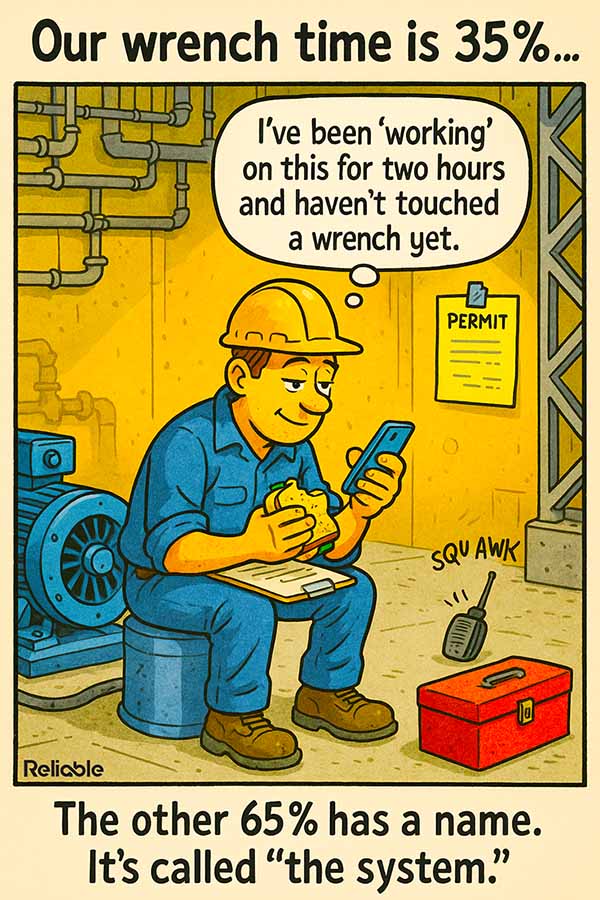

Every plant manager has seen the number. Wrench time: 35%. Maybe lower. It shows up in a study, gets circled in red on a PowerPoint slide, and suddenly everyone wants answers.
The usual response? Blame the techs. They’re on their phones. They’re taking long breaks. They’re milking the clock. And sure, maybe a few of them are. But when your entire workforce is averaging 35% productive wrench time across every crew and every shift, you’re looking at something much bigger than individual effort.
You’re looking at the system.
The 65% No One Wants to Own
That other 65% of the shift has a name. Several names, actually. Waiting on parts. Chasing down permits. Walking back to the shop because the job plan didn’t list the right materials. Standing around while operations clears the equipment. Filling out paperwork that nobody reads.
Every one of those delays traces back to a broken workflow that maintenance technicians have zero control over.
When your entire workforce averages 35% wrench time, you’re measuring the system, not the people.
A tech who shows up ready to work at 7 a.m. might not touch a wrench until 9:30. Two and a half hours gone before a single bolt gets turned. And the frustrating part? That tech knows it. They’ve been living it for years.
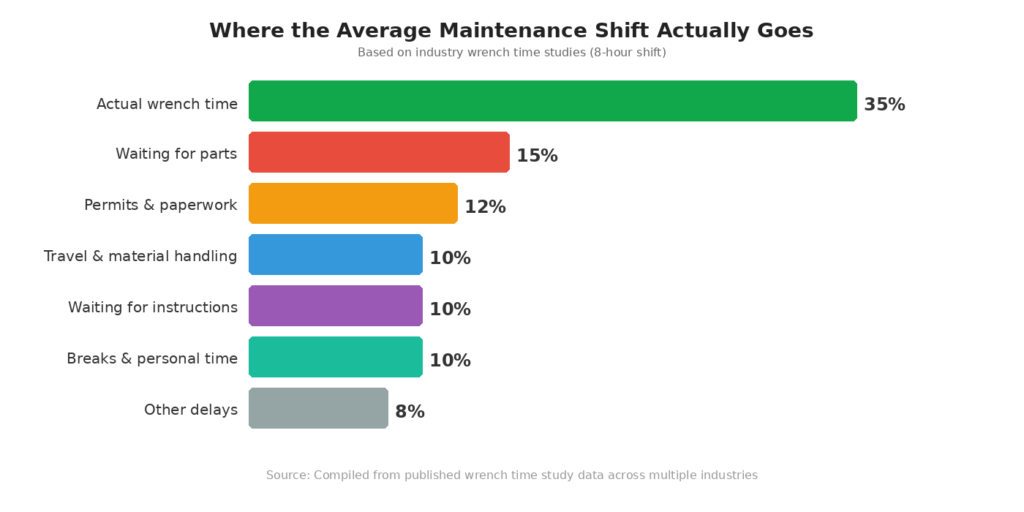
Figure 1: Typical wrench time breakdown across industrial maintenance operations
Look at that chart. The green bar is the only one where actual maintenance happens. Everything else? Organizational overhead, logistical friction, and process gaps that the maintenance department inherited but didn’t create.
Planning Failures Compound Fast
Bad planning is the single biggest thief of wrench time. And by bad planning, I mean work orders that go out without complete job plans. Missing part numbers. Wrong tool lists. No scope of work. A one-liner that says “repair pump” with zero context.
When a tech gets a work order like that, the shift becomes a scavenger hunt. They walk to the storeroom. The part’s not there. They call the planner. The planner’s in a meeting. They improvise. Sometimes they grab something close enough. Sometimes they sit and wait.
Multiply that across 20 techs on a shift and you’ve got a systemic productivity collapse that has nothing to do with motivation.
What good planning actually requires:
- Complete bill of materials with part numbers, quantities, and storeroom locations
- Step-by-step job procedures based on craft feedback, not assumptions
- Permit requirements identified before the job is scheduled
- Estimated labor hours grounded in historical data, not guesswork
- Safety hazards and lockout/tagout procedures documented up front
That list sounds basic. And it is. But most plants can’t consistently deliver even three of those five items on every work order. The planner-to-tech ratio is often wrong (it should be around 1:20 to 1:30), planners get pulled into reactive work, and nobody enforces job plan quality standards.
A work order that says ‘repair pump’ with no parts list, no procedures, and no permit details is a guaranteed two-hour delay before anyone picks up a tool.
Scheduling Is Where the Wheels Fall Off
Good planning without good scheduling still gets you poor wrench time. Scheduling is the coordination layer that determines when work gets done, by whom, and in what sequence. Without it, even well-planned jobs pile up, get shuffled, or sit in a backlog while everyone runs around chasing emergencies.
Most plants say they schedule maintenance. What they actually do is print a list of open work orders and hand it to a supervisor who makes real-time decisions based on who’s yelling the loudest. That’s dispatching, not scheduling.
Real scheduling means the week’s work is locked in by Friday afternoon for the following week. Supervisors assign specific jobs to specific techs. Parts are staged. Permits are ready. Operations has confirmed equipment availability. When the crew shows up Monday morning, they know exactly what they’re doing, where they’re going, and what they need.
That almost never happens.
The Parts Problem Nobody Wants to Fund
Storeroom management is one of the most neglected areas in maintenance. Plants will spend millions on a new CMMS and then run a storeroom with no min/max levels, no cycle counting, and bins labeled with masking tape and Sharpie.
When a tech walks to the storeroom and the part’s not there, that’s 30 to 90 minutes gone. Depending on the part, it could be days. And the job either sits idle or gets “completed” with a temporary fix that guarantees a repeat failure.
Common storeroom failures that kill wrench time:
- No bill of materials linked to equipment in the CMMS
- Inaccurate inventory counts due to lack of cycle counting
- Critical spares not identified or stocked
- Parts kitting not performed before scheduled work begins
- Unauthorized parts removal with no checkout process
You can have the best planners in the industry, but if the storeroom can’t deliver what the job plan calls for, wrench time stays stuck.
Operations Coordination: The Silent Killer
Here’s a scenario every maintenance tech has lived. The job is planned. The parts are staged. The permits are ready. The tech walks to the equipment and operations hasn’t released it. The unit’s still running. Nobody told the operator. The tech walks back to the shop and waits.
You can plan the perfect job. You can stage every part. But if operations hasn’t released the equipment, your tech is eating a sandwich on an overturned bucket.
Operations and maintenance coordination breakdowns are responsible for a huge chunk of lost wrench time. And the fix is straightforward: weekly scheduling meetings where maintenance and operations jointly commit to equipment availability. Both sides sign off. Both sides are accountable.
Simple concept. Rarely executed.
Stop Measuring People, Start Measuring Process
Wrench time studies are useful. They tell you how much productive time your system delivers to the people doing the work. But the emphasis has to land on “system.” If you run a wrench time study and your first instinct is to crack down on the techs, you’ve missed the entire point.
The tech sitting on a bucket, eating a sandwich while scrolling their phone at 9 a.m.? They’ve probably been “working” for two hours already. Waiting on a permit. Walking to the storeroom for parts that weren’t staged. Trying to find a supervisor who can answer a question about the scope of work.
The system built that reality for them.
Where to Start
If your wrench time is sitting in the 25% to 35% range (and it probably is), skip the motivational posters and go straight to a process overhaul. Start with planning. Get the planner-to-tech ratio right. Enforce job plan standards. Then move to scheduling, storeroom optimization, and operations coordination.
The improvements compound. A study by the Marshall Institute found that plants with mature planning and scheduling programs consistently achieve 50% to 65% wrench time. That’s nearly double what most sites get today. The difference? The system works for the technician, instead of against them.
Your techs aren’t the problem. They’re the ones dealing with it every single day. Fix the system around the wrench, and wrench time takes care of itself.