
Every maintenance professional has seen a flange leak and thought, “That shouldn’t have failed.” The gasket was new. The bolts were in place. Someone signed off on the work order. And yet, there it is: a slow weep turning into a steady stream, turning into a shutdown.
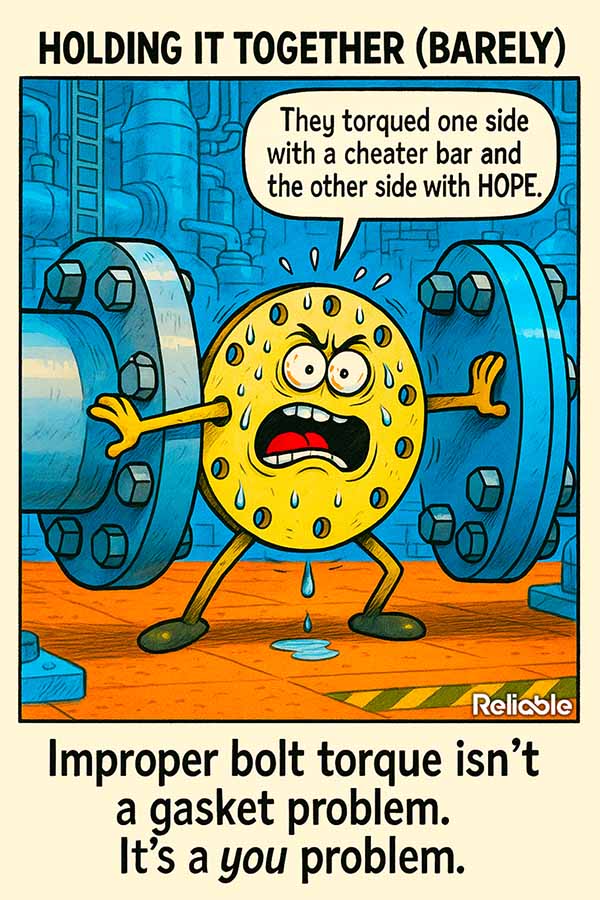
The culprit, more often than most teams want to admit, is inconsistent bolt torque. One side of the flange gets cranked down with a cheater bar. The other side gets tightened by feel. The result is a gasket that’s compressed unevenly, stressed beyond its design limits in some spots and barely seated in others.
The Physics of Uneven Loading
Gaskets work by creating a uniform seal across the entire flange face. That’s their one job. When bolt load varies from one stud to the next, the gasket can’t do what it was designed to do.
A study by the Fluid Sealing Association found that bolt load variation of just 10% across a flange can reduce gasket life by up to 50%. At 25% variation, you’re essentially gambling on whether the seal holds through the next thermal cycle.
A bolt load variation of just 10% across a flange can cut gasket life in half. At 25%, you’re gambling on every thermal cycle.
Think about what that means in practical terms. An eight-bolt flange where two bolts are 20% over target and two are 15% under target will develop a leak path. The gasket material will creep away from the high-pressure points and fail to seal at the low-pressure points.
The math here is unforgiving. Pressure doesn’t care about your intentions.
Why Teams Cut Corners on Torque
Nobody sets out to torque bolts incorrectly. The problem is usually one of time, tools, or training.
Calibrated torque wrenches take time to use properly. Star-pattern sequences require patience. And when there are 47 flanges to close out before a turnaround deadline, shortcuts start looking reasonable.
- Torque wrenches that haven’t been calibrated in over a year (or ever)
- Workers relying on “feel” instead of measured values
- Skipping star-pattern sequences to save time during turnarounds
- Using cheater bars to compensate for undersized wrenches
Each of these shortcuts feels minor in isolation. Combined, they create a reliability debt that comes due in the form of leaks, rework, and unplanned downtime.
The Cheater Bar Problem
Cheater bars deserve special mention because they’re so common and so destructive. Extending a wrench handle with a pipe changes the torque applied, but it does so unpredictably. The person swinging the wrench has no real sense of how much force they’re applying.
Worse, cheater bars frequently lead to bolt yield. Once a bolt has been stretched past its elastic limit, it can’t maintain clamp load over time. The joint slowly relaxes, and the gasket loses compression.
Once a bolt has been stretched past its elastic limit, it can’t maintain clamp load. The joint slowly relaxes, and the gasket loses compression.
This is particularly dangerous in high-temperature services where thermal cycling causes bolts to expand and contract. A yielded bolt has no reserve capacity to accommodate those changes.
What Good Torque Practice Looks Like
Proper bolted joint assembly follows a predictable pattern. It requires the right tools, the right sequence, and a willingness to take the time.
Start with clean, lubricated bolt threads and nut faces. Dry threads can absorb 40% to 50% of applied torque in friction, meaning the gasket sees far less clamp load than the wrench indicates.
- Use calibrated torque wrenches verified within the last 6 months
- Follow the star-pattern sequence for all multi-bolt flanges
- Apply torque in at least three passes: 30%, 60%, then 100% of target
- Perform a final verification pass to confirm all bolts are at target
Some facilities have adopted hydraulic tensioning for critical flanges. Tensioning eliminates the friction variable entirely by stretching bolts to a precise length rather than relying on rotational torque. It’s more expensive, but for high-consequence joints (think steam headers, reactor vessels, ammonia lines), the cost is easy to justify.
The Business Case for Getting This Right
A single flange leak in a refinery can cost anywhere from $50,000 to $500,000 depending on the service, the response time, and whether it triggers a broader shutdown. Environmental penalties add another layer.
Compare that to the cost of a calibrated torque wrench ($200 to $2,000), proper training ($500 per technician), and an extra 15 minutes per flange for correct procedure.
A single flange leak can cost $50,000 to $500,000. Compare that to the cost of a calibrated torque wrench and an extra 15 minutes per flange.
The return on investment is overwhelming. Yet many plants still treat torque procedures as suggestions rather than requirements. The reason usually comes down to culture. If leadership doesn’t enforce torque specifications, the message to the crew is clear: speed matters more than precision.
Changing that culture requires visible commitment. Supervisors who check torque records. Calibration programs with teeth. Pre-job briefs that include torque targets and sequences. And consequences when procedures aren’t followed.
Start With the Next Flange
You don’t need to overhaul your entire maintenance program overnight. Start with the next flange closure. Verify the torque wrench is calibrated. Use the star pattern. Apply torque in multiple passes.
Track the results. Flanges assembled with proper torque procedures will outperform those done by feel. The data will build the case for broader adoption.
Bolt torque consistency is one of those unglamorous reliability fundamentals that separates plants with low leak rates from plants that spend every turnaround chasing the same failures. The tools and knowledge exist. The only question is whether your team will use them.