

Reliability practitioners have long focused on optimizing performance, reducing downtime, and managing lifecycle costs. This technical focus is a significant contributor to organizational success and to value delivery, measured by price, risk, and performance.
More recently, the business environment has become increasingly complex, and companies need to address a wide variety of stakeholders’ concerns. This is where governance comes in. It is a key structural component of businesses that supports consistent, ethical, and effective decision-making across the entire lifecycle.
Governance bridges technical excellence and organizational trust by shaping how decisions are made, owned, and sustained.
Within highly regulated industries, and with a focus on Environmental, Social, and Governance (ESG), governance is the systems, policies, controls, and accountability structures and frameworks that govern how decisions are made, and risks are managed.
For reliability practitioners responsible for maintaining the reliability, availability, and performance of physical assets and equipment, strong governance is essential to institutionalizing leading or best practices into behaviours within the company culture and the ‘way we work around here’.
As more companies and organizations embrace strategic alignment, regulatory compliance, and ESG performance, the role of governance in asset management and reliability is evolving from compliance checkboxes to a strategic enabler of business resilience and trust.
What is Governance Within Asset Management and Reliability?
At its most basic, governance is the framework that enables decisions to be made properly, transparently, and with accountability. In asset-intensive industries, governance defines how asset decisions align with business goals and objectives, how we assess and manage risks, how we use data, and how people are held accountable for their work and associated decisions.
The ISO 5500x suite of standards, which is focused on asset management, strongly emphasizes governance. The ISO 5000x and the GFMAM AM Landscape both underscore the importance of leadership, planning, operations, performance delivery, and continuous improvement to asset management and value realization. All of these require clear roles, decision-making rights, and oversight mechanisms. In other words, governance.
Governance is what turns leadership intent, plans, and standards into consistent decisions, clear accountability, and repeatable outcomes.
Without governance, even the best asset management strategies and plans will falter due to inconsistent implementation of asset management and reliability practices, siloed decision-making, or a lack of accountability.
Governance Enables Consistency and Standardization
Reliability outcomes depend on consistency. Physical assets are maintained in accordance with specifications and regulatory requirements; inspections follow set schedules; and the resulting predictive maintenance data is interpreted using standardized methodologies against consistent performance targets. Governance enables this consistency by defining policies, procedures, and responsibilities and then setting the expectation that they will be followed.
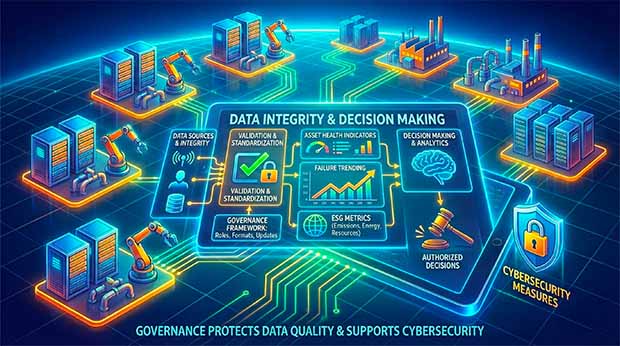
For example, a company with a mature governance model will have standardized Strategic Asset Management Plans (SAMP) and Asset Management Plans (AMP) across all its operating sites, clear guidelines on failure modes, consistency in conducting criticality assessments, and target bands for equipment performance indicators with instructions on what to do if the equipment performance is outside these bands.
This standardization reduces variability, enhances benchmarking, and enables leading practices to be scaled across the company. These practices aren’t reinvented at each site or, worse, ignored when we have good governance. This does not mean continuous improvement isn’t considered for current practices; it simply means that management of change (MoC) is applied when updating them.
Governance as a Driver for Accountability
When managing assets, we see that many unexpected equipment failures are not due to simple wear out or parts breaking under stress. We note that many failures are due to latent organizational issues, including missed inspections, root-cause analysis that focuses on superficial causes, and deferred maintenance. These often stem from unclear accountability, weak oversight, and a culture that accepts reactive failures as the norm.
Good governance addresses this by making roles and responsibilities explicit throughout the asset lifecycle. Who sets the capital project scope? Who approves capital projects? Who owns risk assessments and the associated criteria? Who ensures regulatory compliance for pressure equipment or environmental emissions reporting? Who decides when the reclamation project is complete? The list of questions continues. When governance is strong, everyone knows their responsibilities, and consistent systems are in place to monitor and review performance.
This level of accountability is not only necessary for internal management but also an absolute requirement for external stakeholders, including regulators, auditors, and shareholders. Failure to demonstrate rigorous governance can have reputational and financial consequences for your company.
Risk Management
Risk management is one of the most critical overlaps between reliability and governance. Think of a Venn diagram overlap. Risks are typically classified as safety and health, environmental impact, production impact, downtime, reputation, social licence to operate, and financial effects.
Risk becomes manageable only when governance defines how it is seen, escalated, owned, and acted upon.
Reliability practitioners spend much of their time identifying, evaluating, and mitigating risks. Governance structures and frameworks provide the mechanisms for categorizing and managing these risks. Does your organization have a risk register? Are the risks escalated appropriately? Is there a Board Governance Committee or a cross-functional team that assesses significant risks and approves the mitigation strategies? Does this same cross-functional team conduct periodic audits of a subset of risk decisions across the company to ensure consistency and oversight of how risks are handled?
Strong governance means that risk assessments are more than paperwork and tick boxes. They are integrated into the organization’s strategic and operational planning, with clear thresholds for mitigating actions and associated funding.
Data Integrity and Decision Making
With the positive shift toward data-driven decisions over gut feel or intuition, data integrity and timeliness become increasingly important. Our decisions are only as good as the underlying data and must recognize the increasing complexity and interconnectedness of our production and operating environments.
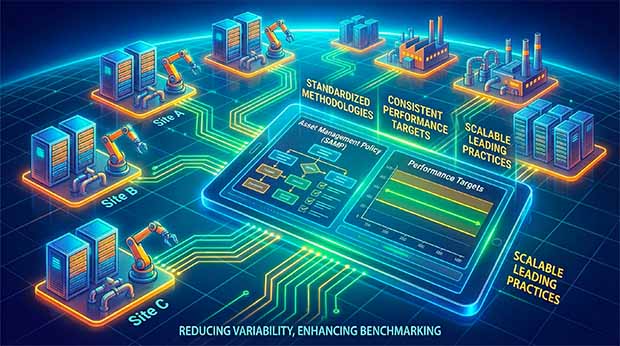
Typical reliability decisions and recommendations focus on asset condition monitoring, asset health indicators, failure trending, and performance indicators. Governance protects data quality by establishing who enters data and in what format, who validates it, how systems are updated, and who has the authority to make decisions based on the resulting analytics. If we take this one step further, data governance supports cybersecurity measures to protect connected assets and systems from external threats.
With increasing regulatory and investor scrutiny of ESG metrics, particularly those related to emissions reporting, energy use, and resource efficiency, data governance is a strategic priority.
Environment, Social, and Governance (ESG) Integration
ESG frameworks require that our companies operate with ethics, transparency, and accountability. When we look at these three pillars of environmental, social, and governance, governance is the enabler for the other two.
For asset managers and reliability practitioners, this means we need to embed governance into our sustainability approach, including emissions tracking, safety programs such as incident reporting and root cause analysis, and capital projects, as we prioritize projects based on risk and return. Governance again enables these initiatives to be consistent across the company, measurable, and aligned with the broader business goals and objectives.
Where to Start to Embed Governance into Reliability Practice?
For reliability and asset managers seeking to strengthen governance in their organizations, a good place to start is to ask yourself a few questions.
- Are our asset strategies governed by a formal policy that spans the asset lifecycle?
- Do we have clear accountabilities and ownership for all significant decisions and processes?
- Is our data quality monitored and its integrity maintained across all systems?
- Do we audit compliance with our maintenance and inspection procedures, intervals, and protocols?
- Are we integrating risk assessments into capital and operational planning?
- Do we have a consistent and clear understanding of what to do based on the answers to these questions?
The answers to these and related questions will reveal what practices to continue, where there may be gaps, and where you may have opportunities to mature your organization’s governance framework.
Conclusion
Good governance should not be viewed as bureaucracy. At its core, it is a structure that provides clarity, consistency, and accountability. For reliability and asset management practitioners, governance is the foundation for ensuring that the systems you build, operate, and maintain are not only efficient and cost-effective but also ethical, transparent, and aligned with long-term business goals.
Organizations continue to face increasing expectations from employees, regulators, shareholders, and the public. Strong governance embedded in our core reliability and asset management practices enables our companies to survive and thrive in this complex, evolving business environment.