
Walk through any plant with a mature condition monitoring program, and you’ll see the evidence of years of investment. Vibration sensors on critical drives. Ultrasound tools in the reliability lab. Infrared cameras for electrical and mechanical inspections. Temperature loggers on heat exchangers. Each technology was selected for good reason, and each delivers real value when used consistently.
That’s the part that trips up most programs. Not the technology itself, but the operational weight of managing too many separate systems at once. The vibration analyst gets promoted, and the routes slow down. The ultrasound program loses momentum because manual data collection competes with every other demand on the team’s time. Oil samples start getting deferred. Not because anyone stopped believing in the technology, but because there are only so many hours in the day.
The monitoring program didn’t fail – it just became impossible to keep every piece of it running at the same time. And that’s one of the most common challenges reliability teams face as programs grow.
More Technologies, More Complexity
Every condition monitoring technology a plant adopts comes with operational overhead. Different software platforms. Different training requirements. Different data formats and calibration schedules. Different levels of expertise are required to interpret results. None of that is a knock on any individual technology – it’s just the reality of scaling a multi-technology program with a finite team.
The goal was never to collect the most types of data. It was to detect the most failure modes with the least operational complexity.
The plants getting the best results aren’t necessarily the ones with the most tools. They’re the ones who found ways to consolidate – covering more failure modes with fewer sensor types, reducing the training burden, and funneling data into a unified view of asset health that can actually drive decisions.
The Integration Challenge
When vibration data lives on one platform, ultrasound data on another, and temperature data on a third, building a complete picture of asset health takes real effort. Analysts toggle between dashboards or mentally correlate data from different systems while standing in front of a machine. And when it’s time to justify the program’s value to leadership, stitching together a coherent story from four different software exports is nobody’s idea of a good time.
This gets harder as programs scale. A single-technology pilot on 50 assets is manageable. Rolling vibration, ultrasound, IR, and oil analysis across 500 assets with a team of four is a different animal entirely. Something almost always falls off – usually the technology that requires the most manual effort or the most specialized expertise. Which, ironically, is often the one that would have caught the failure you just missed.
There’s another layer to this that doesn’t get enough attention: alert fatigue. When you’re running multiple sensor platforms, each with its own alerting logic and its own idea of what “critical” means, nuisance alarms pile up fast. Thresholds that made sense during a single-technology pilot become noise generators at scale.
Technicians start ignoring alerts – not because they’ve stopped caring, but because the system cried wolf too many times. And once your team loses trust in the alerts, it almost doesn’t matter how good your sensor coverage is. You’ve got data nobody acts on. Consolidating onto a single platform with unified alerting logic doesn’t just reduce complexity – it rebuilds credibility with the people who actually have to respond.
Consolidation Is the Upgrade
One example of this consolidation in action is Tractian’s new generation of condition monitoring sensors, which combine vibration analysis, ultrasonic, temperature, and RPM monitoring into a single always-on device.
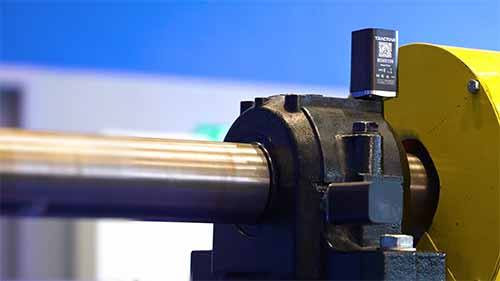
Tractian 2-in-1 Sensor. Courtesy Tractian.
Instead of requiring four separate tools, four separate workflows, and four separate skill sets, teams get continuous multi-parameter data from one sensor with plug-and-play installation and LTE connectivity.
The ultrasonic capability is particularly significant – it pushes detection further left on the P-F curve for lubrication and friction-related issues that vibration alone won’t catch until damage has already progressed. It’s the kind of consolidation that makes condition-based lubrication practical at scale without adding headcount or complexity.
Coverage you can sustain will always outperform coverage you can’t.
Industry data consistently points to lubrication issues as the root cause of up to 80% of premature bearing failures. If your ultrasound program is the one that lost momentum because nobody has time to walk routes, the single biggest failure driver may be going unmonitored – not because you don’t own the right tools, but because your team ran out of bandwidth to use them all.
What Consolidation Actually Looks Like
The shift from “more technologies” to “fewer, smarter technologies” doesn’t mean scaling back your program. It means making the coverage you already believe in something your team can actually keep up with. In practice, that means:
- Continuous data collection that doesn’t depend on manual routes, static schedules, or a single analyst’s availability
- Multi-parameter sensing that covers vibration, ultrasonic, temperature, and speed from one device
- Unified data flowing into one platform so analysts see the full picture without toggling between systems
- Lower training burden so the program doesn’t stall when one person leaves or gets reassigned
Focus Is the Real Win
Technology consolidation unlocks something even more valuable than broader detection: focus. When your team isn’t buried in managing multiple sensor platforms, calibrating different devices, and maintaining proficiency across five different software packages, they have time to analyze data, investigate root causes, and close the loop on corrective actions. That’s where reliability actually improves – not at the point of data collection, but at the point of decision-making. A technician who spends 80% of their time collecting data and 20% acting on it has the ratio exactly backwards.
At some point, the number of sensor types you own stops being a strength and starts being a liability.
If your condition monitoring program is collecting more data than your team can consistently act on, the answer probably isn’t another sensor type. It’s fewer sensor types that do more, deployed in a way your team can actually sustain. Start by auditing what you have. How many technologies are actively generating data that someone reviews and acts on every single month? If the answer is less than what you own, the opportunity isn’t for more coverage. It’s more consistency – and that starts with simplification.