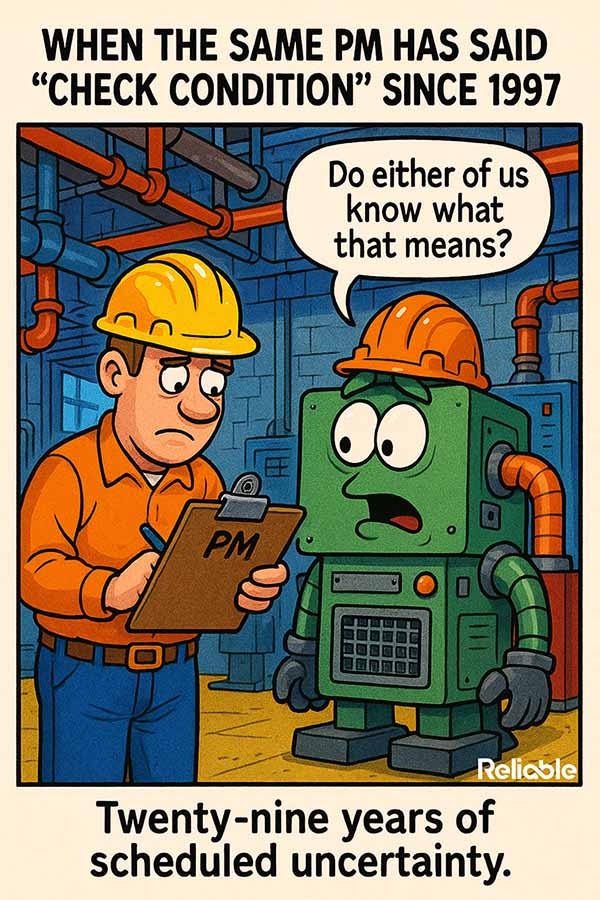

A preventive maintenance (PM) task that has read the same way for thirty years carries a quiet authority. Nobody questions it, and nobody quite remembers what it was first meant to catch. Understanding how to write effective PM procedures begins with an uncomfortable admission: a step that simply says check condition asks a technician to guess at a standard that was never written down anywhere.
The task still gets signed off, because a conscientious technician will not leave a box blank on a route. Two people can complete the same step on the same machine and record opposite conclusions, and each may be able to defend the entry. The wording gave them no shared acceptance criterion, so the records are inconsistent even when both people acted in good faith.
Why Vague Steps Survive for Decades
Loose steps last for years because they are easy to write and difficult to challenge. A line that reads inspect for wear can be satisfied by a quick glance, so it clears the schedule on time while telling the planner very little about the machine. The path of least resistance keeps the words exactly as they are.
The cost shows up later, in the space between a healthy compliance number and an asset that fails anyway. The PM was completed and the paperwork is clean. The same PM never defined what a good reading looked like, so the degradation slid past every signature on the sheet without raising a single question.
Ambiguity also erodes the crew’s faith in the program. Technicians can tell when a task exists mainly to be checked off rather than to detect a meaningful condition, and that quiet cynicism spreads to the steps that genuinely matter. A route padded with vague checks trains people to hurry through the ones most likely to catch a developing problem.
There is a review problem hiding here too. When a serious failure prompts an investigation, a step that reads check condition offers little evidence to defend or improve because it never defined what acceptable meant. A well-written criterion, by contrast, tells the review team what the plant expected and what the technician actually observed or measured.
- Inconsistent results between technicians, shifts, and seasons of the year
- Findings that are difficult to trend consistently because no value, category, or severity scale was recorded
- A comforting sense of coverage that hides a slowly degrading asset
- Steps that quietly outlive the failure mode they were first written to catch
This is the same drift that swallows aging work instructions across a plant. A shelf of outdated SOPs grows one unquestioned revision at a time, and PM task steps rot the same way when nobody owns their accuracy. The fix for both is to make each instruction verifiable by a second person on a different day.
How to Write Effective PM Procedures With Real Acceptance Criteria
A strong step tells the technician what action to perform, where and how to inspect or measure, what acceptable condition looks like, and what response to take when the result falls outside that condition. It replaces private judgment where a clear standard exists and reserves experienced judgment for the situations that genuinely require it.
Acceptance criteria sit at the center of the rewrite, but the limits have to come from a defensible source. A bearing-temperature step should name the measurement point and the applicable OEM or engineering limit. A belt-tension step should specify the correct manufacturer method and target for that drive. A vibration step should define the measurement location, units, and the baseline or alarm criterion being used. Each example turns a soft look into a repeatable check without pretending one number fits every machine.
A procedure earns real trust when two qualified technicians reading it can reach the same conclusion, or closely comparable measurements, on the same machine.
Writing to that standard takes more thought up front and produces far less argument later. The person building the task has to understand the failure mode, the measurement, and the limit, which forces a useful conversation before the step ever reaches a clipboard. That conversation is where most of the value of a PM program is actually created.
The payoff is a record that can finally support trending. Once a step captures a value or a consistent condition code instead of only a checkmark, repeated readings can reveal drift and help trigger follow-up before an applicable limit is crossed. A checkmark by itself can only confirm that the step was completed.
The Anatomy of a Task Step
A step worth following has a predictable shape, whatever the trade behind it. Naming its parts makes the whole procedure repeatable, so the tenth task a planner writes reads as cleanly and lands as firmly as the first. Structure is what lets a program scale past the memory of one talented planner.
Think of each step as four small answers rather than one vague instruction. A qualified technician should not have to reverse engineer what the writer intended while standing in front of the machine. When the structure is consistent, different technicians are more likely to collect comparable information from the same route.
- The action to perform, written as a single verb the technician can picture
- The point of measurement, specific enough that two people choose the same spot
- The acceptance criterion, quantitative when appropriate, with units, tolerance, condition code, or other clearly defined pass/fail basis
- The response when a reading falls outside the limit, including who to notify
These elements belong in a living record rather than in a retiring planner’s head. Sound maintenance documentation keeps the reasoning behind each limit attached to the step, so the next revision sharpens the task instead of guessing at why the number was chosen. A limit with its history attached survives a change of staff.
Photographs and reference values can raise the floor even further. A current reference photo of an acceptable or unacceptable condition, placed beside the step, can make the expected state easier to interpret than prose alone. Use images as supporting evidence, not as a substitute for a measurable or clearly defined criterion when one is available.
Building Limits Your Crew Can Trust
Numbers only help when the crew believes them. A limit pulled from thin air gets ignored the first time it cries wolf, so every threshold needs a defensible source standing behind it. The goal is a set of criteria the technicians would defend themselves, because they helped shape them.
Manufacturer data, engineering limits, historical readings, process context, and past failures can all inform a threshold. For an on-condition task, the estimated P-F interval is one input to task frequency: the interval should provide a reasonable opportunity to detect the potential failure and act before functional failure, while accounting for detectability, uncertainty, consequence, and the time needed to plan and execute the response. Frequency and acceptance criteria have to be designed together.
A limit with no reason behind it is a rule that will be quietly ignored on the first genuinely busy shift.
Involving the technicians who actually run the route can sharpen every threshold. They know the normal operating context and recurring nuisance conditions, and that field knowledge is useful when limits are validated against OEM guidance, engineering requirements, historical data, and the failure mode the task is meant to detect. A criterion set in an office and never tested on the floor tends to age badly.
Where the physics and available evidence support it, use normal, investigate, and alarm bands rather than pretending every condition has one perfect cutoff. Trend bands can accommodate normal process variation while still calling attention to meaningful drift. The bands should be based on a defensible reference and reviewed when the process, machine, or measurement method changes.
Keeping Procedures Alive After the First Revision
A rewritten procedure is a starting point rather than a finished monument. A related failure the task misses, or a false alarm it repeatedly raises, is direct feedback that should trigger review of the failure mode, method, limit, and interval. Changing the step should follow that review rather than happen automatically.
Give every task a named owner and a review trigger. A quick look after a related failure, or on a set calendar cadence, keeps the limits honest as the equipment ages and the process shifts around it. Ownership is what separates a document that improves from one that simply gets older.
The measure of success here is quiet but very real. Compliance numbers begin to line up with actual equipment behavior, arguments over what a reading means start to fade, and the schedule finally reflects the true condition of the assets it covers. The route stops being theater and starts being information.
Keep the rewrites small enough that the crew can absorb them. Pilot the format on one route or a small group of tasks, collect technician feedback, and confirm that the new criteria produce useful data before converting the next batch. A controlled rollout is easier to validate than a binder dropped on the floor in a single week.
Start with the single PM step every technician privately dreads. Give it a clear action, a defined measurement, a sourced limit, and a response, then let the cleaner data it produces make the case for rewriting the next one. Momentum builds one honest step at a time, and the whole program improves from there.