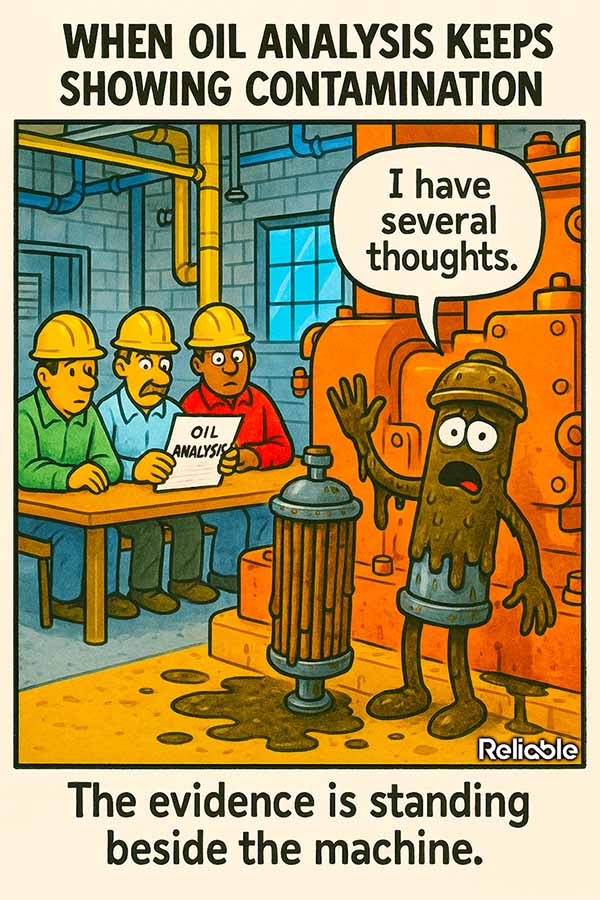

When an oil analysis report comes back flagged for contamination month after month, the result deserves investigation rather than another blind oil change. First confirm that sampling location, technique, operating condition, and laboratory method are comparable from sample to sample. Once the trend is verified, learning how to control oil contamination means finding and controlling the source. Contamination is a primary cause of component wear and failure, but a recurring flag is evidence to investigate, not proof that a bearing or gear failure is inevitable.
Contamination is unwanted material or fluid in the lubricant, and it can do damage in several ways. Hard particles can cause abrasive wear, water can promote corrosion and reduce lubricant film performance, and mixing the wrong fluid can change viscosity or additive performance. With a consistent sampling and testing program, oil analysis can reveal these conditions before obvious machine symptoms appear.
What makes contamination worth chasing is the chance to act before secondary damage becomes severe. Depending on the contaminant, the evidence may appear in particle count, water, elemental analysis, viscosity, spectroscopy, or other tests. Correcting ingress, handling, filtration, or water-control problems early is generally cheaper than waiting for component damage.
Why Oil Analysis Keeps Flagging the Same Contamination
A repeat flag can mean the source is still active, but it can also reflect inconsistent sampling, contamination introduced after the sample was drawn, residual debris, internal wear generation, mixed fluids, or test interference. Teams should read the oil analysis report as a trend and verify sampling consistency before deciding that another oil change is the answer.
When the source really is ongoing ingress, repeatedly changing oil treats the symptom while the pathway remains open. That spends lubricant and labor without fixing the condition that allowed dirt, water, or another fluid into the system.
A recurring contamination flag is a reason to find the source, not simply change the oil again.
The way out starts with treating a repeated, verified abnormal trend as an investigation trigger rather than an automatic reorder point. One flagged sample is data that needs context. Repeated abnormal results from comparable samples deserve a work order or engineering review aimed at the likely source and the risk it creates.
That shift in mindset matters. When a recurring, verified contamination result triggers source investigation, the plant can stop paying for repeated symptom treatment and start closing the actual pathways or internal causes.
It also changes how the sampling program is judged. A run of results within target supports the conclusion that countermeasures are working, provided operating and sampling conditions remain comparable. The trend becomes a scorecard for the contamination-control effort rather than a single pass-or-fail number.
Where Oil Contamination Actually Comes From
Controlling contamination gets easier once you know the common sources of contamination ingress and internal generation. Most lubricant systems see some combination of external ingress, maintenance or transfer contamination, internal wear debris, fluid mixing, water, and degradation products.
- Ingress through breathers and seals, where airborne dust and moisture ride into the reservoir every time the equipment breathes.
- Dirty top-up and transfer practices, where open funnels, shared containers, or new oil that has not been verified against the machine cleanliness target can add contamination during routine service.
- Internal generation, where normal or abnormal wear creates debris and lubricant degradation can produce insoluble oxidation or varnish precursors.
- Water intrusion from washdown, cooler leaks, process leaks, or condensation, which can promote corrosion, reduce film performance, and accelerate lubricant degradation.
Naming the likely source narrows the fix, but the lab result rarely identifies the pathway by itself. A rise in particulate contamination may justify checking breathers, seals, transfer practices, and internal wear, while a water increase may point to condensation, washdown, a cooler, or another process source. Confirm the source before choosing the countermeasure.
A system can have more than one source at the same time, which is why a scattershot response tends to disappoint. Rank likely sources using the trend, inspection evidence, operating context, and risk, then address the pathways with the strongest evidence first.
How to Control Oil Contamination at the Source
Knowing how to control oil contamination starts with exclusion. Keep contaminants out with suitable seals, breathers, sealed fill connections, and clean transfer practices. Use desiccant breathers or other moisture-control devices where the environment and equipment design make them appropriate.
The second move is removal, taking out what still gets in or is generated internally. Properly selected filtration, offline or kidney-loop filtration where appropriate, and water-removal methods matched to the fluid and system can help maintain the specified cleanliness and moisture targets.
You cannot filter your way out of a contamination problem you refuse to stop feeding.
Clean handling matters as much as hardware. New oil should not be assumed to meet the machine’s cleanliness target, especially for sensitive hydraulic and circulating systems. Verify or condition it as needed, keep transfer containers sealed and clean, and dedicate or clearly label them by lubricant type to reduce cross-contamination.
Tie those habits to targets. Set particle-cleanliness and water limits appropriate to the component, lubricant, OEM guidance, and operating environment, then use oil analysis to trend whether the system is staying inside those limits as part of the broader predictive maintenance strategy.
Reading the Oil Analysis Report as a Map
The same report that flags a problem can help narrow its source when a team reads related tests together, compares them with the new-oil baseline, and looks at trends rather than one number in isolation.
- A rising particle count with higher silicon can indicate dirt or dust ingress, but silicon can also come from sealants, additive chemistry, or silicone defoamants. Compare the trend with the new-oil baseline, related elements, filtration condition, seals, and transfer practices before calling it dirt.
- Rising water together with oxidation is a reason to investigate moisture ingress and lubricant degradation, but those two values alone do not prove the source or show that water caused the oxidation. Confirm with the appropriate water test and the rest of the oil-condition data.
- Rising wear metals indicate increasing wear. If wear metals rise along with particle or dirt indicators, contamination may be contributing, but the trend should be confirmed with the relevant tests and machine condition before assigning cause.
Trended across consistent samples, these patterns turn isolated results into a story. That trend helps show whether the last countermeasure worked, whether a source remains active, or whether a different mechanism is developing.
Making Clean Oil the Default
Contamination control holds only when it becomes routine rather than a reaction to the latest bad report. That means building the countermeasures into standard work, so clean oil is the default state of every machine instead of a target chased after each alarm.
The payoff shows up across the reliability program. Cleaner lubricant can reduce abrasive wear and support longer bearing, gear, pump, and valve life when cleanliness targets are appropriate for the equipment. Drain intervals, however, should follow OEM requirements or condition-based criteria rather than being extended on cleanliness alone.
Clean oil is a condition you maintain on purpose, and the lab result helps confirm the work is holding.
Keeping it there is a matter of ownership and standard work. When responsibility is clear, breathers and filters are serviced, samples are pulled consistently, transfer practices are controlled, and excursions are investigated before they become chronic.
That is the whole aim of learning how to control oil contamination: keep the lubricant within appropriate cleanliness and moisture targets, interpret alarms in context, and make verified clean trends the ordinary result of good storage, handling, exclusion, removal, and sampling practices.