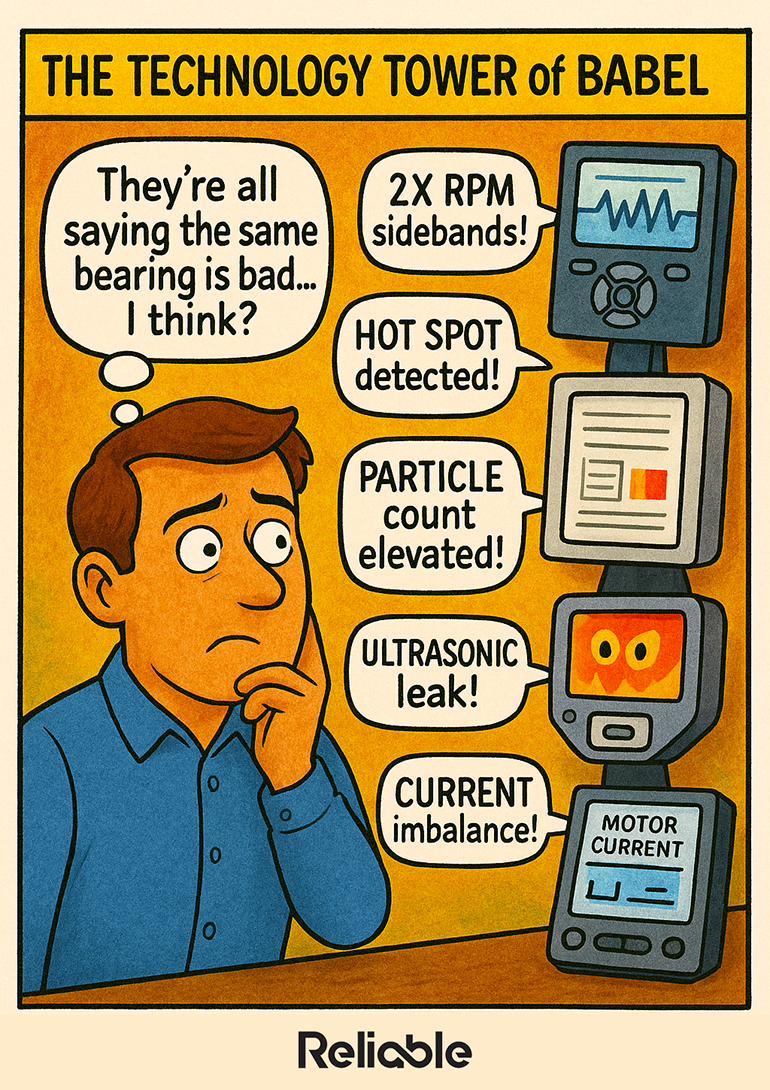

A vibration analyst flags a bearing defect frequency on a cooling tower fan. The same week, the thermographer catches a hot spot on the same motor housing. Oil analysis from last month showed elevated iron and copper particle counts trending upward. Three technologies, three related data streams, one stronger diagnostic picture. When maintenance teams learn how to combine condition monitoring technologies effectively, this kind of convergence becomes routine. Diagnostic confidence moves from a single-indicator judgment to a much stronger, evidence-based diagnosis.
Most industrial facilities already own the tools. They have vibration collectors, infrared cameras, ultrasonic detectors, and oil analysis programs running in parallel. The problem is that these programs typically operate in silos, each managed by a different analyst or contractor, each generating reports that land on separate desks. The data exists. The correlation doesn’t happen by itself.
Why Single-Technology Diagnoses Fall Short
Every condition monitoring technology has blind spots. Vibration analysis excels at detecting many rotating-element defects, especially when speed, load, sensor placement, and data quality are suitable. Infrared thermography catches thermal anomalies quickly, but a hot bearing could indicate a lubrication issue, an alignment problem, or an electrical resistance fault. The thermal image tells you where heat is abnormal. It usually needs operating context and supporting data to identify the failure mode.
Every condition monitoring technology has blind spots. Overlapping your coverage with complementary data sources is the only reliable way to shrink them.
Ultrasonic detection picks up high-frequency friction and electrical discharge, but interpreting amplitude changes requires context that ultrasonics alone can’t provide. Oil analysis can reveal wear debris, lubricant degradation, and contamination trends, but results lag by days or weeks depending on lab turnaround time. By the time a critical result comes back, the condition may already have progressed on the shop floor.
Relying on a single technology means accepting its limitations as your program’s limitations. That’s a choice most plants can’t afford to make on critical equipment where unplanned downtime costs five or six figures per event. The question isn’t whether to use multiple technologies. It’s how to combine condition monitoring technologies so their strengths complement each other and their blind spots overlap as little as possible.
How to Combine Condition Monitoring Technologies in Practice
Integration starts with people and process, not software. The most effective multi-technology programs share three characteristics:
- A single owner or coordinator who reviews findings from all technologies on a regular cadence, weekly or biweekly depending on plant criticality. This person doesn’t need to be an expert in every technology. They need to understand what each technology detects and where its coverage gaps are.
- A shared asset register that maps which technologies cover which equipment. Critical assets should usually have more than one appropriate technology assigned, based on failure modes, consequence, speed, duty cycle, and accessibility. Complementary coverage is the point.
- A common reporting format or dashboard where analysts from different disciplines can flag findings against the same asset ID, making correlation visible instead of accidental.
The coordinator role matters enormously. Without it, the vibration analyst and the thermographer might both detect a developing problem on the same gearbox and submit separate work requests that get scheduled weeks apart. Or worse, one flags it and the other never checks, so the confirming data point never gets captured at all.
The data doesn’t correlate itself. Someone has to connect a vibration spike to a thermal anomaly to a wear metal trend, and do it before the window for planned repair closes.
That someone is the integration coordinator, and their weekly review meeting is where the real value of multi-technology monitoring gets realized. Without that meeting, you have parallel programs. With it, you have a system.
Pairing Technologies by Failure Mode
The strongest diagnostic confidence comes from pairing technologies by failure mode rather than by equipment type. Bearing defects may produce vibration signatures, thermal changes, ultrasonic emissions, and wear debris evidence such as ferrous particles, depending on bearing metallurgy, lubrication system, severity, and sampling method. A vibration alert paired with a matching thermal anomaly and relevant wear debris trend creates a much more defensible diagnosis before disassembly.
Understanding how to combine condition monitoring technologies by failure mode makes the diagnosis layered and defensible. Here are practical pairings for common failure modes:
- Bearing defects: vibration analysis (primary) + infrared thermography (confirming) + oil analysis (trending wear debris over time)
- Misalignment: vibration analysis (primary, axial and radial patterns) + infrared thermography (confirming thermal pattern across coupling and bearing housings)
- Electrical faults in motors: motor current signature analysis and electrical testing + infrared thermography for connections/imbalance/heating + ultrasound where arcing, corona, or partial discharge is plausible.
- Lubrication problems: ultrasound for friction response + oil analysis for lubricant condition/contamination/wear debris + infrared thermography for heat confirmation.
These pairings are starting points, not rigid rules. The specific combination depends on the equipment type, its operating speed, criticality ranking, and what failure modes your reliability-centered maintenance analysis identified as most likely and most consequential.
Combining Condition Monitoring Technologies Without Expensive Software
Many plants assume that knowing how to combine condition monitoring technologies requires a unified analytics platform with machine learning and automated correlation engines. Those platforms exist and they work well for large operations with hundreds of monitored assets, but they’re far from a prerequisite for getting started.
You can correlate condition monitoring data in a spreadsheet if you have disciplined analysts, a shared asset register, and a weekly meeting where they sit in the same room and compare notes.
A shared spreadsheet or simple database that logs findings by asset ID, date, technology, severity, and recommended action gives the coordinator everything they need to spot convergence. When two or more relevant technologies flag the same asset within the same reporting period, that asset should receive a higher review priority, then be ranked by criticality, severity, safety risk, and production impact. The maintenance scheduling process remains important. The key discipline is tagging findings to the asset, not to the technology. Most condition monitoring reports organize by route or by discipline. Reorganizing by asset makes cross-technology patterns visible immediately.
Handling Conflicting Results Between Technologies
Sometimes technologies disagree. The vibration data looks clean, but thermography shows elevated temperature. Or oil analysis trends are worsening while vibration levels remain stable. These apparent contradictions carry diagnostic information of their own.
A clean vibration spectrum with elevated bearing temperature may point to lubrication, overloading, cooling/airflow, alignment, installation, or process-related issues. The bearing surfaces haven’t deteriorated enough to generate defect frequencies, but the friction from inadequate or contaminated lubricant produces measurable heat. Similarly, worsening oil analysis with stable vibration can indicate contamination, abnormal wear, lubricant degradation, or a sampling/labeling problem that needs verification.
Conflicting data should trigger deeper investigation, not dismissal. The question to ask is: what failure mode explains all the data points simultaneously? That question is the foundation of effective root cause failure analysis, and it’s exactly where programs that combine condition monitoring technologies deliver their greatest value. A single technology gives you a symptom. Combined technologies give you a stronger diagnostic basis.
Building the Business Case for Multi-Technology Integration
The financial argument for learning how to combine condition monitoring technologies is straightforward. False positives from single-technology programs waste maintenance labor on unnecessary teardowns. Missed detections cause unplanned downtime. Both are expensive. Multi-technology confirmation can reduce false positives and improve confidence, but the improvement depends heavily on asset type, data quality, analyst skill, and how findings are validated. It can also catch some slow-developing failure modes earlier than a single-technology program would.
When the condition monitoring team presents a finding backed by three independent data sources, the conversation shifts from “are you sure about this?” to “when do we schedule the repair?” That credibility compounds over time.
Operations teams lose faith in predictive programs that generate too many false alarms. Credibility erodes slowly and rebuilds even more slowly. When the PdM team can back up every recommendation with convergent evidence from multiple technologies, operations starts trusting the calls. That trust makes it progressively easier to get planned downtime approved for corrective work before a failure forces the issue.
- Track confirmed diagnoses by the number of technologies that contributed. Over time, this data shows which pairings produce the most reliable calls for your specific equipment population.
- Document avoided failures (catches that prevented unplanned downtime) and tie them to the multi-technology workflow. These save stories justify continued program investment and demonstrate tangible return.
- Review missed detections after every unplanned failure. Ask which technologies had the asset on their route, what they reported, and whether cross-technology correlation would have caught the developing problem sooner.
Plants that combine condition monitoring technologies well develop a diagnostic instinct that goes beyond any individual analyst’s capability. The bearing with a subtle vibration anomaly gets a thermographic check the same week. The oil sample gets pulled early. The whole process becomes faster, more targeted, and far more defensible. That’s the real payoff: fewer surprises, better planning, and equipment that runs the way it was designed to.