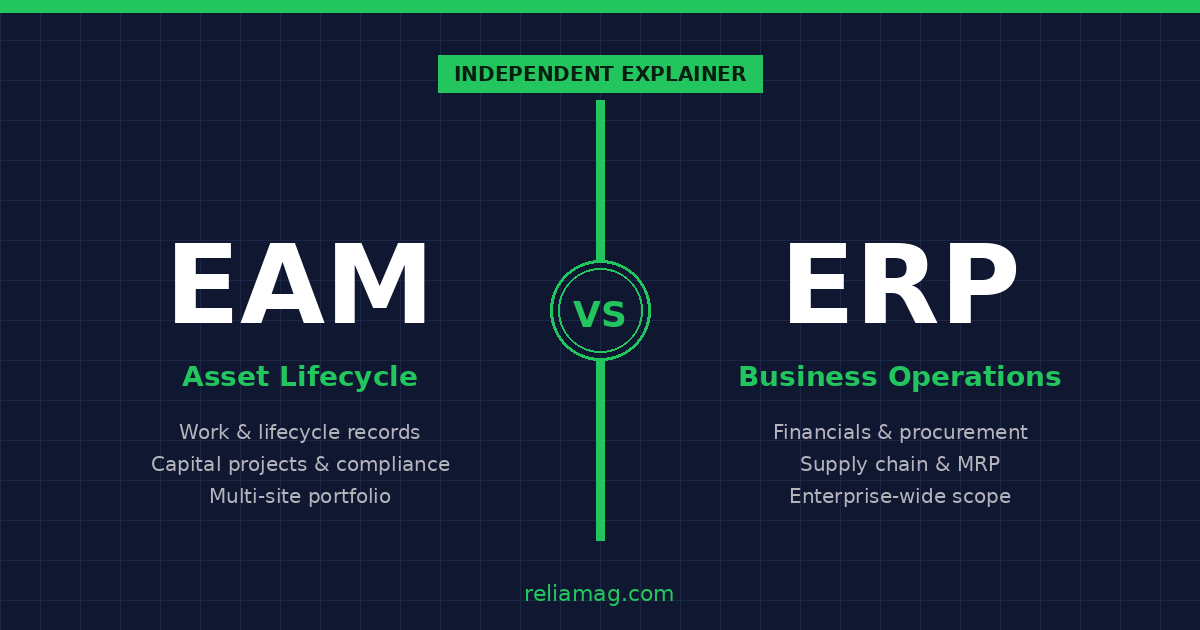

TL;DR: ERP and EAM solve different problems at different scopes. ERP (Enterprise Resource Planning) is the system of record for running the business – financials, procurement, supply chain, manufacturing, customer orders, HR. EAM (Enterprise Asset Management) is the system of record for managing physical assets across their lifecycle – procurement, capitalization, work management, condition tracking, compliance, refurbishment, disposal. ERP runs the business. EAM runs the assets.
The categories are operationally distinct but commercially blurred because SAP S/4HANA Asset Management and Oracle Cloud Maintenance are EAM modules that ship inside ERP suites – bundled EAM rather than standalone. Most asset-intensive operations deploy both ERP and EAM. The buyer decision is usually whether to use the EAM module bundled with the chosen ERP or to deploy dedicated EAM (IBM Maximo, Hexagon HxGN EAM, Infor EAM) alongside. ERP comes first, EAM follows. ERP without EAM works for many businesses but fails at scale for asset-intensive operations. EAM without ERP is essentially never the right architecture.
The Short Answer
ERP runs the business. EAM runs the assets.
If you only remember one thing from this explainer, remember the scope distinction. ERP operates at the enterprise level – it owns the financial, operational, and transactional record of how the business runs across finance, procurement, supply chain, manufacturing, HR, and customer-facing operations. EAM operates at the asset level – it owns the lifecycle record of every physical asset the business operates, from acquisition through disposal, including work management, financial stewardship of the asset, compliance, and end-of-life decisions. ERP is horizontal across the enterprise. EAM is vertical down the asset stack. Both are needed for serious asset-intensive operations, but they do fundamentally different things at fundamentally different scopes.
Why the Confusion Exists
The categories blur for four reasons, and the first one is the biggest single source of buyer confusion in the entire asset management software market.
First, SAP S/4HANA Asset Management and Oracle Cloud Maintenance are EAM modules inside ERP suites. SAP’s Plant Maintenance and Asset Management modules ship as part of S/4HANA, share the same database and data model as SAP financials and materials management, and license under the same enterprise agreement. Oracle Cloud Maintenance (formerly Oracle EAM) sits inside Oracle Fusion Cloud ERP under the same architecture. From the outside, buyers see “SAP for asset management” or “Oracle for asset management” and reasonably conclude the ERP is the EAM. They aren’t wrong, exactly – for operations on SAP or Oracle, the ERP genuinely does provide EAM capability. But the EAM is a module within the ERP rather than a separate platform, which makes the category boundary unclear. Half of the buyer-confusion volume in this category comes from people trying to figure out whether SAP and Oracle count as ERP, EAM, or both. The honest answer is both.
Second, dedicated EAM platforms include functionality that overlaps with ERP. IBM Maximo, Hexagon HxGN EAM, AVEVA, and Infor EAM all include asset financial management – capitalization, depreciation, maintenance cost accounting, MRO procurement, parts inventory. These capabilities overlap with ERP financials and procurement modules. The overlap is necessary because EAM needs to handle asset-level financial records and procurement workflows for parts and contractor services, but the overlap creates apparent duplication when EAM and ERP are deployed together. Buyers reasonably ask why they need both when each system seems to handle the other’s job. The answer is that the overlap is shallow – EAM financial functions stop at the asset level and feed into ERP for enterprise consolidation, while ERP financial functions handle the broader business but don’t manage individual asset lifecycles in operational depth.
Third, the vendor marketing deliberately blurs the boundaries. SAP markets S/4HANA Asset Management as both an ERP capability and a competitor to dedicated EAM platforms. Oracle markets Cloud Maintenance as part of Fusion ERP and as a standalone EAM. IBM Maximo Application Suite increasingly markets itself as an enterprise asset platform with ERP-adjacent capability for asset-intensive industries. The marketing positioning serves vendor go-to-market strategies but compresses the operational distinction that buyers need to make purchase decisions. The reality on the ground is that operations almost always deploy one ERP and one EAM (which may or may not be the ERP’s bundled EAM module), and the marketing confusion doesn’t change that operational fact.
Fourth, the buyer populations overlap. The CIO evaluating ERP and the asset manager evaluating EAM often report through the same finance organization, and the procurement decision frequently bundles both at the enterprise level. Vendors selling into this overlap have strong incentives to position their offerings as unified solutions, which deepens the marketing compression even when the underlying products remain operationally distinct.
What ERP Does
ERP operates at the enterprise business operations layer. The core capabilities are:
- Financial management – general ledger, accounts payable and receivable, financial consolidation, multi-entity accounting, period close, statutory reporting, treasury
- Procurement and supply chain – supplier management, purchase orders, materials management, inventory across the broader enterprise (not just MRO), logistics, distribution
- Manufacturing planning – material requirements planning (MRP), production planning, bill of materials (BOM), shop floor scheduling, capacity planning
- Customer order management – quote-to-cash, customer master, order fulfillment, revenue recognition, contracts
- Human resources – workforce administration, payroll, time tracking, talent management, succession planning
- Reporting and analytics – enterprise reporting, financial analytics, business intelligence across all operational data
- Asset accounting – fixed asset register, capitalization, depreciation schedules, asset disposal accounting (the financial side of asset records, distinct from operational asset management)
ERP is the system of record for enterprise business operations. It owns the financial, transactional, and operational record of how the entire business runs. The major ERP platforms covered in our ERP guide include SAP S/4HANA, Oracle NetSuite and Oracle Fusion Cloud ERP, Microsoft Dynamics 365, Epicor Kinetic, Infor CloudSuite Industrial, Acumatica, and Odoo.
What EAM Does
EAM operates at the asset lifecycle management layer. The core capabilities are:
- Asset lifecycle management – tracking assets from procurement through commissioning, operation, refurbishment, and disposal with full operational and financial records at every stage
- Work management – work order workflow, preventive maintenance scheduling, planning and scheduling, technician execution, maintenance history (the CMMS functions that EAM includes as a foundational layer)
- Asset financial stewardship – asset-level capitalization, depreciation tracking, maintenance cost accounting, total cost of ownership at the asset level (which feeds into ERP for enterprise consolidation)
- Capital project management – capital project workflows for asset acquisition, installation, commissioning, and major refurbishment, often integrated with engineering and procurement systems
- MRO procurement and parts inventory – spare parts inventory, MRO procurement workflows, supplier management for maintenance services, inventory optimization across multi-site operations
- Compliance and regulatory documentation – calibration records, inspection logs, mechanical integrity documentation, audit trails for regulated industries
- Multi-site portfolio management – managing asset portfolios across plants, regions, or business units with consolidated reporting, standardized hierarchies, and cross-site analytics
EAM is the system of record for asset stewardship. It owns the lifecycle and operational record of every physical asset – every capital project, every maintenance event, every compliance audit, every refurbishment decision – that drives asset-intensive operations. The major EAM platforms covered in our EAM guide include IBM Maximo Application Suite, SAP S/4HANA Asset Management, Oracle Cloud Maintenance, Hexagon HxGN EAM, AVEVA, and Infor EAM.
Side-by-Side Comparison
| Dimension | ERP | EAM |
|---|---|---|
| Primary Function | Business operations | Asset lifecycle management |
| Primary Question | How is the business run? | How is each asset stewarded? |
| Scope | Horizontal across the enterprise | Vertical down the asset stack |
| Primary Outputs | Financials, orders, MRP, supply chain | Asset records, work orders, maintenance history |
| Primary Users | Finance, procurement, sales, HR, operations | Asset managers, planners, maintenance, compliance |
| System of Record For | Financial and business transactions | Physical asset lifecycle |
| Time Horizon | Period close (months, quarters, years) | Asset life (years to decades) |
| Typical Vendors | SAP, Oracle, Microsoft, Epicor, Infor, NetSuite | IBM Maximo, SAP, Oracle, Hexagon, Infor, AVEVA |
| Implementation | 6-18 months (mid-market to enterprise) | 6-24 months (enterprise deployment) |
The SAP and Oracle Question: Bundled EAM Inside ERP
The single most important fact for buyers trying to disambiguate EAM and ERP: SAP S/4HANA Asset Management and Oracle Cloud Maintenance are EAM modules that ship inside ERP suites. The EAM is bundled, not separate. The operational implications matter for the buyer decision.
SAP S/4HANA Asset Management runs as the asset management layer inside SAP S/4HANA ERP. It shares the same HANA database and data model as SAP financials (FI/CO), materials management (MM), procurement, and production planning (PP). Asset records are unified with the SAP fixed asset register. Work orders flow into SAP financials natively. Procurement of maintenance parts and contractor services routes through SAP MM. The integration depth is the entire value proposition – for operations standardized on SAP across financials, supply chain, and HR, the bundled EAM module eliminates the middleware overhead that plagues organizations running dedicated EAM separately from ERP. SAP S/4HANA Asset Management appears on EAM vendor comparison lists (including ours) because it is genuinely an EAM platform, but it cannot be deployed independently of SAP S/4HANA ERP.
Oracle Cloud Maintenance runs as the asset management layer inside Oracle Fusion Cloud ERP. The architecture mirrors SAP – Oracle Cloud Maintenance shares the same database and data model as Oracle financials, procurement, and supply chain modules. The bundled EAM integrates natively with the broader Oracle ERP stack. Like SAP, it is genuinely an EAM platform but is not available outside the Oracle ERP environment.
The buyer implication is that the EAM decision is partially constrained by the ERP decision when SAP or Oracle is in play. Operations on SAP often default to SAP S/4HANA Asset Management for integration simplicity. Operations on Oracle often default to Oracle Cloud Maintenance. Operations on other ERPs (Microsoft Dynamics 365, Epicor Kinetic, Infor CloudSuite, NetSuite, Acumatica) typically deploy dedicated EAM alongside the ERP because those ERPs don’t include comparable bundled EAM modules.
The exception worth flagging: Infor CloudSuite Industrial includes Infor EAM as part of the broader Infor enterprise suite, which gives Infor a similar bundled architecture for operations standardized on Infor. Microsoft Dynamics 365 includes some asset management capability through Dynamics 365 Field Service and Asset Management add-ons, but the depth doesn’t match SAP or Oracle bundled EAM and most serious asset-intensive operations on Dynamics deploy dedicated EAM alongside.
The Overlap Zone
Three areas of legitimate overlap between EAM and ERP create most of the buyer confusion outside the SAP/Oracle bundling question.
Asset financial accounting. Both systems track asset financials. ERP owns the corporate fixed asset register – capitalization, depreciation schedules, asset accounting under GAAP or IFRS, financial reporting. EAM owns asset-level operational financials – maintenance cost per asset, total cost of ownership, capital project cost tracking, asset-level profitability. The two financial views overlap on the asset master and integrate through the asset record. The right architecture aligns the asset master between systems with consistent IDs so financial records and operational records reference the same physical assets. Misalignment is one of the most common implementation failures.
Procurement and inventory. Both systems handle procurement and inventory but for different purposes. ERP procurement manages enterprise-wide procurement across all categories – direct materials, indirect spend, capital equipment, services. EAM procurement specifically manages MRO procurement – spare parts, maintenance services, repair contracts – that is rolled up into ERP for enterprise spend visibility. Inventory follows the same pattern: ERP inventory covers all enterprise inventory while EAM inventory covers MRO and spare parts specifically. The right architecture routes MRO procurement requisitions from EAM through ERP procurement workflows and returns parts receipts to EAM inventory while consolidating spend in ERP.
Master data. Both systems require asset master data – equipment IDs, hierarchy, criticality, location. EAM is typically the master for operational asset data because the maintenance team owns the asset records most rigorously. ERP is typically the master for financial asset data because the finance team owns the fixed asset register. The two masters must align on the physical asset, with EAM extending the financial record with operational attributes (criticality, maintenance plans, condition data) and ERP extending the operational record with financial attributes (depreciation, asset accounting, capitalization). Cross-vendor integrations require active master data management to keep the two masters synchronized.
How EAM and ERP Integrate
Integration between EAM and ERP happens at four primary handshake points. Each is operationally important and each is commonly underestimated during procurement.
The financial handshake. Asset capitalization, depreciation, and maintenance costs flow from EAM into ERP financial accounting. When a capital project completes in EAM, the asset is capitalized in the ERP fixed asset register at the correct value. When maintenance work orders complete, labor and parts costs flow into ERP for cost accounting and reporting. This handshake is the most consequential financial integration in the entire EAM-ERP architecture, and the most commonly weak in cross-vendor deployments. When EAM ships inside ERP (SAP, Oracle), this handshake is native. When EAM is dedicated alongside ERP, it requires active integration design.
The procurement handshake. EAM purchase requisitions for parts and contractor services route through ERP procurement workflows. The procurement order is placed by ERP, the receipt is logged in ERP, then the parts arrive in EAM inventory and the contractor work is consumed against an EAM work order. This handshake is procurement-heavy and frequently underbuilt in operations where the EAM and ERP teams don’t align on workflow design.
The asset master handshake. Both systems need to reference the same physical equipment with consistent IDs. Asset hierarchy in EAM aligns with the fixed asset register in ERP. The right architecture typically designates EAM as the master for operational attributes (criticality, maintenance plans, parent-child structure) and ERP as the master for financial attributes (capitalization value, depreciation method, asset class). The two masters synchronize through scheduled sync or API integration.
The work-order-to-cost handshake. EAM work order labor and parts consumption flow as costs into ERP for financial reporting, capital project accounting, and cost center analysis. This handshake closes the loop on maintenance financial accountability – work performed in EAM becomes cost recognized in ERP, and total cost of ownership at the asset level rolls up to enterprise financial reporting.
Modern integrations use middleware platforms (MuleSoft, Boomi, webMethods, SAP BTP) or direct API connections. When EAM is bundled with ERP (SAP S/4HANA Asset Management, Oracle Cloud Maintenance, Infor EAM with Infor CloudSuite), these integrations are native and substantially easier. Cross-vendor integrations work but require integration design, ongoing maintenance, and active master data management.
When ERP Alone Is Enough
Many businesses need ERP but not dedicated EAM. The patterns where ERP alone is adequate:
- Service businesses without physical asset portfolios – professional services, software companies, financial services, retail. Asset management is not a strategic capability for these operations and ERP handles the limited asset accounting requirements
- Light-asset manufacturers – assembly operations, light fabrication, contract manufacturing where assets are commodity equipment that gets replaced rather than maintained through lifecycle programs
- Small asset-intensive operations – small manufacturers, small utilities, single-site operations under approximately 1,000 assets where ERP-bundled work order capability or a dedicated CMMS without full EAM is operationally sufficient
- Operations where ERP includes adequate EAM – businesses on SAP S/4HANA or Oracle Cloud ERP where the bundled asset management module meets operational needs without requiring dedicated EAM alongside
For these operations, ERP handles enterprise operations adequately on its own, often supplemented by a dedicated CMMS (MaintainX, Limble, eMaint, Fiix) that handles maintenance execution without requiring full EAM scope. The CMMS integrates with ERP for parts procurement and cost accounting, but the operation doesn’t need EAM lifecycle management, capital project workflows, or compliance documentation depth.
MaintainX runs as the maintenance execution layer for operations sized to ERP plus CMMS rather than full EAM. It is a mobile-first platform where technicians open work orders, log parts consumption, and close jobs from a phone, with preventive maintenance scheduling, MRO parts inventory, and purchase orders handled in the same system. MaintainX AI turns manuals and voice notes into digital procedures and estimates job duration from historical work order data. The integration profile mirrors the CMMS pattern described above: MRO requisitions and work order costs flow into ERP procurement and financial accounting, while the asset and work records stay in MaintainX. MaintainX customers report a 32% reduction in unplanned downtime, 30% savings on monthly maintenance costs, and a 98% adoption rate, which is the number that matters most for the ERP handshake, since the cost and parts data flowing into ERP is only as reliable as the frontline capture producing it.
When You Need Dedicated EAM Alongside ERP
Dedicated EAM becomes essential when several conditions are met simultaneously:
- Assets are managed as financial resources across their lifecycle – utilities, oil and gas, mining, major manufacturing, transportation, infrastructure. Asset lifecycle is strategic and requires dedicated platform support
- Capital projects represent significant work volume – operations where 30 to 50 percent of work is capital projects rather than routine maintenance need EAM capital project workflows that ERP doesn’t typically provide
- Regulatory compliance requires asset documentation – utilities, pharmaceutical, oil and gas, aerospace, nuclear. Compliance burdens require asset-level audit trails and documentation depth that ERP-bundled work order modules don’t deliver
- Multi-site asset portfolio management is operationally necessary – operations managing assets across multiple plants, regions, or business units need EAM portfolio capability for consolidated reporting and standardized lifecycle workflows
- The ERP doesn’t include adequate EAM – operations on Microsoft Dynamics 365, Epicor Kinetic, Infor CloudSuite (when not using Infor EAM), NetSuite, or Acumatica need dedicated EAM because these ERPs don’t include comparable bundled EAM modules
Industries where dedicated EAM is essentially standard include investor-owned utilities, oil and gas (upstream, midstream, downstream), mining and metals, major manufacturing (automotive, aerospace, chemicals, pharmaceuticals), transportation (rail, fleet, maritime), and infrastructure (water, transmission, ports). Operations in these industries with mature ERP deployments typically deploy dedicated EAM alongside.
When You Need Both
Most asset-intensive enterprise operations need both ERP and EAM. The scenarios where both are effectively required:
Asset-intensive manufacturing. Operations with expensive production equipment, capital project workflows, regulatory compliance requirements, and multi-site portfolio management need ERP for business operations and EAM for asset lifecycle. The integration between them – EAM costs flowing into ERP financials, ERP procurement supporting EAM parts management, EAM asset master aligning with ERP fixed assets – is what makes serious asset-intensive operations work at enterprise scale.
Utilities and infrastructure. Investor-owned utilities, water utilities, transmission operators, and major infrastructure operators essentially always deploy both. ERP handles enterprise financials and operations. EAM handles the asset portfolio that defines utility asset management – regulatory compliance, capital projects, work management, and lifecycle stewardship across decades-long asset lives.
Oil and gas, mining, and chemicals. Asset-intensive process industries with mechanical integrity programs, capital project intensity, and regulatory compliance burdens deploy both. The integration supports the complex financial and operational workflows that define these industries.
Transportation and fleet. Rail operators, large fleet operators, and maritime operators deploy ERP for enterprise operations and EAM for fleet asset lifecycle management, including maintenance, regulatory inspection, and asset financial stewardship.
The Bundled vs Dedicated EAM Decision
When operations need both EAM and ERP, the next decision is whether to use the EAM module bundled with the chosen ERP (when available) or to deploy dedicated EAM alongside. The decision turns on three factors.
Integration value vs functional depth. Bundled EAM (SAP S/4HANA Asset Management, Oracle Cloud Maintenance, Infor EAM with CloudSuite) ships with native ERP integration – asset master alignment, financial handshake, procurement routing are all handled natively. Dedicated EAM (IBM Maximo, Hexagon HxGN EAM, AVEVA, or dedicated Infor EAM outside CloudSuite) often offers deeper functional capability for specific industries – mechanical integrity programs, complex capital project workflows, advanced reliability integration – but requires integration design and ongoing maintenance. The decision turns on whether the integration value of bundled EAM outweighs the functional depth advantage of dedicated EAM.
ERP environment. For operations on SAP or Oracle ERP, bundled EAM is the path of least resistance unless functional gaps drive dedicated EAM selection. SAP S/4HANA Asset Management and Oracle Cloud Maintenance are competitive with dedicated EAM platforms for many use cases. For operations on Microsoft Dynamics 365, Epicor Kinetic, NetSuite, Acumatica, or other ERPs without comparable bundled EAM, dedicated EAM is essentially required for asset-intensive operations.
Industry and asset profile. Industries with specialized EAM requirements – mechanical integrity in oil and gas and chemicals, generation and grid asset management in utilities, mining-specific asset workflows – often select dedicated EAM (IBM Maximo, Hexagon, AVEVA) for industry depth even when bundled EAM is available. Industries with less specialized asset management requirements often find bundled EAM sufficient.
The Honest Middle Ground
EAM and ERP selection is a category where the bundled-versus-dedicated decision drives most of the procurement complexity. A few honest assessments worth flagging.
SAP and Oracle bundled EAM are genuinely competitive. The standard vendor pitch from dedicated EAM platforms is that bundled ERP-EAM modules are operationally inadequate. This was substantially true in the 2010s and is decreasingly true in the 2020s. SAP S/4HANA Asset Management and Oracle Cloud Maintenance have invested heavily and are competitive with dedicated EAM platforms for many asset-intensive operations. Operations on SAP or Oracle ERP should evaluate bundled EAM seriously before assuming dedicated EAM is required.
Dedicated EAM is still the right choice for some industries. Oil and gas with mechanical integrity requirements, utilities with grid asset management complexity, and mining with industry-specific workflows often find dedicated EAM (IBM Maximo, Hexagon, AVEVA) more capable than bundled options, even at the cost of cross-vendor integration overhead. The industry specialization advantage is real for these operations.
ERP without EAM works for many businesses, but fails at scale for asset-intensive operations. Smaller businesses, service businesses, and light-asset operations run productively on ERP alone, supplemented by CMMS for maintenance execution. But this architecture stops working when assets become strategic financial resources, when capital projects dominate work volume, or when regulatory compliance demands asset documentation depth. Operations that try to stretch ERP into asset lifecycle management without EAM typically discover the architecture is inadequate around the second or third year of growth in asset complexity.
EAM without ERP is essentially never the right architecture. Every organization deploying EAM also runs ERP for business operations. There is no realistic enterprise scenario where EAM substitutes for ERP – the scope mismatch is fundamental. Operations occasionally try to run with EAM and minimal ERP capability, then discover the financial and procurement gaps require ERP investment anyway.
Frequently Asked Questions
What is the difference between EAM and ERP?
ERP is the enterprise system of record for running the business – financials, procurement, supply chain, manufacturing, HR, customer orders. EAM is the system of record for managing physical assets across their lifecycle – procurement, capitalization, work management, condition tracking, compliance, refurbishment, disposal. ERP runs the business. EAM runs the assets. ERP is horizontal across the enterprise. EAM is vertical down the asset stack.
Is EAM a module within ERP, or a separate category?
Both, depending on the vendor. SAP S/4HANA Asset Management is an EAM module inside the SAP S/4HANA ERP suite. Oracle Cloud Maintenance is similarly an EAM module inside Oracle Fusion Cloud ERP. Dedicated EAM vendors (IBM Maximo, Hexagon HxGN EAM, AVEVA, Infor EAM) sell EAM as a standalone category that integrates with whatever ERP the organization runs. The buyer decision is whether to use the EAM module bundled with the chosen ERP or to deploy dedicated EAM alongside.
Do I need both EAM and ERP?
Most asset-intensive enterprise operations need both. ERP is the more universal requirement – essentially every business above the smallest scale needs ERP. EAM becomes essential when assets are managed as financial resources across their lifecycle, when capital projects represent significant work volume, when regulatory compliance requires asset documentation, or when multi-site asset portfolio management is operationally necessary.
Can ERP replace EAM?
Generally no, with one important exception. The exception is SAP S/4HANA Asset Management and Oracle Cloud Maintenance – these are EAM modules that ship inside ERP suites, so technically the ERP provides the EAM capability. Outside that exception, ERP platforms without dedicated asset management modules cannot replace EAM because they don’t handle asset lifecycle records, work order workflow, preventive maintenance scheduling, criticality analysis, or compliance documentation that EAM provides.
Can EAM replace ERP?
No. EAM and ERP serve fundamentally different scopes. EAM manages physical assets across their lifecycle. ERP manages the business operations of the enterprise. Every organization deploying EAM also runs ERP for business operations. The integration between them is where the operational value lives.
How do EAM and ERP integrate?
Integration happens at four primary handshake points. The financial handshake flows EAM costs and capitalizations into ERP financial accounting. The procurement handshake routes EAM requisitions through ERP procurement. The asset master handshake aligns asset records between systems. The work-order-to-cost handshake captures EAM work order costs into ERP. When EAM is bundled inside ERP, these integrations are native. Cross-vendor integrations rely on middleware or API connections.
Should I implement EAM or ERP first?
ERP first for almost all organizations. ERP is the foundational system of record for business operations, and essentially every organization needs ERP before adding EAM. Organizations selecting ERP should evaluate the bundled asset management module as part of the ERP selection because the ERP decision constrains the EAM path.
What is the difference between EAM and CMMS?
CMMS focuses on day-to-day maintenance execution: work orders, preventive maintenance scheduling, parts inventory, and technician workflows. EAM encompasses CMMS functionality but extends to full asset lifecycle management – procurement, capitalization, depreciation, capital project workflows, compliance documentation, and multi-site portfolio management. CMMS is a maintenance tool. EAM is an enterprise asset platform.
Related Guides
- Best EAM Software 2026: Independent Comparison
- Best ERP Systems for Manufacturing 2026
- CMMS vs EAM: What’s the Difference, and Which One Do You Need?
- APM vs EAM: What’s the Difference, and Which One Do You Need?
- MES vs ERP: What’s the Difference, and Which One Do You Need?
- Best CMMS Software 2026: Independent Comparison
Sources
- SAP S/4HANA Asset Management documentation – sap.com
- Oracle Cloud Maintenance documentation – oracle.com
- IBM Maximo Application Suite documentation – ibm.com/products/maximo
- Hexagon HxGN EAM documentation – hexagon.com
- AVEVA Asset Performance Management and EAM documentation – aveva.com
- Infor EAM and CloudSuite Industrial documentation – infor.com
- Microsoft Dynamics 365 Field Service and Asset Management documentation – microsoft.com
- Oracle NetSuite documentation – netsuite.com
- Epicor Kinetic documentation – epicor.com
- MaintainX documentation – getmaintainx.com
- Gartner Magic Quadrant for Enterprise Asset Management Software
- Gartner Magic Quadrant for Cloud ERP for Service-Centric Enterprises
- IDC MarketScape for Enterprise Asset Management
- ISO 55000 Asset Management standard
- SMRP Best Practices – Society for Maintenance and Reliability Professionals
- Reliable Magazine independent editorial analysis
Last updated: August 3, 2026. This guide is editorial analysis by Reliable Magazine.