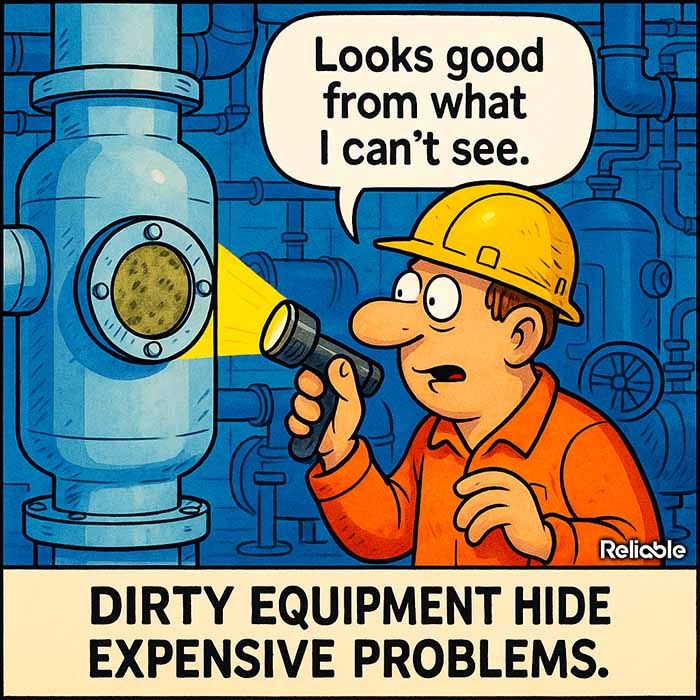

Dirty equipment hides problems. That statement sounds obvious, and it is, which makes it remarkable how many plants ignore it. Grease buildup, dust accumulation, oil leaks left to spread unchecked: all of it conceals the early warning signs that separate a planned repair from an emergency shutdown. Adopting equipment cleanliness best practices is one of the lowest-cost, highest-return moves a maintenance organization can make.
A technician inspecting a motor covered in grime can’t spot a cracked housing, a discolored terminal, or a weeping seal. The inspection becomes a formality. The checklist gets completed, the condition gets missed, and the failure that was detectable three months ago becomes a surprise at 2 a.m. on a holiday weekend.
Why Equipment Cleanliness Best Practices Start with Inspections
Clean equipment is inspectable equipment. Every layer of dirt, oil film, or product residue on an asset’s surface reduces the technician’s ability to identify defects during routine rounds.
The connection between cleanliness and reliability runs deeper than aesthetics. Consider what becomes visible on a clean machine:
- Oil leaks show their origin point instead of blending into a general mess.
- Crack propagation on housings and bases becomes visible before structural failure.
- Thermal discoloration on electrical connections signals resistance heating early.
- Loose fasteners reveal themselves through clean witness marks on mounting surfaces.
- Abnormal vibration analysis readings correlate more accurately when sensors mount on clean surfaces free of grease interference.
Japanese manufacturing formalized this principle decades ago through the first pillar of Total Productive Maintenance: Initial Cleaning. The concept treats the first deep clean of an asset as an inspection event, not a janitorial task. Technicians who clean equipment find defects. Consistently, reliably, and cheaply.
A clean machine tells you what’s wrong with it. A dirty machine keeps its secrets until they become expensive.
One packaging plant documented the results after implementing cleaning-based inspections on 40 critical assets. In the first 90 days, technicians identified 212 defects during cleaning rounds. Seventy-three of those defects were classified as safety or production-critical. Total cost of the cleaning program: $14,000 in labor and supplies. Estimated cost of the failures those defects would have caused: over $380,000.
Building a Cleaning Standard That Sticks
Equipment cleanliness best practices fail when they rely on general instructions like “keep equipment clean” without defining what clean means, how often cleaning happens, and who owns the task.
Effective cleaning standards specify four elements:
- Target condition: what does clean look like for this asset? Photographs of acceptable and unacceptable conditions remove ambiguity.
- Frequency: daily wipe-downs for high-contamination environments, weekly for moderate, monthly deep cleans for enclosed equipment.
- Responsibility: assign cleaning to operators (who see the equipment every shift) for routine tasks, and to maintenance for deep cleaning that requires lockout or partial disassembly.
- Inspection integration: every cleaning event includes a structured inspection checklist tied to known failure modes for that asset.
The operator ownership model works in plants with mature autonomous maintenance programs. Operators clean, inspect, and report. Maintenance responds to the defects operators find. This division of labor keeps equipment clean without pulling skilled technicians away from complex repairs.
Plants that resist operator involvement in cleaning typically cite skill concerns or union boundaries. Both are solvable. Operators already monitor their equipment visually every shift. Adding a structured cleaning step with a simple defect tag system requires minimal training and produces outsized results.
Accountability matters. Track cleaning compliance the same way you track PM completion rates. Post the results. Plants that treat cleaning as optional get optional results. Plants that treat it as a core maintenance activity see defect detection rates climb within weeks.
Contamination Control: Preventing the Problem at the Source
Cleaning equipment after it gets dirty is necessary. Preventing it from getting dirty in the first place is better. Contamination ingress through worn seals, missing covers, open breathers, and poorly maintained enclosures introduces particles that accelerate wear on bearings, gears, and hydraulic components.
A single gram of dirt in a hydraulic system can reduce component life by 50% or more. That statistic has been replicated across enough studies that it’s functionally settled science. Yet walk through most plants and you’ll find breather caps missing, inspection covers left open after maintenance, and seal replacements deferred because the leak “isn’t that bad yet.”
Contamination control costs pennies per asset. The damage it prevents costs thousands.
Simple interventions deliver the biggest returns: desiccant breathers on gearboxes and reservoirs, shaft seal replacements at the first sign of weeping, magnetic drain plugs to capture ferrous particles, and proper storage practices for spare parts so they arrive clean when installed.
Equipment cleanliness practices also protect condition monitoring investments. Infrared thermography produces unreliable readings through layers of dirt. Ultrasonic inspection loses sensitivity on contaminated surfaces. Oil sampling from systems with ingressed particles generates false positives that waste analyst time and erode confidence in the monitoring program.
Lubrication programs suffer especially hard from poor cleanliness. Contaminated oil is the leading cause of premature bearing failure in rotating equipment, responsible for more breakdowns than misalignment and imbalance combined. A clean fill, a clean breather, and a clean storage container eliminate the majority of contamination-related bearing failures before they start.
The return on cleanliness compounds quietly. Fewer contaminant-driven failures, more accurate inspections, longer component life, and a maintenance team that spots problems early instead of reacting late. The investment is minimal. The discipline is the hard part. But every plant that commits to it wonders why they waited so long to start.