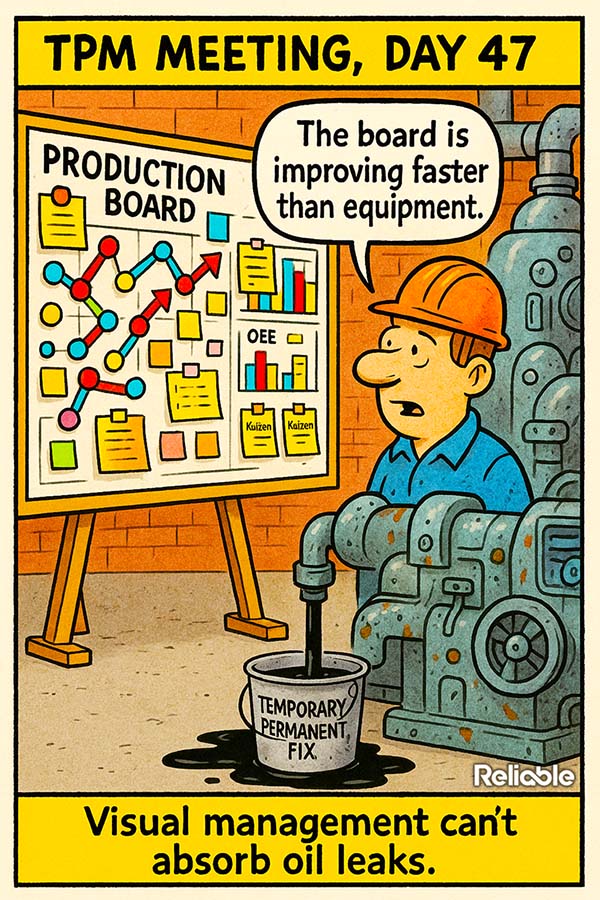

Most TPM rollouts start with energy, a few consultants, and a production floor covered in new whiteboards. Six months later, the boards are updated daily, the 5S audit scores look great, and the equipment is leaking just as much oil as it was before the kickoff meeting. Understanding why TPM programs fail requires looking past the visual artifacts and into the structural mistakes that undermine real progress.
TPM (Total Productive Maintenance) was designed to give operators ownership of basic equipment care while maintenance teams focused on higher-complexity work. The concept is sound. The execution goes sideways when organizations confuse the visible outputs of TPM (boards, checklists, meeting cadences) with the actual outcomes (improved equipment reliability and performance).
Why TPM Programs Fail at the Implementation Level
TPM failures rarely stem from a single catastrophic decision. They accumulate through a series of small compromises, each one seemingly reasonable, that together drain a program of any real impact.
The Visual Management Trap
Visual boards are a tool, one piece of a larger system. They become a problem when updating the board replaces working on the equipment. That substitution happens more often than anyone involved wants to admit.
Here’s how the pattern typically unfolds:
- Leadership launches TPM with a focus on visual management and daily team meetings
- The production floor gets boards, tags, color-coded labels, and standardized templates
- Teams spend 15 to 30 minutes per shift updating boards
- Supervisors evaluate TPM progress by how polished the boards look
- Equipment condition, the thing the boards are supposed to track, becomes secondary to board maintenance
The board becomes the deliverable, overshadowing the equipment condition it was designed to reflect.
Training Without Follow-Through
Most TPM rollouts include initial training: basic equipment care, cleaning routines, inspection checklists, tagging procedures. The training gets delivered, attendance gets tracked, and everyone goes back to the floor.
What’s usually missing is the closed loop. Operators identify defects during autonomous maintenance rounds, but the defects sit in a backlog that nobody reviews. Tags hang on equipment for months. The operators learn (quickly) that tagging a problem doesn’t lead to a fix, so they stop tagging.
Operators will do the inspections, the cleaning, the autonomous tasks. They won’t keep doing them indefinitely if nobody closes the loop on what they find.
This kills engagement faster than any other implementation mistake. A functional closed-loop system includes:
- A defined process for converting operator defect tags into CMMS work requests
- A maximum response time (e.g., 72 hours for non-critical, same shift for safety-related)
- Feedback to the operator who reported the defect: what was done, when, and why (or why not)
Ownership Without Authority
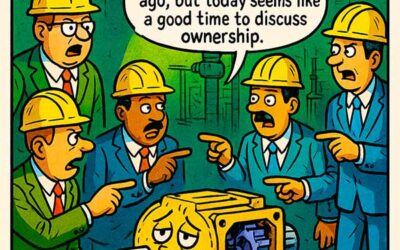
TPM asks operators to take ownership of their equipment. Ownership implies influence: the ability to get a bearing replaced before it fails, to stop a machine for a 30-minute repair before it becomes a 6-hour breakdown, to refuse to run equipment that shows obvious signs of deterioration.
In practice, most operators get the responsibility without the authority. They can tag a defect. They can fill out a form. They can mention it at the shift meeting. They can’t stop the line, can’t prioritize a repair, and can’t approve a parts purchase. The ownership is cosmetic.
Structural Reasons Why TPM Programs Fail Over Time
Even programs that launch well tend to degrade. The structural issues below explain most of the decline.
Competing Priorities and Production Pressure
TPM activities take time. Autonomous maintenance rounds, team meetings, 5S audits, and training sessions all compete with production output. When output targets tighten (and they always tighten), TPM activities are the first things cut.
The math feels obvious in the moment: skip the 15-minute inspection, run an extra cycle, hit the shift target. The long-term cost of skipped inspections takes months to materialize, arriving as an unplanned breakdown that costs 50 times what the inspection would have taken.
Organizations that treat TPM as optional when production pressure rises are telling the floor exactly how much they value the program. The floor listens.
No Connection to Maintenance Planning
TPM generates data: defect tags, inspection findings, operator observations about equipment condition. That data has real value, but only if it flows into the maintenance planning and scheduling process.
In too many plants, TPM data lives on whiteboards, in binders, or in a standalone spreadsheet that the planning team never sees. Operator findings don’t become work orders. Inspection results don’t inform the preventive maintenance schedule. The predictive maintenance strategy runs on vibration data and oil analysis while ignoring the operator who noticed the guard rattling two weeks ago.
When TPM data stays disconnected from the formal planning process, the program becomes a parallel system with no real influence on how maintenance work gets prioritized or executed.
When TPM data stays disconnected from the maintenance planning process, the program becomes a parallel universe with no influence on how work gets prioritized.
Bridging this gap requires deliberate integration: a clear path from operator observation to work request in the CMMS, and a planning team that treats operator data as a legitimate input alongside condition monitoring technology.
Measuring Activity Instead of Results
Programs that measure TPM by activity metrics (meetings held, boards updated, training hours completed, 5S audit scores) create the illusion of progress. Activity is visible. Results take longer to materialize and require different measurements entirely.
The metrics that matter for a TPM program are equipment-focused:
- Mean time between failures (MTBF) for equipment in the TPM scope
- Percentage of defect tags closed within 30 days
- Operator-identified defects per week (trending upward is good; it means people are actually looking)
- Reduction in unplanned downtime for TPM-covered assets
- Wrench time improvements for maintenance crews freed from reactive firefighting
If the only numbers improving are the activity metrics, the program is producing paperwork at the expense of reliability.
What Working TPM Programs Get Right
The plants where TPM delivers genuine results share a few common characteristics.
They close the loop on defects. Every operator-reported issue gets a response: scheduled for repair, deferred with explanation, or resolved on the spot. The feedback cycle stays intact.
They tie TPM data directly into the CMMS. Operator findings become work requests. Inspection data feeds the PM schedule. The planning team treats operator observations as a legitimate data source, on par with condition monitoring technology.
They protect TPM time from production pressure. The autonomous maintenance rounds happen every shift, even when output targets are tight. Leadership backs the time investment publicly and consistently.
They measure equipment outcomes alongside program activity. MTBF, downtime reduction, and defect closure rates drive the conversation.
Leadership’s Role in TPM Sustainability
Every failed TPM program has a leadership problem underneath it. The program launches with executive endorsement. The executive moves on to the next initiative. The plant manager stops asking about TPM in the weekly meeting. The supervisors notice. The operators notice faster.
Sustaining TPM requires visible, ongoing leadership engagement. That means plant managers who walk the floor and ask about defect closure rates. It means operations directors who track equipment reliability trends alongside production output. It means a budget process that funds the parts and labor needed to close defect backlogs within a reasonable timeframe.
The program consultant leaves after month three. If leadership leaves with them (mentally, if not physically), the program has an expiration date measured in weeks.
Rebuilding a Stalled TPM Program
If a TPM program has stalled or degraded into a visual management exercise, the recovery path starts with the equipment.
Pick three to five critical assets. Conduct an honest assessment of their condition. Catalog every open defect, every skipped PM task, every operator observation that went unaddressed. Fix the backlog first. Then rebuild the autonomous maintenance routines around those assets, with a commitment to close the loop on every finding within a defined timeframe.
Once the pilot assets demonstrate results, document what worked and what didn’t. Train the next wave of operators using real examples from the pilot. Build the expansion plan around the same closed-loop principles: every finding gets a response, every metric tracks equipment condition, every time commitment gets protected by management.
Expand only after the pilot assets show measurable improvement in reliability metrics. Scaling a broken process just produces more broken process across more equipment.
Understanding why TPM programs fail points to the same root cause in nearly every case: the program became about the program instead of about the equipment. Bringing the focus back to machine condition, operator empowerment, and closed-loop defect management is the path forward.