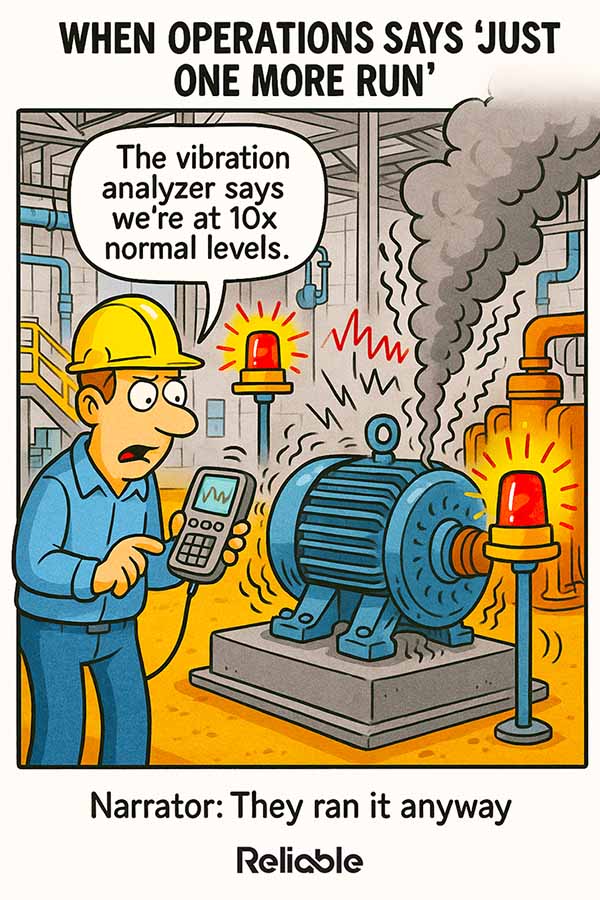

Every maintenance professional has heard it. The vibration readings are climbing. The analyzer is flashing warnings. And someone from operations walks over and says the five most expensive words in industrial reliability: “Let’s just do one more run.”
That phrase has launched a thousand catastrophic failures. It sounds reasonable in the moment. Production targets are real. Downtime costs money. But the math almost never works out the way operations thinks it will.
The Real Cost of “One More Run”
A 2022 study by the Society for Maintenance and Reliability Professionals found that unplanned downtime costs industrial plants an average of $260,000 per hour. Compare that to a planned shutdown, which typically runs 5% to 10% of that figure. The difference is staggering.
The gap between those two numbers is where “one more run” lives. It’s a bet with terrible odds, and the stakes get higher every minute the equipment keeps turning.
Unplanned downtime costs 10 to 20 times more than planned shutdowns. Every ‘one more run’ is a gamble against those odds.
When a vibration analyzer shows readings at 10 times normal levels, the equipment is telling you something urgent. Bearings are degrading. Shafts are misaligned. Rotors are out of balance. These conditions don’t plateau; they accelerate along an exponential curve.
The failure progression for rotating equipment is particularly treacherous. What looks like a gradual climb on a trend chart can become a catastrophic failure in hours, sometimes minutes. A bearing that’s been running hot for a week can seize in an instant, taking the shaft, coupling, and adjacent components with it.
And the collateral damage extends beyond the machine itself. A failed motor can send metal fragments into product lines, contaminate batches, and create safety hazards that shut down entire sections of a plant. The original repair that would have cost $15,000 during a planned outage can easily balloon to $500,000 or more once you factor in the cascade.
Why Operations Keeps Pushing
It’s easy to blame operations for ignoring data. But the root cause is usually systemic.
Most operations teams face relentless pressure to hit throughput targets. Their KPIs are built around uptime and output. Maintenance, on the other hand, gets measured on equipment reliability and repair costs. These incentives pull in opposite directions, and the tension plays out on the plant floor every day.
The result? A tug of war where the loudest voice (or the most senior title) wins. And that voice usually belongs to someone who won’t be writing the repair order when things go sideways.
When operations and maintenance KPIs conflict, the equipment always loses. Aligning incentives is the first step toward better decisions.
There’s also a powerful cognitive bias at work. If someone pushed past a warning last month and the equipment held up, that near miss becomes “evidence” that warnings are overblown. Psychologists call this normalcy bias. In reliability circles, it’s sometimes called running to failure on purpose, and it’s shockingly common.
Each successful gamble reinforces the behavior. The operations manager who ran past three warnings without incident now has a track record (in their mind) of knowing when to push and when to stop. Until the day the equipment doesn’t cooperate.
Breaking the Cycle
Plants that consistently avoid the “one more run” trap share a few common traits:
- Clear escalation protocols that define who has authority to override a shutdown recommendation, and what documentation that requires before the equipment keeps running.
- Shared KPIs between operations and maintenance teams, so both groups win or lose together based on total cost of ownership.
- Visible failure cost tracking posted where operations managers see it daily, showing the real price tag of every unplanned event.
These practices sound basic, and they are. But the gap between knowing them and implementing them consistently is where most plants fall short.
Vibration Data Doesn’t Lie
Modern vibration analysis tools can detect bearing defects weeks or months before failure. They pinpoint misalignment to within thousandths of an inch. They identify imbalance, looseness, resonance, and a dozen other fault conditions with remarkable accuracy.
The technology has never been better. The data has never been clearer. And yet the same conversation keeps happening on plant floors across every industry, from petrochemical to food processing to power generation.
The problem has always been what happens after the instruments deliver their verdict. Too many plants collect condition monitoring data religiously, then ignore it when production pressure mounts.
- Condition monitoring data should trigger automatic work orders at predefined severity thresholds, removing human hesitation from the equation entirely.
- Trend data should be reviewed in joint operations and maintenance meetings weekly, so both teams see the same trajectory and agree on next steps.
- Every override of a shutdown recommendation should require a signed risk acceptance form that enters the plant’s permanent record.
That last point tends to change behavior in a hurry. People make different decisions when their name is permanently attached to the outcome.
When every override requires a signature, the ‘one more run’ conversation gets a lot shorter. Accountability changes behavior.
The most effective plants treat condition monitoring data the way aviation treats cockpit warnings. You don’t negotiate with an engine fire light. You follow the procedure, every single time, regardless of schedule pressure.
Building a Culture That Listens
Technical solutions only work inside a culture that supports them. If a maintenance technician flags a critical vibration reading and gets overruled three times in a row, they’ll stop flagging. The data will still exist in the system, but no one will act on it.
Leadership sets the tone here. When a plant manager backs a maintenance recommendation over a production target, it sends a signal that ripples through the entire organization. When they don’t, that sends a signal too, and everyone on the floor notices.
The best reliability programs treat equipment health the same way they treat safety. You wouldn’t tell a worker to skip their fall protection harness for “just one more climb.” The pump, the motor, the compressor: they deserve the same respect.
Because that machine told you exactly what was coming. The vibration data was clear, the trends were unmistakable, and the recommended action was sitting in a work order. The only question is whether anyone was willing to listen before the bill came due.