
A critical pump goes down at 3 a.m. on a Tuesday. The maintenance team diagnoses the problem in 45 minutes: a failed mechanical seal. The repair itself would take two hours. There’s just one problem. The seal isn’t in stock.
What follows is a familiar nightmare. Phone calls to distributors. Emergency freight quotes. Production managers asking for ETAs every 30 minutes. The part arrives 72 hours later, and the plant has been limping along on a bypass that’s costing $40,000 a day in reduced throughput.
The seal costs $800.
The Real Price of an Empty Shelf
Spare parts management is one of those functions that nobody thinks about until it fails. When the storeroom has what you need, maintenance is just maintenance. When it doesn’t, maintenance becomes a logistics crisis with a production impact that dwarfs the cost of the missing part.
The math is brutal and consistent across industries. The cost of an unplanned outage typically runs between 10 and 50 times the cost of the part that caused it. A $200 bearing that’s not in stock when a motor fails can easily generate $20,000 in lost production before the replacement arrives. A $5,000 control valve that takes three weeks to procure can shut down a process unit that generates $100,000 per day.
The cost of carrying a critical spare is visible on a balance sheet. The cost of not carrying it shows up as a production disaster that everybody remembers and nobody budgeted for.
These numbers are real. Every plant has a collection of stories about the time a $300 part brought a million-dollar process to its knees. The stories are always told with a mix of frustration and dark humor, as if they were unpredictable events. They were predictable consequences of an inventory strategy that optimized for the wrong thing.
How Plants Get Spare Parts Wrong
Most spare parts programs fall into one of two failure modes, and some manage to hit both simultaneously.
Failure Mode One: The Bare Shelf
The first failure mode is under-stocking. This usually happens when spare parts inventory gets managed as a pure cost center. Someone in finance looks at the carrying cost of the storeroom, sees $2 million in parts sitting on shelves, and asks the obvious question: why are we tying up that much capital?
The answer, of course, is that those parts exist to prevent production losses that would cost 10 to 50 times their value. But that answer requires data, context, and a willingness to think about risk. It’s easier to set a blanket inventory reduction target and tell maintenance to make do.
- Critical spares get reclassified as non-stock items, requiring a purchase order for each withdrawal.
- Reorder points get lowered until stockouts become routine.
- Lead times get ignored. A part with a 16-week lead time gets managed the same way as a part available overnight from a local distributor.
- Insurance spares (expensive, rarely needed items like large motor rotors or transformer cores) get eliminated entirely because they haven’t been used in five years. The fact that they haven’t been needed is treated as evidence they’re unnecessary, rather than evidence that the equipment is still running.
The result is a storeroom that looks efficient on paper and fails in practice. Stockout rates climb. Emergency purchases increase. And those emergency purchases come with premium pricing, expedited freight charges, and the hidden cost of extended downtime while everyone waits.
Failure Mode Two: The Overloaded Warehouse
The second failure mode is over-stocking, and it’s often a reaction to the first. After a plant gets burned by a critical stockout, the pendulum swings. Maintenance starts hoarding parts. Every project leaves behind surplus material that gets absorbed into the storeroom without a plan. Vendors offer quantity discounts that sound appealing but create dead stock.
A storeroom stuffed with parts you don’t need is just as broken as one missing the parts you do. Both cost money. Only one of them looks tidy.
Over-stocked storerooms carry their own costs. Parts deteriorate on the shelf. Elastomers harden, lubricants separate, electronics become obsolete. You’re paying to store, insure, and manage inventory that will never be installed. And the clutter makes it harder to find the parts you actually need, which paradoxically leads to even more emergency purchases.
One large refinery audited its storeroom and found $4.5 million in parts that hadn’t moved in over five years. Some of those parts were for equipment that had been decommissioned a decade earlier. The carrying cost alone was over $300,000 annually.
Building a Critical Spares Strategy That Works
The solution isn’t complicated, but it requires a different way of thinking about inventory. Instead of managing spare parts as a cost to be minimized, manage them as insurance against production risk.
Start with a criticality analysis. Rank every piece of equipment by its consequence of failure: safety impact, environmental impact, production impact, and repair cost. This ranking determines which assets deserve critical spare coverage and which can tolerate longer procurement lead times.
- For critical assets (high consequence of failure, long lead time parts), carry spares on site. The carrying cost is a fraction of one unplanned outage.
- For important but non-critical assets, establish vendor agreements with guaranteed delivery windows. Know exactly how long it takes to get every key part, and build that lead time into your planning.
- For low-criticality assets, manage parts reactively. If a failure on this equipment doesn’t significantly impact production or safety, it’s acceptable to order parts after the failure occurs.
This tiered approach concentrates investment where it matters most and accepts calculated risk where the consequences are manageable.
The Procurement Bottleneck
Even the best storeroom strategy fails if procurement can’t execute. In many organizations, the purchase order process for maintenance parts is identical to the process for office supplies or raw materials. A $500 bearing for a critical pump goes through the same approval chain as a $500 order of printer paper.
The delays add up. A requisition sits in a queue for three days. Approval takes another two. The PO gets issued on day five. The vendor ships on day eight. Standard freight takes a week. What should have been a planned repair with a two-day lead time becomes a three-week wait, all because the procurement process doesn’t distinguish between critical maintenance parts and routine purchases.
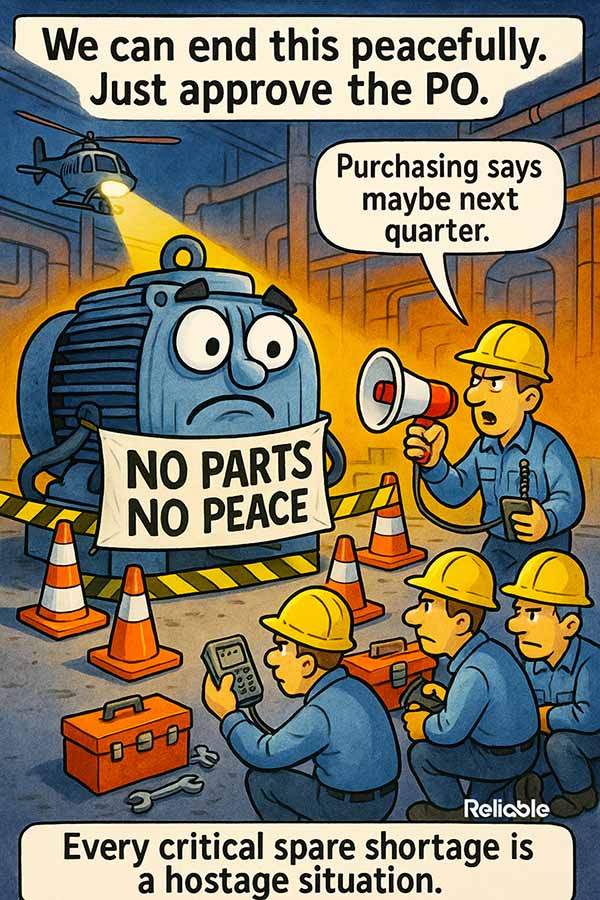
When purchasing treats a critical spare like a routine buy, every approval layer adds downtime. The procurement process should reflect the urgency that the equipment demands.
Fix this by creating a fast-track procurement path for critical maintenance parts. Pre-approved vendors, blanket purchase orders, delegated spending authority for the maintenance manager up to a reasonable threshold. The goal is to get critical parts ordered within hours, not weeks.
- Establish blanket POs with your top 10 parts suppliers. This eliminates the per-order approval cycle for routine maintenance purchases.
- Set a delegated authority threshold (say, $5,000) below which the maintenance manager can approve parts purchases without additional sign-off.
- Track procurement cycle time as a KPI. Measure the elapsed time from parts request to parts receipt for both planned and emergency orders. If your emergency procurement isn’t faster than your planned procurement, the process is broken.
Measuring What Matters
The metrics most plants use for spare parts management are incomplete. They track inventory value, turnover rate, and maybe stockout frequency. Those numbers are useful but insufficient.
Add these to the dashboard: production hours lost waiting for parts (this is the number that makes leadership pay attention), emergency purchase frequency and premium cost versus planned purchase cost, percentage of critical assets with identified and stocked critical spares, and procurement cycle time by urgency category.
When you can show that the plant lost 240 production hours last year waiting for parts that could have been on the shelf for a total carrying cost of $35,000, the conversation about inventory investment changes dramatically. The storeroom stops looking like a cost center and starts looking like what it actually is: production insurance.
Getting Started
You don’t need to overhaul your entire inventory system to make progress. Start with your top 20 failure modes by production impact. For each one, answer three questions. Do we have the parts needed to repair this failure? If not, how long does it take to get them? What does each hour of downtime cost while we wait?
Those three answers will tell you exactly where your spare parts strategy has gaps and exactly what those gaps are costing you. The investment case builds itself.
Spare parts management isn’t glamorous. It doesn’t trend on LinkedIn. It doesn’t win innovation awards. But when the call comes in at 3 a.m. and the right part is on the shelf, it’s the difference between a two-hour repair and a three-day crisis. That’s worth more than any cost reduction initiative your finance team has ever proposed.