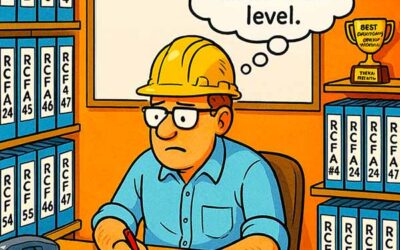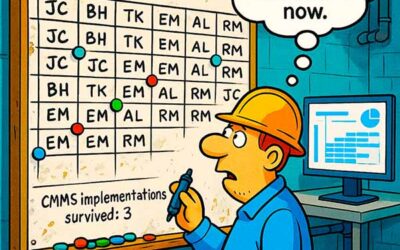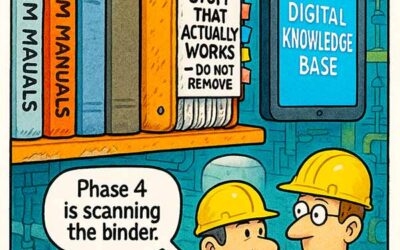
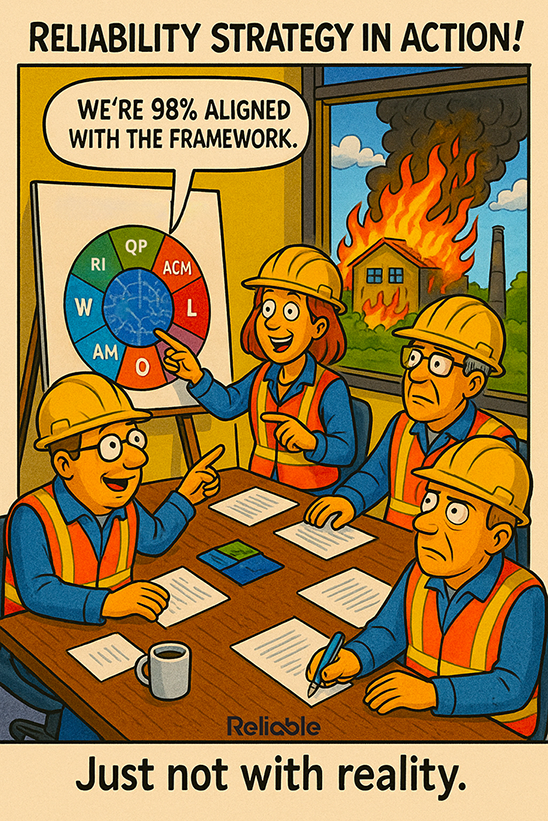

Every plant has a story that mirrors this cartoon: a confident reliability team reviewing a colorful framework chart while chaos unfolds outside the window. On paper, the program looks perfect, the metrics are green, the alignment is 98%, and the consultants have declared victory. Yet production is behind, assets are failing, and the maintenance team is exhausted.
That’s the paradox of reliability strategy implementation. Success in the meeting room doesn’t always translate to performance on the plant floor. The frameworks and models that promise alignment and excellence often collapse under the weight of real-world complexity.
A strategy that isn’t grounded in daily operations isn’t a strategy, it’s theater. And while frameworks can guide thinking, they must evolve to reflect the living system they aim to improve.
The Illusion of Framework Alignment
Organizations love measurable progress. It feels satisfying to declare, “We’re 98% aligned with the framework.” The charts look impressive, the scorecards glow green, and leadership sees movement. But alignment metrics can create a dangerous illusion, the belief that structure equals success.
Frameworks like TPM, RCM, and ISO 55000 are powerful because they provide order to complexity. Yet they can also lull teams into a compliance mindset. Meetings multiply, audits expand, and maintenance planners spend more time updating templates than solving root causes.
This “framework over function” syndrome erodes credibility. When frontline teams see leadership obsessing over slide decks while machines fail, cynicism takes root. Reliability becomes a paperwork exercise rather than an operational discipline.
Alignment is not an achievement. It’s only the starting point.
The objective measure of reliability strategy implementation isn’t how well the model is followed; it’s how much unplanned downtime disappears, how many failures are prevented, and how much capacity is reclaimed. Frameworks must bend to fit reality, not the other way around.
Metrics Without Meaning: The Dangerous Disconnect
KPIs are essential, but they can also distort priorities. Many organizations track maintenance compliance, PM completion, or asset health scores with impressive precision. Yet these metrics often fail to capture what matters most: whether the strategy actually improves reliability.
Consider a plant boasting 98% PM completion. If the PMs are poorly designed, irrelevant, or ignored by production, that statistic is meaningless. In effective reliability strategy implementation, metrics should validate real-world improvement, not bureaucratic motion.
High-level metrics must connect directly to operational truth:
- Mean Time Between Failures (MTBF) should rise because interventions are more innovative, not just because failures go unreported.
- Schedule compliance should reflect well-planned coordination, not last-minute firefighting.
- Framework maturity should mean higher uptime, not just thicker documentation.
When KPIs lose connection to the equipment’s story, decision-makers drift into a dangerous comfort zone. The plant looks “strategically mature”—until the following major breakdown exposes the fragility beneath the numbers.
To fix this, organizations must shift focus from counting activities to measuring consequences. Data should reflect behavior change, asset health, and process reliability, not administrative compliance.
Culture: The True Determinant of Reliability Strategy Implementation
Frameworks don’t execute themselves; people do. And if culture resists the strategy, no amount of alignment will deliver results.
A culture of firefighting, shortcutting, or “just get it running” will destroy even the most elegant reliability plan. The most significant barrier to effective reliability strategy implementation is not technical; it’s human. It’s the friction between maintenance and production, the absence of cross-functional accountability, and the tolerance for recurring problems.
Reliability demands a culture where everyone owns uptime.
- Leaders must connect reliability to business outcomes, productivity, profit, safety, and reputation.
- Maintenance teams must be empowered to challenge poor practices and schedule proactive work without resistance.
- Operations teams must share accountability, understanding that planned downtime prevents catastrophic unplanned downtime.
When leadership treats reliability as a shared mission, not a department initiative, it creates a self-reinforcing loop of improvement.
Culture isn’t soft; it’s a strategic infrastructure. Without it, the implementation of the reliability strategy becomes hollow. With it, every framework becomes a tool for continuous improvement rather than compliance theater.
Bridging the Gap Between Strategy and Execution
The bridge between the framework and the field is built through feedback, iteration, and validation. Real success in reliability strategy implementation comes from closing the loop between plans and outcomes, continuously learning from every success and failure.
Practical actions that convert strategy into sustainable results include:
- Field Testing Every Assumption – If your strategy recommends “monthly inspections,” verify that frequency through actual failure data and criticality analysis. Don’t let theoretical intervals define reality.
- Integrate Systems – Link your strategy to your CMMS, analytics platform, and digital dashboards so every work order, failure mode, and RCA feeds back into the framework.
- Use Failures as Feedback – Every unplanned downtime event should drive refinement. The best organizations treat every breakdown as a learning event, not a setback.
- Empower Frontline Insight – Operators, millwrights, and technicians often spot misalignments before analysts do. Their lived experience must inform the evolution of strategy.
- Keep Strategy Dynamic – Reliability isn’t static. As asset mix, production demand, and workforce skills evolve, your strategy must adapt. Static frameworks die; dynamic ones thrive.
This is how alignment becomes impact. When strategy lives, learns, and adapts, it becomes an operational force rather than an academic concept.
Leadership, Discipline, and Long-Term Thinking
Most reliability strategy implementations fail not because of technical missteps but because of leadership impatience. Reliability maturity requires years of disciplined behavior, accurate planning, precise execution, and continuous improvement. Yet executive expectations often run on quarterly timelines.
When leadership demands fast ROI, reliability programs are forced to produce visible wins, often at the expense of foundational change. Quick hits replace systemic reform.
The best leaders resist this pressure. They understand that reliability delivers compounding returns: reduced maintenance costs, increased throughput, extended asset life, and improved safety.
Strategic patience —the willingness to invest consistently and measure progress in years, not months —separates the organizations that look reliable from those that are.
Reality Always Wins
Every framework, no matter how sophisticated, eventually collides with reality, resource limits, cultural inertia, and operational chaos. When that happens, only flexible, feedback-driven reliability systems survive.
The goal isn’t to abandon frameworks; it’s to humanize them, to turn abstract models into living practices that guide behavior and decision-making. A framework is a compass, not a cage.
The organizations that thrive are those that turn reflection into action, and theory into practice, those that know reliability isn’t achieved through alignment alone, but through relentless adaptation to what’s real.
Because when the plant’s on fire, figuratively or literally, it doesn’t matter how pretty the framework looks. What matters is whether it works.