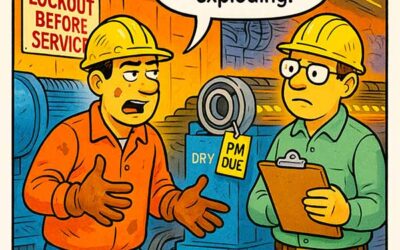


When RCM Becomes a Hammer and Everything Looks Like a Nail
The reliability-centered maintenance process (RCM) is one of the most transformative methodologies in modern maintenance strategy. It empowers teams to make data-driven decisions about how to maintain equipment based on its function, potential failures, and the consequences of those failures. Yet, when someone first learns about RCM, it often becomes a universal solution, applied to everything, from mission-critical turbines to light switches in the maintenance office.
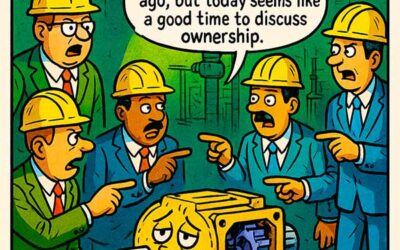
The cartoon above captures this perfectly. The well-intentioned engineer, clipboard in hand, insists that a light switch is a “critical asset” requiring a 47-step failure mode analysis. The humor lands because it’s true; many of us have been that person. Early enthusiasm for RCM can quickly devolve into obsessive analysis, where everything gets a criticality score and nothing gets done.
The irony? RCM was designed to simplify maintenance by aligning effort with risk. When applied indiscriminately, it does the opposite. The real challenge of mastering the reliability-centered maintenance process is knowing where to stop.
Understanding the Reliability-Centered Maintenance Process
The reliability-centered maintenance process emerged from the aviation industry in the 1960s, when airlines sought a structured method to ensure safety and reliability without unnecessary maintenance. Its brilliance lies in its focus on function. RCM doesn’t just ask, “How do we maintain this asset?” It asks:
- What are the functions and performance standards of this asset?
- How can it fail to fulfill those functions?
- What causes each failure mode?
- What happens when each failure occurs?
- How does the failure matter (safety, environment, production, cost)?
- What can be done to predict or prevent it?
- What if we can’t do anything about it?
Each question builds a logic chain that connects failure risk to practical maintenance actions. Done correctly, it ensures that every preventive task has a clear justification.
But here’s where many programs go wrong: they treat every asset as equally deserving of RCM analysis. The truth is that only a small percentage of plant assets merit full-scale RCM. Performing exhaustive FMEAs on every valve and sensor wastes time and resources that could be spent improving reliability on truly critical equipment.
An innovative organization uses a tiered approach: comprehensive RCM for high-risk systems, streamlined RCM for medium-risk assets, and simple preventive strategies for low-risk equipment.
The Hidden Cost of Overanalyzing Low-Criticality Assets
When the reliability-centered maintenance process is applied to everything, it becomes an exercise in bureaucracy rather than reliability. Teams spend weeks building massive spreadsheets filled with failure modes for assets whose failures have minimal consequences. Meetings drag on. Reports multiply. But equipment reliability doesn’t improve.
This “analysis paralysis” is a common trap. It happens when the drive for thoroughness overrides common sense. The cost of overanalyzing low-criticality assets includes:
- Resource waste: Skilled engineers spend time documenting non-critical systems instead of optimizing high-value assets.
- Decision fatigue: Endless data makes it harder to see meaningful insights.
- Delayed action: Maintenance improvements stall while teams debate trivial rankings.
- Demoralization: Field technicians disengage when analysis feels disconnected from real-world priorities.
The point of RCM is not to analyze everything. It’s to identify where failure matters most—safety, environment, production, or cost- and ensure maintenance actions align with those priorities. Everything else should follow simplified, standardized practices.
Remember: if the failure consequence is low, so should be the analytical rigor.
How to Right-Size Your RCM Implementation
Scaling the reliability-centered maintenance process correctly separates elite programs from inefficient ones. Successful practitioners understand that the value of RCM depends on proportionality—the right amount of analysis for the right level of risk.
Here’s how to achieve that balance:
Start with a criticality assessment.
Before launching into full RCM, assess the relative importance of each asset. Rank them by potential impact on safety, environment, production, and repair cost. The top 10–20% of assets should receive full RCM attention.
Adopt a tiered methodology.
- Tier 1: Full RCM and FMEA for high-criticality systems (e.g., compressors, turbines, main conveyors).
- Tier 2: Streamlined RCM or risk-based maintenance (RBM) for medium-criticality systems.
- Tier 3: Simplified PM optimization for low-criticality systems.
Leverage historical and condition data.
Historical reliability data, failure logs, and CMMS records can often provide enough insight to skip deep analysis. Let real-world evidence guide where deeper investigation is justified.
Train analysts in selective application.
Reliability engineers should be trained not only in analysis but also in restraint. The goal is actionable insight, not documentation for its own sake.
Review results periodically.
RCM is not static. Revisit analyses annually or after primary process changes to ensure the conclusions still hold.
This disciplined, risk-based approach preserves the power of RCM without letting it become administrative overkill.
What Are the Benefits of Vibration Analysis and Complementary Tools?
While the reliability-centered maintenance process provides the strategic framework, condition monitoring technologies bring it to life. Among these, vibration analysis is one of the most potent tools in predictive maintenance.
Here’s how these tools strengthen the RCM framework:
- Vibration Analysis: Detects imbalance, misalignment, bearing wear, and resonance before catastrophic failure occurs.
- Oil Analysis: Identifies contamination, oxidation, and wear metals that reveal hidden degradation trends.
- Thermography: Highlights hot spots, electrical imbalances, and insulation breakdowns invisible to the naked eye.
- Ultrasound Testing: Pinpoints air leaks, cavitation, and lubrication issues.
Integrating these technologies with RCM transforms it from a theoretical exercise into a living feedback system. Instead of relying solely on assumed failure modes, condition monitoring provides real data on how assets actually degrade over time.
This integration of predictive maintenance and RCM leads to fewer unplanned outages, better prioritization of work orders, and continuous improvement of maintenance plans. It’s not enough to know the reliability-centered maintenance process; you must energize it with real-time insights.
From Analysis Paralysis to Practical Reliability
True mastery of the reliability-centered maintenance process means knowing when to stop analyzing and start optimizing. RCM should never be a paperwork exercise; it should be a living system that informs decision-making and drives measurable performance.
When applied correctly, RCM enables organizations to:
- Reduce maintenance costs by eliminating unnecessary tasks.
- Improve uptime by focusing on high-risk failure modes.
- Enhance safety and environmental compliance.
- Increase stakeholder confidence through data-driven maintenance justification.
The cartoon’s humor masks a more profound truth: when learning RCM, it’s easy to overdo it. Real reliability professionals learn to balance enthusiasm with discipline. They know that not every valve, switch, or pipe fitting deserves an FMEA, and that simplicity, when guided by good data, can be just as powerful as complexity.
In the end, reliability excellence is achieved not through exhaustive documentation but through intelligent prioritization, measurable results, and continuous feedback. The goal isn’t to analyze every light switch in the plant; it’s to keep the lights on where they matter most.