Understanding the Reliability Centered Maintenance Methodology
The Reliability Centered Maintenance Methodology (RCM) remains one of the most misunderstood yet powerful reliability frameworks in industry. Initially developed for the aviation sector, RCM’s purpose is simple but profound: to determine what must be done to ensure that each physical asset continues to perform what its users require in its current operating context.
That phrase, in its present operating context, is what separates successful RCM implementations from hollow ones. When organizations treat RCM as a one-time project or compliance exercise, they end up documenting failure behavior rather than changing it. Teams fill out forms, record predictable failures, and congratulate themselves on being “data-driven.” But predictable failure is still failure. Reliability isn’t about forecasting the next breakdown; it’s about preventing it altogether.
Predictability might comfort management, but prevention transforms performance.
The Reliability Centered Maintenance Methodology isn’t just a tool for maintenance engineers. It’s a decision-making system for operations, engineering, and leadership. It defines functional requirements, determines criticality, evaluates failure consequences, and ensures maintenance strategies are both technically feasible and economically justified. When properly executed, it transforms maintenance from a reactive cost into a strategic advantage.
The Core Questions Behind Reliability Centered Maintenance
RCM begins with seven structured questions that guide maintenance teams from function definition to optimal task selection:
What are the asset’s functions and performance standards?
- In what ways can it fail to fulfill those functions?
- What causes each functional failure?
- What happens when each failure occurs?
- What are the consequences of each failure?
- What can be done to predict or prevent each failure?
- What should be done if a suitable proactive task cannot be found?
Each question forces precision. For example, describing a failure as “bearing wear” is vague. Describing it as “loss of pump discharge pressure due to bearing clearance exceeding design limits” makes it actionable. That distinction allows RCM to guide not just maintenance work but also design improvements, procurement decisions, and training priorities.
Common Pitfalls in RCM Methodology
Even organizations with strong reliability programs can misapply RCM. The most common pitfalls include:
- Over-documentation without insight.
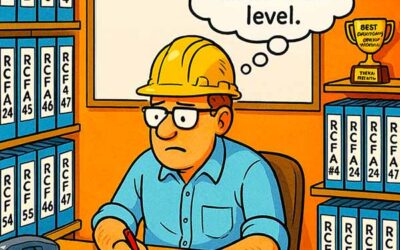
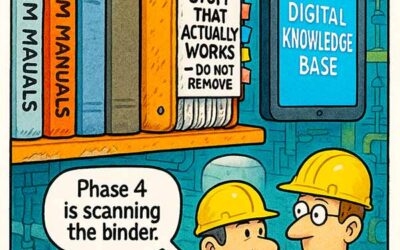
Teams often treat RCM as a paperwork exercise. Without connecting analysis to decision-making, RCM becomes a maintenance library instead of a reliability strategy. - Treating predictability as success.
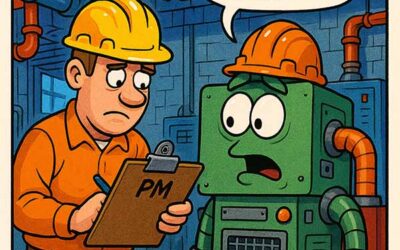
A pump that fails every six months on schedule isn’t reliable. It’s consistent in its failure. RCM aims to identify and remove the conditions that make that predictability possible. - Failure data without quality.
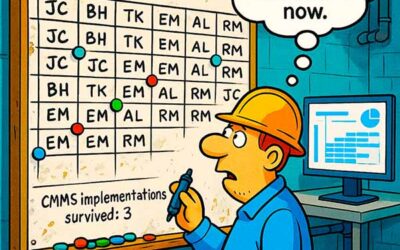
Many CMMS databases are filled with vague entries like “motor failure” or “seal leak.” The Reliability Centered Maintenance Methodology depends on precise data that distinguishes between primary, secondary, and latent causes. - Ignoring human error and operational stress.
Poor installation, rushed startup procedures, or inadequate lubrication practices can render even the best-designed maintenance strategy ineffective. - No link to risk.
Maintenance teams often focus on frequency rather than consequences. RCM prioritizes based on operational risk, downtime costs, and safety implications.
These pitfalls arise when organizations view RCM as a mechanical rather than a thinking process. The real value lies not in the forms or reports—but in the conversations and decisions they provoke.
Building a Function-Focused Reliability Culture
Successfully implementing the Reliability Centered Maintenance Methodology requires cultural alignment. Maintenance teams must evolve from “fixing equipment” to “preserving function.” That shift begins with redefining success.
- Define asset functions clearly. Without a clear statement of function, maintenance actions become guesswork.
- Establish measurable performance standards. Define “good performance” using quantifiable parameters such as flow rate, vibration limits, temperature thresholds, or energy efficiency.
- Engage cross-functional input. Operators, engineers, and technicians must collaborate on failure analysis. The person who runs the equipment daily often knows its weak points better than anyone.
- Align incentives with reliability outcomes. If production bonuses are tied only to output, reliability will always lose.
A function-focused culture means reliability is everyone’s job, not just the reliability engineer’s. Operators become the early warning system, planners become strategy architects, and leaders become accountability drivers.
Turning Failure Analysis Into Preventive Action
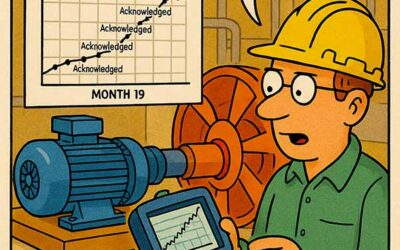
The cartoon’s humor—two scientists asking if a predictably failing toaster is “reliable”—illustrates the absurdity of data without discipline. In many plants, failure analysis stops at correlation: “This component fails every 500 hours.” True RCM goes deeper, exposing root causes and converting insight into measurable improvement.
Here’s how mature organizations operationalize the Reliability Centered Maintenance Methodology:
- Collect accurate, context-rich data. Record not just what failed, but how it failed, under what conditions, and what the consequences were.
- Perform structured analysis. Tools such as FMEA, fault tree analysis, and cause-and-effect diagrams reveal interactions between design, operation, and environment.
- Link findings to maintenance strategy. Every identified failure mode must correspond to a specific preventive, predictive, or corrective task.
- Quantify improvement. Use MTBF, OEE, and downtime cost avoided as proof that RCM is delivering business value.
- Close the feedback loop. When a failure recurs, revisit the original analysis. Either the task is ineffective, or the failure cause has evolved.
RCM isn’t a one-time study—it’s a continuous process of learning and refinement. The payoff is enormous: reduced downtime, lower maintenance costs, and a measurable increase in equipment reliability.
Integrating RCM With Modern Technology
The evolution of condition monitoring and AI-based analytics has given new life to the Reliability Centered Maintenance Methodology. What once relied on manual observation now integrates seamlessly with predictive technologies.
- Online condition monitoring detects early degradation through vibration, oil analysis, and thermography.
- Machine learning models identify patterns that humans miss, offering real-time failure probability forecasts.
- Digital twins allow engineers to simulate functional failures before they happen.
Yet technology alone doesn’t deliver reliability. Without the RCM framework, these tools become expensive noise. RCM defines why the data matters and how to act on it. When paired correctly, the result is an intelligent, self-improving reliability ecosystem.
Expanding Reliability Beyond Maintenance
A fully implemented Reliability Centered Maintenance Methodology drives transformation beyond the maintenance department. It informs asset design, spare parts management, energy efficiency, and even operator training.
- Engineering: Uses RCM findings to redesign chronic problem assets.
- Procurement: Selects components based on reliability performance, not just price.
- Training: Develops technicians based on identified failure patterns and knowledge gaps.
- Leadership: Uses reliability metrics as key business indicators, not maintenance KPIs.
When reliability becomes a strategic pillar, the organization stops treating downtime as usual and starts treating it as a design flaw. That mindset shift defines world-class performance.
The Real Goal: Reliability as a Competitive Advantage
The Reliability Centered Maintenance Methodology is not a cost. It’s a multiplier. Every failure prevented is capacity gained, risk reduced, and profit protected. Plants that master RCM achieve operational stability that competitors can’t easily replicate.
Predictability may seem like progress, but reliability is freedom. The freedom to produce on schedule, meet customer commitments, and reinvest savings into innovation. RCM is the method, but reliability is the mindset.
When organizations stop guessing and start diagnosing, the guessing ends, and so do the predictable failures.