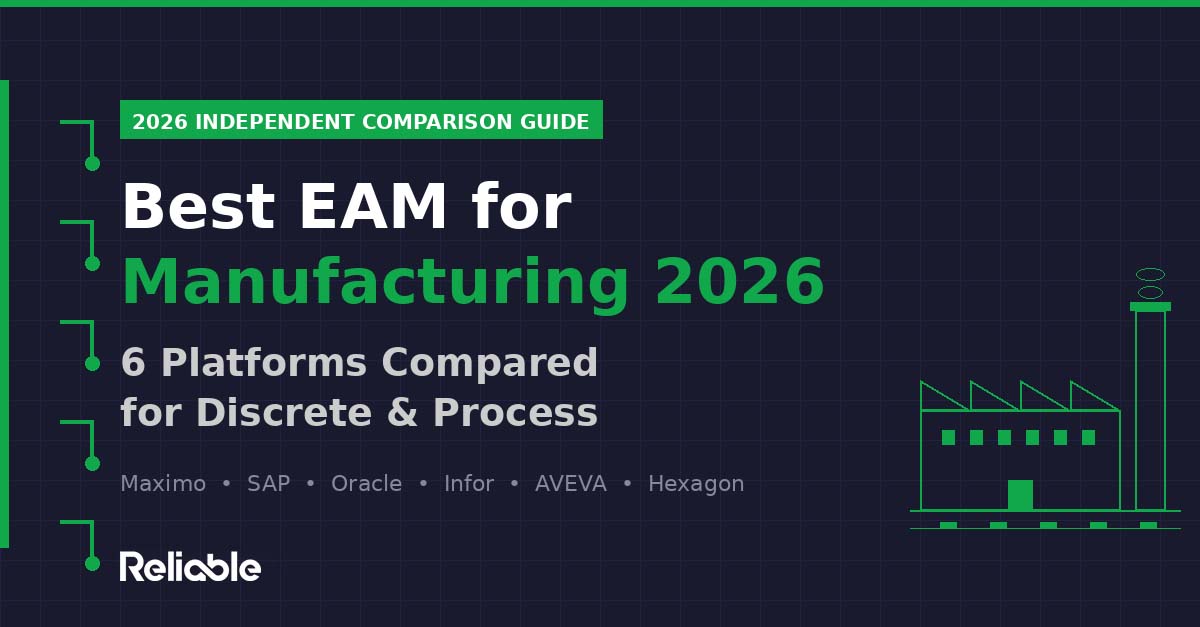

TL;DR: Manufacturing is the largest EAM vertical by buyer count and the most diverse, spanning discrete and process manufacturing across automotive, aerospace, food and beverage, pharmaceutical, electronics, chemicals, and consumer goods. IBM Maximo leads the category overall through breadth and platform maturity. SAP EAM and Oracle EAM are the natural choices for manufacturers standardized on those ERPs. Infor EAM is the strongest mid-market choice with deep industry-specific configurations. AVEVA leads process manufacturing specifically. Hexagon EAM serves asset-intensive manufacturing like automotive assembly and heavy industry. Choose based on manufacturing mode, industry, scale, and ERP environment – not on horizontal EAM rankings that ignore manufacturing context.
How We Evaluated
This guide is independent editorial analysis based on publicly available product documentation, analyst reports from Gartner and IDC, verified customer reviews across G2 and Capterra, and hands-on product demonstrations. Reliable Magazine does not sell EAM software and has no commercial interest in routing buyers toward any particular platform. Reliable does not accept payment for rankings. Vendors may sponsor enhanced listings with additional detail, but editorial rankings are independent. Read our editorial policy.
We evaluated each platform across six criteria that matter most for manufacturing EAM decisions:
- Manufacturing mode fit – depth of functionality for discrete, process, batch, or hybrid manufacturing operations
- Industry-specific capabilities – vertical strength for automotive, aerospace, food and beverage, pharmaceutical, chemicals, and other manufacturing segments
- ERP integration – native or near-native connectivity to SAP, Oracle, and other manufacturing ERPs
- MES and production system integration – connectivity with manufacturing execution systems and production data
- Compliance and regulatory support – built-in support for FDA, ISO, FSMA, and industry-specific regulatory requirements
- Implementation and total cost of ownership – realistic deployment timelines and full-lifecycle costs at manufacturing scale
Why Manufacturing EAM Is Different
Manufacturing is the most diverse EAM vertical, and that diversity is the central challenge in selecting the right platform. A discrete automotive assembly plant has fundamentally different EAM requirements than a continuous chemical processing facility. A pharmaceutical operation under FDA validation has different needs than a food and beverage plant under FSMA. A small contract manufacturer has different needs than a global aerospace OEM. The same vendors often serve all these segments, but the configurations, modules, and implementation approaches differ significantly enough that vendor choice matters.
The other defining characteristic of manufacturing EAM is the relationship between assets and production. In utilities, assets ARE the business – a transmission line is the product. In manufacturing, assets enable the business – equipment exists to produce products. This means manufacturing EAM has to integrate tightly with production systems (MES, ERP production planning) in ways that other EAM verticals do not. Asset downtime in manufacturing immediately affects production schedules and customer commitments, which makes the integration between EAM and production planning systems a core selection criterion rather than a nice-to-have.
The third characteristic is regulatory diversity. Different manufacturing industries face very different regulatory regimes. Pharmaceutical and medical device manufacturing under FDA validation has documentation and audit trail requirements that horizontal EAM platforms struggle to meet. Food and beverage under FSMA has traceability and sanitation requirements. Automotive has IATF 16949 quality management requirements. Aerospace has AS9100. Each driver pushes toward different EAM capabilities, and the right platform depends heavily on which regulatory regime the operation actually faces.
The 7 Best EAM Platforms for Manufacturing in 2026
1. IBM Maximo – Best for Global Manufacturing Enterprises
IBM Maximo is the leading EAM platform for manufacturing in 2026, and the natural choice for global manufacturing enterprises that need broad horizontal capabilities across diverse manufacturing modes and industries. The Maximo Application Suite (MAS) integrates IoT, AI-driven predictive maintenance, APM, and asset health into a unified platform, which gives manufacturers capabilities beyond traditional EAM that are increasingly important as Industry 4.0, smart factory, and digital transformation initiatives mature.
Manufacturing is Maximo’s strongest single vertical, with deployments spanning automotive (every major OEM has Maximo somewhere in its operations), aerospace, food and beverage, pharmaceutical, chemicals, electronics, and consumer goods. The platform handles discrete, process, and hybrid manufacturing operations through configurable modules and industry-specific add-ons. The trade-offs are typical of enterprise EAM: implementations are major projects requiring experienced systems integrators, the platform requires substantial in-house expertise to configure properly, and total cost of ownership is significant. For manufacturers with the scale and complexity to need Maximo’s capabilities, the platform is the safest choice.
Best for: Global manufacturing enterprises, multi-site operations across diverse manufacturing industries, organizations needing integrated APM and IoT capabilities through Maximo Application Suite.
Pricing: Custom enterprise quotes; per-user costs typically start at $100+ per user per month with substantial implementation costs.
2. SAP EAM – Best for SAP-Standardized Manufacturers
SAP EAM is the natural choice for manufacturers standardized on SAP S/4HANA, which represents a substantial share of the global manufacturing market – particularly in Europe, Asia, and among major multinational manufacturers. The integration with SAP financials, procurement, supply chain, and production planning is native rather than bolted on, which means asset records, work orders, parts, and financial transactions flow through a single source of truth alongside production data.
For manufacturers, SAP EAM’s strength goes beyond financial integration. SAP S/4HANA’s production planning, materials management, and quality management modules connect natively to SAP EAM, which enables maintenance planning that respects production schedules, parts availability that reflects inventory reality, and quality data that ties back to specific equipment and production runs. This level of integration is genuinely difficult to achieve when EAM and ERP are separate platforms. SAP EAM is rarely the right choice for manufacturers not standardized on SAP, but for SAP-aligned manufacturers, the integration economics frequently make it the best total cost of ownership choice.
Best for: Manufacturers standardized on SAP S/4HANA, multi-site manufacturing enterprises needing single-platform integration of production, financial, and asset management.
Pricing: Custom enterprise quotes; typically tied to broader S/4HANA licensing and deployment.
3. Oracle EAM – Best for Oracle-Standardized Manufacturers
Oracle EAM (delivered through Oracle Cloud SCM Maintenance) is the parallel choice to SAP EAM for manufacturers standardized on Oracle ERP. The platform offers native integration with Oracle Cloud SCM, Financials, manufacturing modules, and HCM, which makes it the natural EAM extension of an Oracle environment. Oracle has invested significantly in modernizing the platform with cloud-native architecture, and current customer experience is meaningfully improved over older on-premise Oracle EAM deployments.
The same logic applies as with SAP: Oracle EAM is the right choice when you are committed to the Oracle ecosystem, and a less compelling choice when you are not. Oracle’s manufacturing customer base skews toward specific industries – process manufacturing, life sciences, consumer goods – where Oracle ERP has strong penetration. For manufacturers in these industries with existing Oracle investments, Oracle EAM is often the path of least resistance.
Best for: Manufacturers standardized on Oracle Cloud SCM and Oracle ERP, particularly in process manufacturing, life sciences, and consumer goods.
Pricing: Custom enterprise quotes; typically tied to broader Oracle Cloud licensing.
4. Infor EAM – Best for Mid-Market Manufacturing
Infor EAM is the strongest choice for mid-market manufacturers – operations with one to a handful of facilities, hundreds to a few thousand assets, and limited bandwidth for major IT implementations. What sets Infor EAM apart in manufacturing specifically is the depth of industry-specific configurations. Infor has built specialized configurations for food and beverage manufacturing (with strong FSMA compliance support), healthcare and medical device manufacturing, consumer goods, and other manufacturing segments. These configurations deploy faster than custom-configured Tier 1 platforms while still delivering genuine EAM functionality rather than upper-tier CMMS capabilities.
The trade-off is depth at the largest manufacturing scale. For a global Fortune 500 manufacturing deployment, Infor EAM lacks some of the multi-geography, multi-language, and ultra-complex hierarchy capabilities that Maximo provides. For mid-market manufacturing – operations with hundreds to a few thousand assets across modest multi-site footprints — Infor EAM often delivers better total cost of ownership than the larger platforms while still supporting the full asset lifecycle management that distinguishes EAM from CMMS.
Best for: Mid-market manufacturing, food and beverage manufacturers, healthcare and medical device manufacturers, consumer goods manufacturers needing genuine EAM with lower implementation overhead than Maximo, SAP EAM, or Oracle EAM.
Pricing: Custom enterprise quotes; generally lower than Tier 1 platforms at comparable scale.
5. AVEVA Asset Management – Best for Process Manufacturing
AVEVA’s Asset Management capabilities (delivered through AVEVA Asset Performance Management and the AVEVA PI System) are positioned specifically for process manufacturing – chemicals, pharmaceutical bulk manufacturing, food and beverage processing, pulp and paper, and similar verticals where operational technology and process control systems are central to operations. The platform’s strength is the integration between asset management, process data historians, and operational technology, which gives process manufacturers operational visibility that horizontal EAM platforms cannot match.
AVEVA is genuinely best-in-class for process manufacturing and notably weaker outside it. Discrete manufacturing – automotive, aerospace, electronics – gets little benefit from AVEVA’s process integration depth and would be better served by Maximo or platforms designed for discrete operations. Process manufacturers with deep AVEVA investments (PI System, Plant SCADA, control systems) should evaluate AVEVA Asset Management as the natural extension of existing infrastructure. Process manufacturers without existing AVEVA investments face a more complex evaluation since the value proposition depends on the broader OT integration.
Best for: Chemicals, pharmaceutical bulk manufacturing, food and beverage processing, pulp and paper, and other process manufacturing operations needing integrated operational technology and asset management.
Pricing: Custom enterprise quotes; typically deployed as part of broader AVEVA portfolio investments.
6. Hexagon EAM – Best for Asset-Intensive Manufacturing
Hexagon EAM serves a specific segment of manufacturing where its asset hierarchy depth and facility-scale management capabilities offer real advantages — automotive assembly plants, heavy industry, large fabrication facilities, and other operations where the manufacturing facility itself is asset-intensive. The platform’s strength in asset hierarchy modeling, condition tracking, and integration with geospatial systems serves these operations better than horizontal EAM platforms designed for distributed multi-site deployments.
Hexagon’s manufacturing positioning is narrower than its utilities or oil and gas presence. The platform is rarely the right choice for typical mid-market manufacturing or for distributed multi-site manufacturing where SAP EAM or Maximo offer better fit. For automotive OEM assembly plants, heavy industry, large fabrication operations, and similar asset-intensive manufacturing environments, Hexagon’s specialized capabilities can justify the more limited horizontal flexibility.
Best for: Automotive assembly plants, heavy industry, large fabrication facilities, asset-intensive manufacturing operations needing deep asset hierarchy and facility-scale management.
Pricing: Custom enterprise quotes; competitive with Maximo at comparable manufacturing scale.
7. MaintainX – Best for Mid-Market Maintenance Execution
Below the roughly 1,000-asset threshold, the mid-market CMMS failure mode is rarely missing features, it is unused ones. MaintainX is one of the platforms occupying that middle ground with a mobile-first design that puts work orders, PMs, assets, parts, and purchase orders in the hands of technicians on the floor rather than at a shared desktop. When frontline teams log work on their phones as it happens, asset history stays accurate enough to support PM tuning, parts forecasting, and eventually IIoT-driven condition monitoring. MaintainX customers report a 98% adoption rate and a 32% reduction in unplanned downtime, the numbers that determine whether a CMMS is actually running the plant or just recording it.
Best for: Mid-market manufacturers and multi-site operators that need strong maintenance execution and reliability outcomes without a multi-year EAM rollout.
Pricing: Published per-user tiers, with typical deployments in weeks rather than months.
Manufacturing EAM Platform Comparison Table
| Platform | Best For | Manufacturing Mode | Industry Strength |
|---|---|---|---|
| IBM Maximo | Global manufacturing enterprises | Discrete, process, hybrid | All major industries |
| SAP EAM | SAP-standardized manufacturers | Discrete, process, hybrid | Multinational manufacturing |
| Oracle EAM | Oracle-standardized manufacturers | Discrete, process | Process, life sciences, consumer goods |
| Infor EAM | Mid-market manufacturing | Discrete, process | F&B, healthcare, consumer goods |
| AVEVA | Process manufacturing | Process, batch | Chemicals, pharma, F&B processing |
| Hexagon EAM | Asset-intensive manufacturing | Discrete, heavy industry | Automotive assembly, heavy industry |
| MaintainX | Mid-market maintenance execution | Discrete, process (CMMS) | Cross-industry mid-market |
How to Choose the Right Manufacturing EAM Platform
Manufacturing EAM platform selection comes down to four questions that matter more than feature comparison:
1. What kind of manufacturing do you actually do?
Discrete manufacturers – making distinct units (cars, electronics, packaged goods) – are best served by Maximo, SAP EAM, Oracle EAM, or Hexagon EAM depending on scale and ERP environment. Process manufacturers – making continuous flows or batches (chemicals, pharma, food and beverage) – should evaluate AVEVA seriously alongside Maximo and the ERP-aligned options. Hybrid operations should focus on Maximo or SAP EAM, both of which handle hybrid environments better than vertical specialists.
2. What is your existing ERP environment?
Manufacturers standardized on SAP S/4HANA should evaluate SAP EAM seriously regardless of manufacturing mode – the integration economics with production planning, materials management, and quality management are usually compelling. Manufacturers standardized on Oracle should evaluate Oracle EAM. Manufacturers running multiple ERPs or mid-market manufacturers without a dominant ERP have more flexibility and should choose based on manufacturing-specific functional fit rather than ERP alignment.
3. What industry are you in specifically?
Pharmaceutical and medical device manufacturers under FDA validation should evaluate Maximo, SAP EAM, and Oracle EAM as the strongest candidates given their compliance capabilities. Food and beverage manufacturers should add Infor EAM (with FSMA-specific configurations) and AVEVA (for process operations) to that list. Automotive manufacturers should evaluate Maximo, SAP EAM, and Hexagon EAM. Aerospace manufacturers should focus on Maximo and SAP EAM given their AS9100 capabilities. Each industry has its own strongest fit within the broader category.
4. What scale are you actually operating at?
Global manufacturing enterprises with thousands of assets across dozens of sites need Tier 1 platforms – Maximo, SAP EAM, or Oracle EAM. Mid-market manufacturers with hundreds to a few thousand assets often get better value from Infor EAM. Smaller manufacturers with one or two facilities and a few hundred assets often get better value from a strong CMMS than from any EAM platform. Read our CMMS vs EAM explainer if you are uncertain which category fits your operation.
The Honest Middle Ground
Manufacturing is the EAM vertical where overbuying is most common. Vendor sales processes consistently push manufacturers toward larger, more complex platforms than they actually need, because EAM deals are large and incentives align with selling more. Many mid-market manufacturers end up with Maximo or SAP EAM deployments that take three years to roll out, cost millions, and deliver functionality that Infor EAM or even a strong CMMS would have provided in months at a fraction of the cost.
The opposite mistake is real for genuine enterprise manufacturers. Global multi-site operations with thousands of assets, complex regulatory environments, and finance-driven asset accountability sometimes try to use upper-tier CMMS instead of EAM, ending up with maintenance teams in CMMS, finance teams in spreadsheets, and procurement teams in ERP. The cost of that fragmentation is invisible but enormous, and recovering from it requires the EAM migration that should have happened initially.
The right answer is honest assessment of manufacturing mode, industry, scale, and ERP environment. Talk to peer manufacturers of similar size and operational profile, not just the largest manufacturers in your industry. The buyer who selects manufacturing EAM based on what global enterprises use will frequently select an overengineered platform for their actual operation.
Frequently Asked Questions
What is the best EAM software for manufacturing in 2026?
IBM Maximo leads the manufacturing EAM category in 2026 with the broadest industry coverage and deepest integration through Maximo Application Suite. SAP EAM is the natural choice for manufacturers standardized on SAP S/4HANA, which represents a substantial share of the global manufacturing market. Oracle EAM serves Oracle-standardized manufacturers. Infor EAM is the strongest mid-market choice with deep industry-specific configurations. AVEVA leads process manufacturing specifically. Hexagon EAM serves asset-intensive manufacturing operations like automotive assembly and heavy industry.
How is manufacturing EAM different from MES?
EAM (Enterprise Asset Management) manages the full lifecycle of manufacturing assets — production equipment, facility infrastructure, and supporting systems – including procurement, depreciation, maintenance, and end-of-life decisions. MES (Manufacturing Execution System) manages production execution on the shop floor – work orders, machine data, quality, traceability, and operator instructions in real time. EAM keeps the equipment running through its lifecycle. MES uses the equipment to make products. They are complementary systems that integrate with each other, and most manufacturing operations need both.
Do discrete and process manufacturers need different EAM software?
Yes, often. Discrete manufacturers – making distinct units like cars, electronics, packaged goods – typically benefit from EAM platforms with strong work order execution, asset hierarchy depth, and integration with discrete manufacturing systems. IBM Maximo, SAP EAM, and Oracle EAM all serve discrete manufacturing well. Process manufacturers – making continuous flows or batches like chemicals, pharma, food and beverage – benefit from EAM platforms with operational technology integration, batch production support, and process plant asset management. AVEVA Asset Management is specifically designed for process manufacturing. Hybrid operations should evaluate Maximo or SAP EAM, both of which handle hybrid environments better than vertical specialists.
Which EAM platform integrates best with manufacturing ERP?
ERP integration depth is the single most important factor in manufacturing EAM selection. SAP EAM has native integration with SAP S/4HANA and is the best choice for SAP-standardized manufacturers. Oracle EAM has native integration with Oracle Cloud SCM and is the best choice for Oracle environments. IBM Maximo, Infor EAM, AVEVA, and Hexagon EAM all offer strong integration with major ERPs but require middleware or custom development that ERP-aligned EAM does not. For pure SAP or Oracle environments, the ERP-aligned EAM is the path of least resistance.
How much does manufacturing EAM software cost?
Manufacturing EAM platforms are typically priced for enterprise deployments and rarely publish public pricing. Per-user costs often start at $100 per user per month for Tier 1 platforms like IBM Maximo, SAP EAM, and Oracle EAM, with implementation costs ranging from mid six figures for mid-market deployments to seven figures or more for global manufacturing enterprises. Implementation timelines typically run 12 to 24 months for major rollouts. Mid-market platforms like Infor EAM offer more accessible entry points but enterprise manufacturing deployments still require six-figure implementation budgets.
Should mid-market manufacturers use EAM or upgrade their CMMS?
Most mid-market manufacturers – operations with one to a handful of facilities and dedicated maintenance teams – get better value from a strong CMMS than from EAM. Modern CMMS platforms like MaintainX, Limble, UpKeep, Fiix, and eMaint have absorbed capabilities that used to be exclusive to EAM, including multi-site management, asset hierarchies, and ERP integration. Manufacturing operations should consider EAM when complexity, multi-site scale, and finance-driven asset accountability genuinely outgrow what a CMMS can provide. The dividing line is typically around 1,000 assets and five sites – below that, modern CMMS is usually sufficient.
Related Guides
- Best EAM Software 2026: Independent Comparison of 6 Platforms
- Best EAM Software for Utilities 2026
- Best EAM Software for Oil and Gas 2026
- Best MES Platforms for Manufacturing 2026
- Best ERP Systems for Manufacturing 2026
- CMMS vs EAM: What’s the Difference, and Which One Do You Need?
- Best CMMS Software 2026: Independent Comparison of 7 Platforms
Sources
- IBM Maximo Application Suite product documentation — ibm.com/products/maximo
- SAP S/4HANA Asset Management documentation — sap.com
- Oracle Cloud SCM Maintenance documentation — oracle.com
- Infor EAM product documentation — infor.com
- AVEVA Asset Performance Management documentation — aveva.com
- Hexagon EAM product documentation — hexagon.com
- MaintainX product documentation — getmaintainx.com
- Gartner Magic Quadrant for Enterprise Asset Management Software
- IDC MarketScape for Enterprise Asset Management
- G2 and Capterra verified customer reviews (April 2026)
- Reliable Magazine independent product demos and editorial analysis
Last updated: August 3, 2026. This guide is editorial analysis by Reliable Magazine. No vendor paid for ranking consideration or editorial input.