
Dirt is patient. It accumulates one layer at a time, without fanfare, without a work order, without showing up on a vibration report. By the time the motor overheats, the bearing seizes, or the heat exchanger chokes, the damage has been compounding for months. Understanding how to prevent equipment contamination buildup is one of the simplest ways to extend asset life, and one of the most commonly ignored.
Most plants have cleaning somewhere in their PM program. The problem is where it sits: at the bottom. Cleaning tasks get bumped, deferred, or dropped entirely when the schedule gets tight. That makes sense in the moment (you’ve got real work to do), but it creates a slow-motion reliability problem that compounds over months and years.
Why Contamination Buildup Destroys Equipment Faster Than You Think
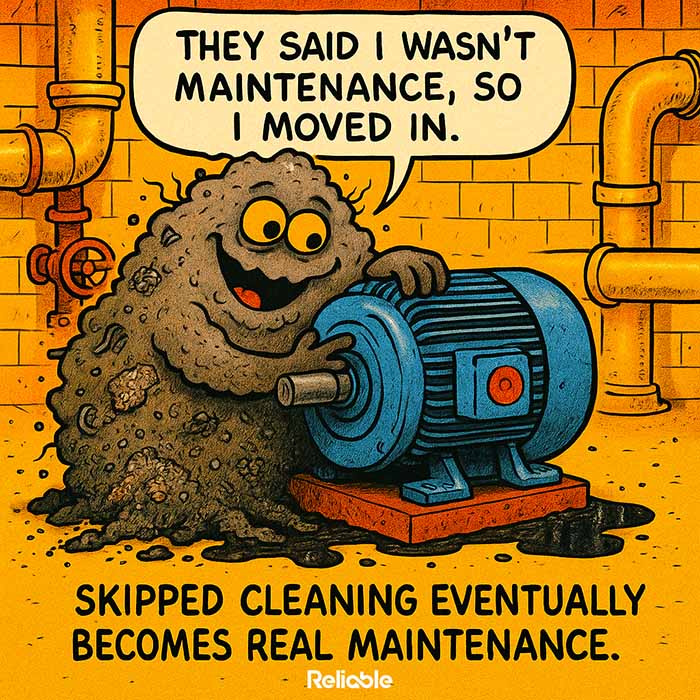
The physics here are straightforward. Contamination acts as an insulator. A motor caked in dust and grime can’t dissipate heat properly. Internal temperatures climb. Winding insulation degrades faster. The motor’s useful life shortens by years, all because nobody wiped it down.
The same principle applies across asset classes. Hydraulic systems ingest particles through worn seals and breathers, accelerating wear on pumps and valves. Heat exchangers lose efficiency as fouling builds on tube surfaces. Gearboxes running in contaminated oil see accelerated tooth wear and pitting.
A 0.002-inch layer of grime on a motor housing can raise operating temperature by 10°C, cutting insulation life nearly in half.
The link between contamination and failure is well documented. Contamination ingress remains one of the leading contributors to premature equipment degradation across industries. The frustrating part is that most of this damage is entirely preventable with consistent cleaning and basic exclusion strategies.
The Hidden Cost of Deferred Cleaning
When a cleaning task gets skipped, nothing dramatic happens. The motor still runs. The gearbox still turns. That lack of immediate consequence is exactly what makes contamination so dangerous.
Consider a facility running 200 electric motors. If contamination-related overheating shortens average motor life by even 15%, that’s dozens of premature replacements over a five-year window. Add in unplanned downtime, emergency labor, and expedited parts, and the real cost of skipping cleaning starts to look enormous.
Studies by the Electric Power Research Institute have found that thermal stress (often driven by inadequate cooling from surface contamination) accounts for roughly 30% of motor winding failures in industrial settings. That’s a large slice of the failure pie driven by something a rag and a schedule could address.
The numbers get worse for hydraulic systems. Contaminated oil accelerates internal component wear by factors of three to five compared to clean systems operating at ISO 4406 target levels. A hydraulic pump rated for 20,000 hours of service might last barely 5,000 when oil cleanliness standards slip. That’s real money: $8,000 to $12,000 per pump, plus the production loss while you wait for a replacement.
How to Prevent Equipment Contamination Buildup in Your Facility
Getting serious about contamination control requires more than adding “clean motor” to a PM checklist. It takes a systematic approach that addresses sources, frequency, and accountability.
Start with a contamination source audit. Walk the plant floor and identify where contamination originates:
- Airborne dust from raw material handling, grinding, or outdoor exposure
- Fluid leaks from hydraulic lines, lubrication systems, or process piping
- Moisture intrusion through damaged seals, open breathers, or condensation in enclosures
- Process byproducts like chemical overspray, metal fines, or cooling mist
Once you know where the contamination comes from, you can prioritize which assets need the most attention. A motor in a clean control room and a motor next to a crusher have very different cleaning requirements.
This risk-based approach prevents the most common mistake in contamination control: treating every asset the same. A blanket “monthly cleaning” schedule wastes effort on equipment in clean environments while under-serving the ones that need weekly attention. Match the frequency to the exposure, and the labor investment starts paying real dividends.
The best contamination prevention programs set cleaning frequency by exposure level, not by equipment type alone.
Next, build cleaning into your maintenance planning with the same discipline you’d give any other PM task. That means:
- Assigning specific cleaning methods per asset (compressed air, solvent wipe, pressure wash, or vacuum)
- Setting frequency based on environment severity rather than arbitrary calendar intervals
- Tracking completion with the same rigor as any other scheduled task
- Defining acceptance criteria so technicians know what “clean” actually looks like
Plants that take autonomous maintenance seriously tend to handle this well. Operator-driven cleaning and inspection routines catch contamination buildup early, before it reaches the point of causing measurable damage.
Sealing and Exclusion Strategies
Cleaning is reactive by nature: you’re removing contamination that already arrived. The better long-term strategy for preventing equipment contamination buildup is keeping it out in the first place.
Practical exclusion measures include:
- Upgrading breathers on gearboxes and hydraulic reservoirs to desiccant-style units
- Replacing standard lip seals with labyrinth or bearing isolator seals on critical rotating equipment
- Installing filtration on hydraulic and lube oil systems rated to the OEM’s cleanliness targets
- Enclosing or shielding equipment in high-exposure areas
These upgrades are inexpensive relative to the cost of a premature failure. A desiccant breather runs $30 to $80. A bearing isolator runs $150 to $300. Compare that to a $15,000 motor replacement or a $50,000 production loss from unplanned downtime.
Every dollar spent on contamination exclusion returns five to ten dollars in avoided repair and downtime costs over the asset’s lifecycle.
Seal upgrades pay for themselves fastest on assets in the harshest environments. Focus initial investment on the top 20% of critical assets with the highest contamination exposure. Track seal-related failures before and after the upgrade to quantify the return, and use those numbers to justify expanding the program to the next tier of assets.
Using Condition Monitoring to Catch What Cleaning Misses
Even the best contamination prevention program leaves some particles behind. Condition monitoring catches the ones that slip through. Oil analysis tracks particle counts and moisture levels before they reach critical thresholds. Thermography reveals hotspots on motors, panels, and heat exchangers that signal fouling or restricted airflow.
If your facility hasn’t built this capability yet, learning how to start a condition monitoring program is a logical next step after establishing baseline cleaning and exclusion practices. The two strategies reinforce each other: clean equipment produces cleaner baseline data, making real anomalies easier to spot.
Making Contamination Prevention Part of the Reliability Strategy
The biggest challenge with contamination control programs is sustainability. They start strong and fade. Three months in, cleaning tasks start getting deferred again because something “more important” came up.
The fix is making contamination visible. Trend the data. Track cleaning completion rates alongside equipment failure rates and show the correlation. When leadership can see that the motors in the area with 95% cleaning compliance last twice as long as the ones running at 60%, the conversation changes fast.
Build a simple contamination scorecard. Track three metrics: cleaning task completion rate, condition monitoring cleanliness trends (particle counts, moisture levels), and contamination-related failure count. Review them monthly. When all three trend in the right direction, the program is working. When they diverge (high completion rate but rising particle counts), the cleaning procedures need revision.
Knowing how to prevent equipment contamination buildup matters, but sustaining the effort matters more. Tie contamination metrics to your regular maintenance review. Make them part of the standing agenda, right next to backlog and schedule compliance numbers.
The plants that get this right don’t have a special secret. They gave cleaning the same planning, scheduling, and follow-up as any other maintenance activity. And their equipment lasted longer because of it.