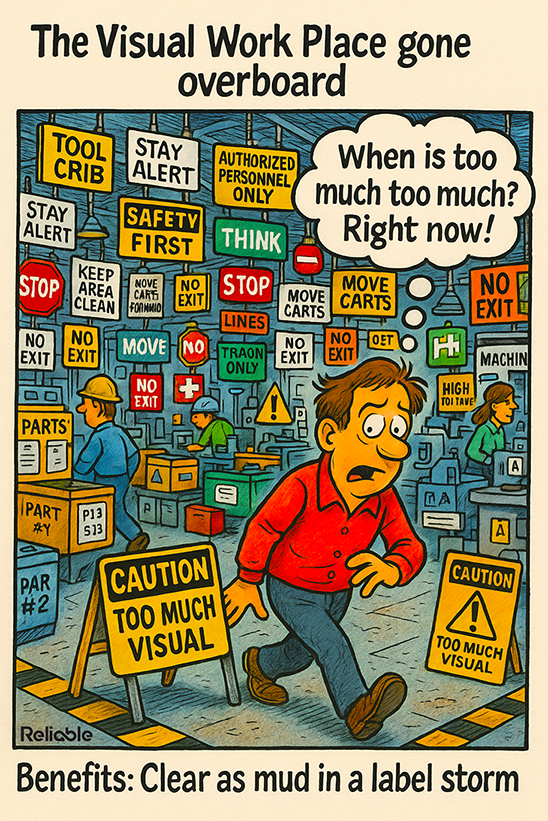

Visual management in lean manufacturing was designed to simplify work. The idea is straightforward: communicate key information visually so teams can act without hesitation. But when every surface, floor, and wall becomes plastered with colors, signs, arrows, and warnings, clarity vanishes.
This cartoon captures that perfectly: a worker drowning in visual clutter, surrounded by signs shouting contradictory instructions. Instead of guiding him, the visuals overwhelm him. The message is unmistakable: a good idea taken too far becomes its opposite.
When clarity crosses the line into clutter, visual management stops managing anything.
Let’s look at what visual management is meant to achieve, why it often spirals out of control, and how to restore true visual clarity that improves performance rather than sabotaging it.
1. The True Purpose of Visual Management in Lean Manufacturing
Visual management in lean manufacturing is a fundamental pillar of lean thinking. Its goal is communication without words. A well-placed sign or color code eliminates the need for verbal instruction or written explanation. Operators can instantly see what’s right, what’s wrong, and what to do next.
At its best, visual management delivers:
- Instant understanding: Workers interpret status or instructions within seconds.
- Error reduction: Visual standards prevent mistakes and reinforce procedures.
- Faster decision-making: Teams act immediately instead of pausing to ask questions.
- Ownership and accountability: When processes are visible, responsibility becomes clear.
However, many organizations miss one critical rule: visuals only work when they simplify, not complicate. When leaders demand “more visuals” without design discipline, they inadvertently destroy the very clarity they hoped to create.
Visual control isn’t about quantity. It’s about meaning. Every mark must matter.
2. How Visual Management Turns Into Visual Overload
Over time, plants evolve. New equipment, new initiatives, and new safety campaigns all bring their own signs and symbols. Without strict visual standards, every improvement adds to the noise. Soon, the workplace looks like a collage of contradictions: five fonts, ten color codes, and twenty conflicting instructions.
Cognitive psychology explains why this fails. The human brain has a limited capacity for attention, called cognitive bandwidth. When exposed to too many competing signals, the mind begins filtering them out. The result is sign blindness, where critical information becomes invisible amid clutter.
Symptoms of visual overload include:
- Workers ignore important alerts because they blend with nonessential signs.
- Confusion during audits due to redundant or outdated visuals.
- Excessive training time to explain visual cues that should be intuitive.
- Frustration among operators who feel micromanaged by endless reminders.
Ironically, this visual noise often signals a cultural problem: management tries to “fix” behavior with signs instead of improving systems. When people stop following procedures, leadership adds another label instead of addressing the root cause.
When every message screams, the workplace goes deaf.
3. Simplifying Visual Management in Lean Manufacturing
To restore effectiveness, treat visual management as a designed system, not a decoration exercise. Every mark on the floor, every sign, and every color must serve a purpose aligned with process flow.
Practical Steps to Reduce Visual Noise
- Audit Your Environment. Walk the floor and identify all existing visuals. Count them. Then ask: how many are actually used?
- Eliminate Redundancy. Remove duplicate or outdated visuals. If a message doesn’t directly support safety, quality, or flow, erase it.
- Prioritize the Critical Few. Define which visuals truly impact daily performance, like status boards, safety alerts, and flow indicators.
- Standardize. Create a visual management manual specifying color codes, shapes, font sizes, and placement.
- Engage Operators. Let the people who use the visuals design them. They’ll keep them relevant and practical.
A clean, standardized system dramatically reduces cognitive load. Operators stop guessing. Supervisors stop explaining. The plant feels quieter, visually and mentally.
Excellent visual management should disappear into the background until it’s needed.
4. Building a Sustainable Visual Management System
Visual management in lean manufacturing must evolve continuously, but deliberately. Additions should only occur through a structured change process. Before introducing a new visual element, ask these questions:
- What specific behavior or decision does this visual influence?
- Will it reduce confusion or add more complexity?
- Is there a more straightforward, non-visual way to achieve the same result?
- Who is responsible for maintaining and auditing this visual?
Core Principles for Sustainable Visual Systems
- Simplicity Over Style: Limit the number of colors and icons. Each should carry one meaning only.
- Standardization Over Creativity: Innovation belongs in processes, not signs.
- Location-Based Logic: Place visuals exactly where actions occur, not on general boards where they’ll be ignored.
- Clarity Over Completeness: Better to have three helpful visuals than thirty unread ones.
Link your visuals to continuous improvement cycles. During kaizen events or Gemba walks, evaluate which visuals still serve their purpose. Remove the obsolete. Refresh the effectiveness.
When done right, visual management becomes a living system that adapts to change while staying clear, concise, and human-centered.
5. The Human Side of Visual Management
Behind every visual is a person trying to make sense of their environment. Remember: humans crave order, not chaos. A well-designed visual workplace reduces stress, improves communication, and strengthens safety culture. A cluttered one does the opposite. It overwhelms, confuses, and discourages initiative.
A reliable culture communicates through respect, not wallpaper.
In many cases, over-labeling also signals a lack of trust. When leaders assume workers can’t make decisions without constant visual reminders, morale erodes. The most reliable plants achieve balance. They empower people with clarity, not control through noise.
Clarity Is the Lean Advantage
Visual management in lean manufacturing isn’t about covering walls with messages. It’s about guiding human attention. The goal is intuitive understanding, not information overload.
Remove distractions. Standardize visuals. Teach teams to value simplicity over saturation. In a truly lean workplace, clarity isn’t loud, it’s unmistakable.
When everything shouts, silence speaks volumes.