

When Machines Cry Wolf: The Cost of False Alarms
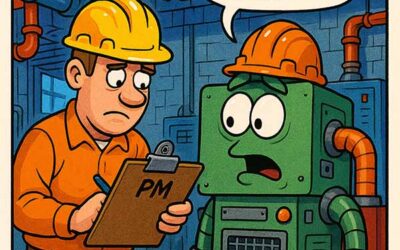
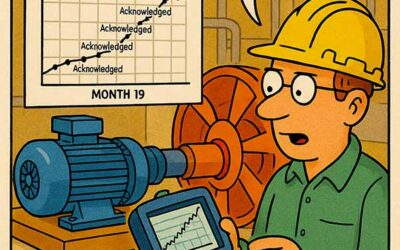
The cartoon hits a familiar nerve; an overly dramatic vibration sensor blaring alarms just to “know you still care.” Funny, until you realize how many plants live this joke daily. In industrial settings, false alarms in vibration monitoring aren’t just noise; they’re credibility killers.
When systems cry wolf too often, people stop listening. Every ignored alert erodes confidence in the technology that’s supposed to protect assets. Once a predictive maintenance system loses trust, it can take months (or even years) to rebuild faith in its data. In the meantime, legitimate warnings may be dismissed as “just another false alarm,” setting the stage for catastrophic equipment failures.
When maintenance stops trusting the data, failure doesn’t just creep in; it walks right through the front door.
The actual cost isn’t just downtime or maintenance hours; it’s cultural. False alarms breed skepticism, and skepticism kills proactive reliability faster than any bearing failure.
Why Vibration Monitoring False Alarms Happen
False alarms occur when technology is implemented faster than it’s understood. The hardware may be solid, but without proper setup, calibration, and contextual intelligence, the system becomes hypersensitive.
- Incorrect Thresholds
Most vibration sensors use fixed thresholds that don’t account for normal variation. Machines have unique “personalities,” such as vibration patterns that fluctuate with load, speed, and environment. A one-size-fits-all threshold guarantees false positives. - Environmental Noise
Plants are dynamic ecosystems filled with electrical noise, resonance, and mechanical interference. These can produce phantom signals that mimic actual fault frequencies. Without spectral filtering or isolation, every hum becomes a “problem.” - Algorithmic Blind Spots
Many systems still rely on static baselines and lack event correlation. A vibration spike during startup or shutdown is typical, but to a poorly tuned algorithm, it’s an emergency. Without contextual awareness, even good sensors make bad calls. - Human Factors
Data interpretation matters as much as the data itself. Poor training or overreliance on automated diagnostics leads to missed nuance. People either overreact or ignore patterns entirely.
The good news? Every one of these problems can be corrected with smarter configuration, better integration, and data-informed feedback loops.
Reducing False Alarms Through Smarter Analytics
The evolution of predictive maintenance is data-driven, not alarm-driven. To restore trust, systems must evolve from reactive alerting to intelligent interpretation. Modern analytics and machine learning offer new ways to separate signal from noise.
Key strategies to minimize vibration monitoring false alarms:
- Adaptive Thresholding
Replace fixed limits with adaptive ones that evolve. Smart systems adjust baselines dynamically as they learn what “normal” looks like across varying loads and environmental conditions. - Cross-Sensor Correlation
Validate vibration anomalies using temperature, amperage, and ultrasonic data. True faults tend to manifest across multiple channels; false ones don’t. - Frequency Band Filtering
Use order tracking, envelope analysis, and band-pass filtering to isolate relevant frequencies. This eliminates unrelated noise caused by nearby machines or power fluctuations. - Human-in-the-Loop Feedback
Empower technicians to tag false positives directly in the system. These inputs refine algorithms, turning human expertise into machine learning fuel. - Contextual Event Mapping
Align alarms with process data like load changes, speed variations, startup/shutdown events to prevent alerts from triggering under predictable operational shifts.
In short, don’t silence your alarms. Teach them to speak more clearly.
The Hidden Cost of Ignored Alarms
Ignoring alarms isn’t apathy, it’s self-defense. Technicians overwhelmed by constant alerts develop “alarm fatigue,” where every warning feels suspect. The irony is that this behavior is rational in an irrational system.
A 2023 study across multiple industrial sites found that up to 65% of vibration alerts were false or unverified. When every third signal wastes time, the human mind stops distinguishing. This desensitization causes the most dangerous failures, the ones that were predicted but ignored.
The ripple effects extend far beyond the maintenance team:
- Production Uncertainty: Frequent false alerts lead to unnecessary shutdowns or inspection delays.
- Resource Misallocation: Teams chase phantom problems while real ones mature unnoticed.
- Data Distrust: Engineers start bypassing the monitoring system entirely, relying on “gut feel” instead of analytics.
These downstream effects cripple the very reason condition monitoring exists: to prevent surprises.
Restoring Trust in Predictive Monitoring
Trust isn’t restored by silence; it’s restored by accuracy. To rebuild belief in condition monitoring, organizations must invest not only in smarter systems but in smarter adoption.
Start by treating your vibration monitoring system like an apprentice, not an oracle. Feed it verified data, correct its mistakes, and let it learn. Integrate vibration data with asset criticality, operating context, and maintenance history to transform alarms into actionable insights.
Technology earns trust the same way people do, by being right more often than it’s wrong.
Training is equally vital. When analysts understand how frequency bands, harmonics, and machine dynamics interact, they can fine-tune alerts that balance sensitivity with specificity. Over time, this harmony creates a feedback loop: better data leads to better decisions, which leads to better performance.
In the end, reducing vibration monitoring false alarms isn’t about silencing technology. It’s about teaching it when to speak and when to stay quiet. A machine that cries wolf might just need reassurance that someone’s still listening.
Because in reliability, the loudest signal isn’t always the truest one.