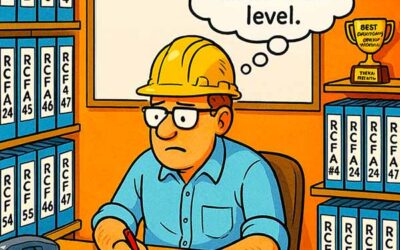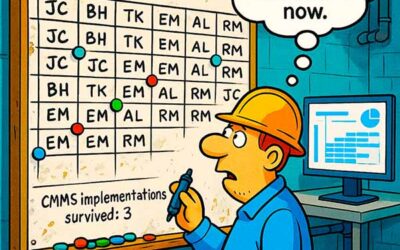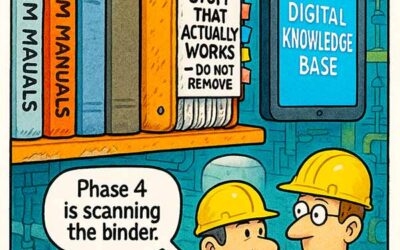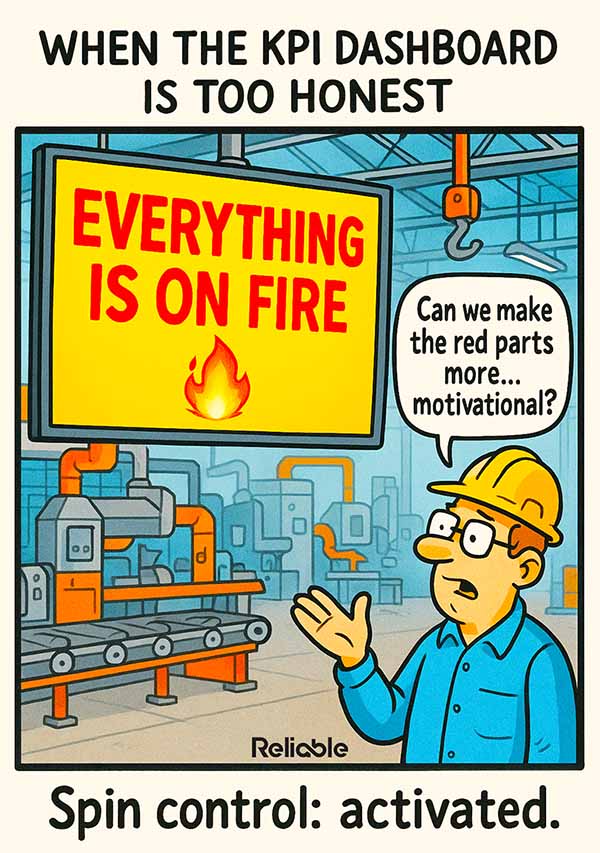

Every maintenance manager has seen a dashboard that looks great on paper. Work order completion rates above 90%. Schedule compliance in the green. Backlog trending downward. The numbers tell a story of a well-run operation, except the shop floor tells a completely different one.
Recognizing the signs your maintenance KPIs are misleading is the first step toward metrics that actually drive improvement. The most dangerous dashboard is the one that makes everyone feel comfortable while equipment quietly deteriorates beneath the surface.
Here are seven red flags that your maintenance metrics may be painting an inaccurate picture, plus practical guidance on what to measure instead.
1. Your Work Order Completion Rate Ignores Quality
A 95% completion rate sounds impressive. But if the metric counts a work order as “complete” the moment someone closes it in the CMMS (regardless of whether the repair actually fixed anything) then it measures administrative compliance, not maintenance effectiveness.
Check your rework rate alongside completion. If technicians are returning to the same assets within 30 to 90 days, those “completed” work orders were premature closures. The completion number went up, but the equipment didn’t get better. Some plants carry rework rates above 20% while simultaneously reporting 90%+ completion, and nobody connects the two numbers because they live on different reports.
The most dangerous dashboard is the one that makes everyone feel comfortable while equipment quietly deteriorates beneath the surface.
A meaningful completion metric ties closure to a verified outcome: the asset returned to specified operating parameters and stayed there. That requires a follow-up verification step, which most CMMS workflows skip entirely.
2. Schedule Compliance Measures Activity, Not Effectiveness
Schedule compliance is one of the most commonly gamed KPIs in maintenance. Teams hit their numbers by prioritizing easy, fast jobs and deferring complex ones. The metric goes up. The backlog of critical work grows quietly underneath.
True schedule compliance should weight jobs by criticality and consequence of deferral. A plant that completes 92% of scheduled work but keeps pushing off its highest-priority PMs has a more serious problem than one at 85% compliance that tackles the hard jobs first. Understanding maintenance scheduling discipline matters far more than hitting an arbitrary percentage target.
Another warning sign: schedule compliance stays consistently high while emergency work orders stay consistently high too. If both numbers are up, the schedule is accommodating reactive work rather than preventing it.
Signs Your Maintenance KPIs Are Misleading: The Middle Traps
3. You’re Tracking MTBF Without Context
Mean time between failures is a useful reliability metric when applied to a single asset class operating under consistent conditions. It becomes misleading when averaged across an entire facility or mixed asset population.
An average MTBF of 180 days might mean everything runs reasonably well. Or it might mean half your assets run for 350 days and the other half fail every 10. The average hides the distribution, and the distribution is where the actionable problems live.
An average MTBF of 180 days might mean everything runs well, or it might mean half your assets fail every 10 days. The average hides the distribution.
Break MTBF down by asset class, criticality tier, and failure mode. Look at the standard deviation alongside the mean. A tight distribution around a decent MTBF tells a very different story than a wide distribution around the same number. That granularity is where actionable patterns emerge.
4. PM Compliance Is High but Failures Haven’t Budged
Preventive maintenance compliance above 90% should correlate with fewer unplanned failures over time. When that correlation is missing, one of three things is typically happening: the PM tasks themselves are ineffective, the intervals are wrong, or the PMs are being checked off without thorough execution.
High PM compliance with flat failure rates signals a need to audit PM task content and execution quality. A predictive maintenance strategy that uses condition data to trigger interventions often outperforms calendar-based PMs that get rubber-stamped every 90 days.
Look specifically at whether your PM tasks actually inspect failure-prone components or just check off generic items. A PM that says “inspect pump” tells the technician nothing. A PM that says “check seal face for leakage, measure bearing temperature, verify suction pressure within 45-55 PSI” drives real condition assessment.
5. You Measure Maintenance Cost Per Unit but Ignore Asset Health
Cost-per-unit metrics create perverse incentives. Maintenance managers facing pressure to reduce this number will defer work, extend PM intervals, and choose cheaper (often inferior) replacement parts. The short-term cost drops. The long-term reliability drops faster.
Pair cost metrics with asset health indicators: vibration trends, oil analysis results, thermographic data, bearing condition assessments. If costs are going down while condition data is getting worse, you’re borrowing against the future. The bill comes due eventually, usually as a catastrophic failure that costs ten times what the deferred maintenance would have.
If maintenance costs are going down while condition data is getting worse, you’re borrowing against the future.
The Strategic Red Flags
6. Your Backlog Metric Counts Work Orders, Not Labor Hours
A backlog of 200 work orders sounds manageable. But if 15 of those are major overhauls requiring 80 labor hours each, and the rest are 30-minute tasks, the number is meaningless without a labor-hour breakdown.
Effective backlog management requires tracking total estimated labor hours, segmented by priority and craft. A backlog expressed in weeks of available labor capacity (typically targeting 3 to 5 weeks) tells leadership something useful. A raw work order count tells them almost nothing.
The same principle applies to backlog age. Work orders sitting in the queue for six months or more represent either chronic under-resourcing or a prioritization system that keeps deferring difficult problems indefinitely. Either way, the aging backlog hides real risk behind a simple number.
7. You Report Lagging Indicators but Never Leading Ones
Downtime hours, failure count, and total maintenance cost are all lagging indicators. They tell you what already went wrong. By the time these numbers move in the wrong direction, the damage is done and the money is spent.
Leading indicators predict where you’re headed. These include schedule compliance on critical PMs, parts availability rate at job start, percentage of work that’s planned versus reactive, and maintenance optimization trends over rolling 90-day windows. If your dashboard only shows lagging metrics, your team is driving by looking in the rearview mirror.
If your dashboard only shows lagging metrics, your team is driving by looking in the rearview mirror.
The best maintenance dashboards pair each lagging indicator with at least one leading indicator. Report downtime, but also report planned work percentage. Report failure count, but also report PM task completion quality scores.
What to Do When You Spot These Warning Signs
Recognizing that signs your maintenance KPIs are misleading should prompt action, not panic. Here’s where to start:
- Audit every KPI on your dashboard against a simple question: does this metric change when equipment reliability actually changes? If the answer is no, it’s a vanity metric that needs replacing.
- Pair every lagging indicator with at least one leading indicator. If you report downtime, also report planned work ratio. If you report cost, also report asset condition trends.
- Stop rewarding KPI targets that can be gamed. Celebrate outcomes (fewer unplanned failures, higher first-time fix rates) rather than activity metrics (work orders closed, PMs completed).
- Review metrics quarterly with both maintenance and operations present. A KPI that only maintenance reviews is a KPI that only maintenance cares about, and that limits its organizational impact.
Getting measurement right takes ongoing effort. Build in regular reviews, question assumptions, and keep asking whether the numbers on screen match the reality on the floor. Honest metrics are harder to look at, but they’re the only ones that lead to real, sustained improvement.
Better Metrics Build Better Maintenance Programs
The goal of a maintenance KPI dashboard should be clarity, even when clarity is uncomfortable. Every metric should connect to a decision: if this number moves, what do we do differently? If nobody can answer that question, the metric is decoration.
When you see signs your maintenance KPIs are misleading the team, resist the urge to tweak the presentation. Instead, fix the underlying measurement. Replace vanity metrics with ones that expose real equipment health, real maintenance effectiveness, and real progress toward reliability goals.
The plants that improve fastest are the ones willing to look at ugly data and act on it. The ones that stall are the ones that keep adjusting the colors on the dashboard until everything looks green.