
When “Run to Failure” Becomes a Maintenance Mindset
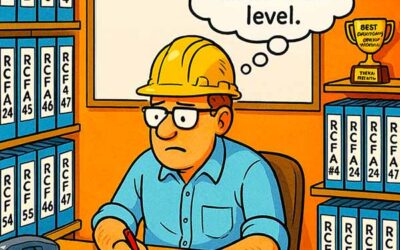
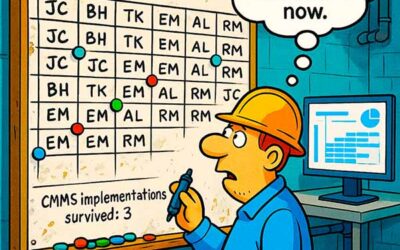
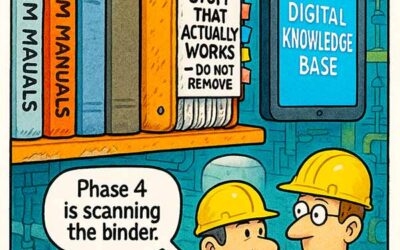
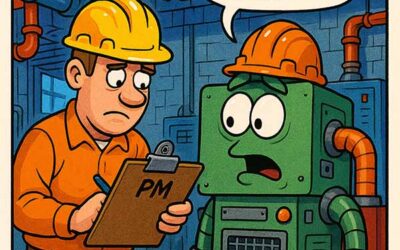
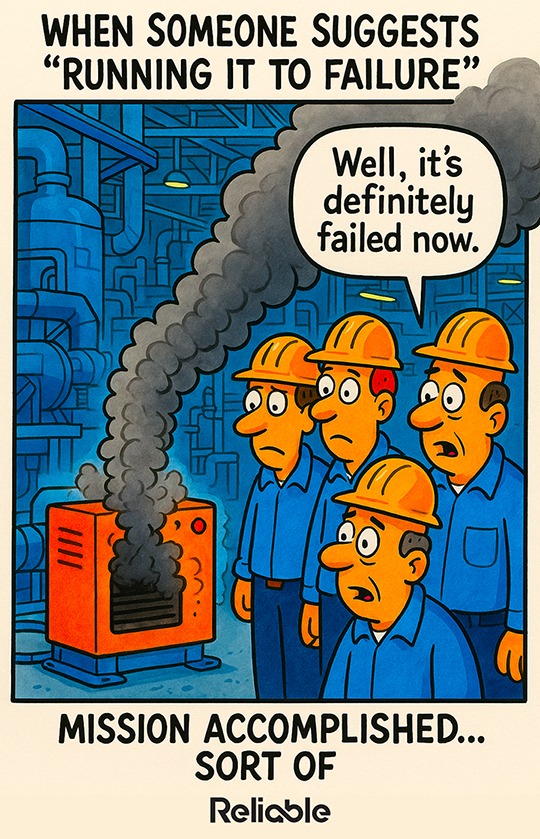
The cartoon nails it: a group of technicians stares at smoking machinery, realizing too late that “run it to failure” succeeded in the worst way possible. The run-to-failure approach might sound like a strategy, but it’s usually just a lack of one. It means waiting for something to break before acting, often under the illusion that it will save time and money.
This mindset stems from a misunderstanding of cost efficiency. When maintenance budgets tighten, leadership sometimes concludes that skipping routine work saves money. Yet the result is almost always the opposite. Each deferred inspection, delayed oil change, or postponed bearing replacement quietly compounds risk until an expensive failure exposes the flaw.
The run-to-failure approach is like gambling with uptime—and the house always wins.
Running equipment to failure might be acceptable when the consequences are trivial, but in most manufacturing plants, those conditions rarely exist. For critical assets, unplanned failures result in production losses, safety hazards, and skyrocketing repair costs.
The Hidden Costs Behind the Run to Failure Approach
On the surface, a run-to-failure approach appears inexpensive. No preventive labor, no scheduled downtime, no parts purchased in advance. But the hidden costs tell a different story:
- Unplanned Downtime: The worst failures happen during peak demand or tight deadlines. Every hour offline costs exponentially more than scheduled maintenance.
- Expedited Repairs: Emergency repairs often require premium parts, rush shipping, and after-hours labor.
- Collateral Damage: A failed bearing can destroy a shaft, housing, and motor coupling in seconds. The cost escalates from hundreds to tens of thousands.
- Safety Incidents: Failures under load, temperature, or pressure can expose teams to serious hazards.
- Operational Instability: Frequent breakdowns erode confidence across departments. Production blames maintenance, and reliability culture collapses.
Reactive maintenance may seem cheaper, but it actually shifts expenses from the maintenance budget to the operations ledger, masking the actual financial impact.
Preventive maintenance is optional, until the failure forces it to be mandatory.
When the Run to Failure Approach Makes Sense
Despite its pitfalls, the run-to-failure approach can be rational in specific scenarios:
- Low-Criticality Equipment: Assets whose downtime doesn’t halt production, like small exhaust fans or redundant pumps.
- Easily Replaceable Components: Items that can be swapped in minutes with minimal cost.
- Predictable and Safe Failure Modes: Parts that fail gracefully without risk to people, environment, or production quality.
- Short Replacement Lead Times: Assets supported by strong spare parts availability or modular design.
In these cases, deliberately running to failure may indeed optimize resources, especially when predictive monitoring on high-value assets consumes most of the reliability budget. The key is intentionality. Every “run to failure” decision should come from a criticality analysis, not from habit or neglect.
For instance, running a disposable fan motor to failure might make sense. Running a gearbox or hydraulic pump the same way? That’s negligence disguised as cost control.
Transforming from Failure-Driven to Reliability-Driven
Transitioning away from a run-to-failure approach doesn’t happen overnight. It requires a structured strategy combining data, discipline, and culture:
- Asset Criticality Ranking: Categorize equipment by production impact, safety risk, and repair cost. Prioritize high-criticality assets for predictive programs.
- Failure Mode and Effects Analysis (FMEA): Identify how each asset fails, what triggers it, and what it costs. Use this data to justify maintenance investment.
- Condition-Based Monitoring (CBM): Leverage vibration analysis, infrared thermography, ultrasound, and oil analysis to detect early signs of deterioration.
- Feedback Integration: Ensure inspection and sensor data flow into the CMMS—Automate work orders when thresholds are exceeded.
- Reliability KPIs: Track Mean Time Between Failures (MTBF), Mean Time To Repair (MTTR), and maintenance cost as a percentage of Replacement Asset Value (RAV).
- Training and Culture: Teach teams the economics of reliability. When technicians understand the cost of reactive work, they advocate for proactive solutions.
This structured progression transforms maintenance from firefighting to foresight. Instead of reacting to breakdowns, teams predict, plan, and prevent them.
Reliability isn’t the absence of failure; it’s the mastery of control over it.
The Business Impact of Reliability Thinking
Replacing the run-to-failure approach with a proactive reliability model delivers tangible financial gains:
- Reduced Downtime: Scheduled maintenance minimizes unexpected outages.
- Lower Total Cost of Ownership: Assets last longer, consume less energy, and require fewer emergency repairs.
- Improved Resource Planning: Labor, parts, and schedules align with operational priorities.
- Enhanced Safety and Compliance: Predictable systems mean fewer incidents and better audit readiness.
- Cultural Shift: Maintenance teams evolve from reactive repair crews into strategic partners in production excellence.
In reliability-centered organizations, leadership doesn’t ask, “How much does maintenance cost?” They ask, “How much does failure cost when we ignore it?” That subtle shift defines competitive advantage.
Choose Predictability Over Probability
The run-to-failure approach thrives in environments where short-term thinking dominates. It offers the illusion of savings until reality sends the repair bill. Reliability isn’t about preventing every failure. It’s about ensuring that when failure comes, it’s planned, safe, and affordable.
The cartoon’s “mission accomplished” punchline perfectly captures this paradox: yes, it failed, but so did the strategy. The goal isn’t to run equipment to its breaking point; it’s to run it to its potential.
A reliability-driven mindset accepts that all machines eventually fail—but it refuses to let them fail by surprise.