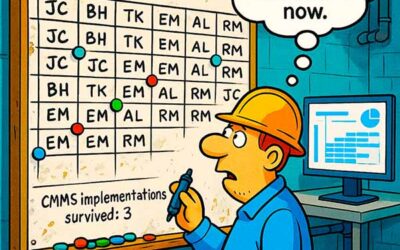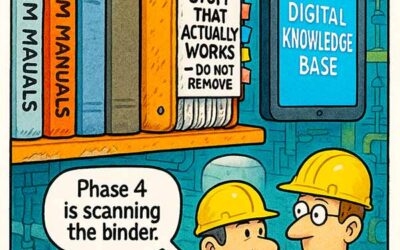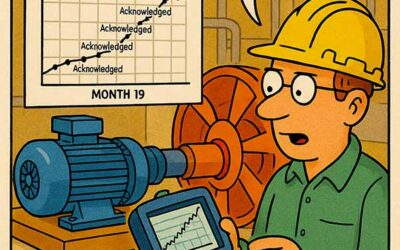


Every plant has at least one pump that seems to have a personality: temperamental, unpredictable, and always quick to implicate something else. This cartoon captures this archetype perfectly: a smug pump teaching others how to disguise their own bearing problems as someone else’s motor coupling issue. Funny? Yes. But also an uncomfortable truth about how maintenance culture often works in the real world.
In most plants, the loudest failures start as quiet bearing problems: misread, misdiagnosed, and blamed on the nearest motor.
Pump bearing failure is the silent killer of uptime. It creeps into production schedules through minor oversights: contaminated lubricant, improper alignment, or neglect of early warning signs. And while the symptoms may appear to be coupling problems, electrical issues, or hydraulic imbalance, the cause is almost always mechanical fatigue deep inside the bearing.
The bigger problem isn’t just the failure itself. It’s the cascade of misdiagnosis that follows. When one wrong assumption leads to another, teams replace the wrong parts, restart unreliable assets, and erode the plant’s confidence in its own data.
Why Pump Bearing Failure Happens More Often Than You Think
The first truth of pump bearing failure is that it rarely happens overnight. Bearings don’t suddenly collapse; they deteriorate quietly over time. In most plants, three root causes dominate: contamination, lubrication issues, and misalignment.
- Contamination: Dust, water, or process fluid can enter the bearing housing through worn seals or poor storage practices. Even microscopic particles cause abrasive wear, shortening bearing life exponentially.
- Lubrication Issues: Too much grease increases friction through churning; too little leaves metal-on-metal contact. Either way, heat builds, viscosity drops, and the bearing’s precision geometry breaks down.
- Misalignment: When the motor and pump shafts aren’t perfectly aligned, bearings absorb unintended loads. These forces distort load zones, create edge stresses, and generate vibration signatures that mimic coupling or motor issues.
Every maintenance engineer knows that once a bearing starts to degrade, there’s no recovery. The only question is whether the failure will be detected in time or masquerade as something else until it’s too late.
According to data from multiple industry studies, bearing-related faults account for over 60% of all failures in rotating equipment. That number doesn’t just represent mechanical fatigue; it means missed opportunities to intervene early.
Misdiagnosis: When the Real Problem Hides in Plain Sight
In most facilities, the battle isn’t against mechanical breakdown; it’s against diagnostic noise. A misaligned coupling can create vibration that appears almost identical to bearing inner-race damage. Electrical imbalance can mask rolling element defects. Even a loosened baseplate can produce harmonics that confuse the analysis.
The result? Misdiagnosis. A motor gets replaced. The pump is balanced. The coupling is changed. And the underlying pump bearing failure remains untouched, festering beneath the surface until the next costly shutdown.
When these errors accumulate, they distort reliability metrics. CMMS logs show incomplete histories. Failure codes don’t reflect reality. Predictive models built on this data become useless. And reliability engineers lose the ability to distinguish between performance problems and data errors.
It’s not sabotage in the literal sense. But it’s systemic self-sabotage through procedural neglect. Teams that skip root cause verification unintentionally teach future failures to repeat themselves.
Accurate failure identification begins with evidence-based diagnostics. Confirm the pattern. Validate the load path. Don’t close the work order until there’s physical proof, such as oil debris, damaged raceways, or heat discoloration. Pump bearing failure leaves fingerprints; you just have to look for them.
Proven Methods for Diagnosing Pump Bearing Failure Correctly
Reliable diagnosis requires multiple instruments and perspectives. Each tool catches what others miss:
- Vibration Analysis: The cornerstone of rotating equipment diagnostics. Detect characteristic frequencies such as BPFO (Ball Pass Frequency Outer Race) and BPFI (Ball Pass Frequency Inner Race). Combine time waveform analysis with spectral trending for early detection.
- Ultrasound Testing: Before vibration amplitudes rise, frictional contact generates high-frequency acoustic signatures. Ultrasound detects these subtle changes long before catastrophic failure.
- Oil and Grease Analysis: Microscopic debris reveals bearing wear stages like polishing, pitting, or spalling. Water content and particle count pinpoint contamination pathways.
- Infrared Thermography: Localized hot spots near bearing housings indicate friction and lubricant breakdown.
- Visual and Manual Inspection: Simple, but indispensable. A technician with a trained eye can spot corrosion tracks, fretting, or raceway fluting that instruments might miss.
Integrating these methods into a standard reliability workflow ensures that each data point strengthens the accuracy of the next. When technicians correlate evidence across vibration, thermography, and lubricant results, pump bearing failure moves from a mystery to a measurable, predictable event.
Building a Reliability Culture That Prevents the “Sabotage” Mentality
The cartoon’s humor works because it highlights a cultural flaw: maintenance teams that learn to deflect instead of diagnose. In too many organizations, speed is rewarded over accuracy. Technicians are praised for getting the pump “back online,” even if the fix was superficial.
A true reliability culture replaces blame with curiosity. It encourages technicians to ask “why” five times before closing a ticket. It prioritizes pump bearing failure prevention not as a one-time repair but as an organizational habit.
Here’s how leading plants make that shift:
- Data Integrity Audits: Ensure CMMS failure codes reflect actual causes. No more “miscellaneous mechanical fault” placeholders.
- Cross-Functional Reviews: Maintenance, operations, and engineering jointly validate failure data before assigning blame.
- Predictive Analytics Feedback Loop: Integrate sensor data into AI-driven systems that learn from both successful and failed diagnoses.
- Recognition for Root Cause Accuracy: Reward teams for precise diagnoses and verified prevention, not just fast turnarounds.
When technicians feel ownership of the data they collect and the failures they prevent, reliability transforms from an obligation to a mindset.
The Real Cost of Getting It Wrong
Every misdiagnosed pump bearing failure carries a hidden financial shadow. Spare parts inventory grows bloated, reactive maintenance spikes, and production schedules lose stability. But beyond cost, there’s something deeper: credibility.
Bad data doesn’t just waste money. It destroys trust. Once credibility fails, reliability soon follows.
When predictive maintenance alerts get ignored because “they’re always wrong,” it’s usually because they’ve been trained on bad data. One false failure report cascades into a dozen wrong predictions, eroding trust in the system. Over time, this skepticism costs more than downtime. It costs culture.
A plant that values accuracy over appearance begins to win reliability battles that others don’t even see coming. That’s when uptime stops being luck and starts being engineered.
Truth Is the Ultimate Maintenance Tool
The cartoon’s punchline—“Those who can’t teach… still operate vindictively”—is a mirror for every plant that blames first and investigates later. Pumps don’t lie. Bearings don’t conspire. But people and processes often do.
When your maintenance strategy embraces honest diagnosis, pump bearing failure becomes less a recurring nightmare and more a predictable, preventable event. The real victory isn’t in catching failures. It’s in making sure they never happen the same way twice.
Reliability isn’t built on optimism or haste. It’s built on evidence, learning, and accountability. Don’t let your pumps attend the sabotage masterclass. Teach them the science of precision instead.