

When Metrics Multiply Faster Than Meaning
Modern maintenance teams are buried in data: OEE, MTBF, MTTR, schedule compliance, uptime, backlog, wrench time. Every system generates reports, and every manager wants visibility into them. But more data doesn’t always mean more understanding. The irony is that as dashboards expand, clarity often shrinks.
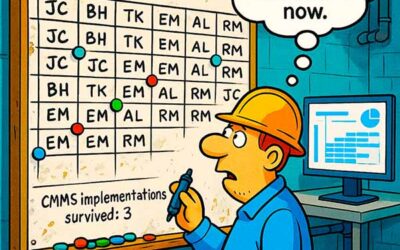
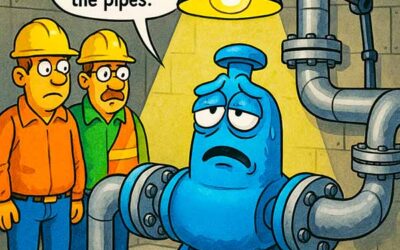
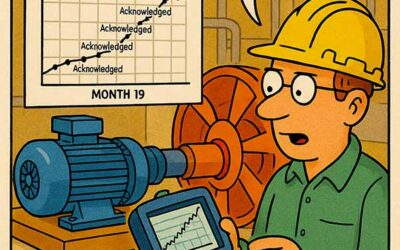
The cartoon captures this perfectly: a maintenance crew staring at a wall of charts, trying to guess what the green bars mean. It’s not a lack of intelligence; it’s a lack of focus. Maintenance performance metrics should sharpen decisions, not cloud them. When teams drown in dashboards, analysis paralysis takes hold, and intuition replaces insight.
The real power of metrics lies in their structure and selectivity. You don’t need 100 KPIs. You need the right 10 that reflect how well maintenance decisions translate into uptime, safety, and cost control. Without disciplined measurement, performance becomes a guessing game.
Why Maintenance Performance Metrics Should Drive Behavior
A metric has no value unless it influences action. The purpose of maintenance performance metrics is to drive better behavior across the organization—alignment, accountability, and anticipation. Good metrics change how people think; bad ones just fill reports.
Well-chosen indicators reveal where resources should go, when reliability risks are rising, and how effective the current strategy really is. For example:
- Wrench Time: Measures technician efficiency and readiness. Low wrench time often signals poor planning or material availability issues.
- Planned vs. Unplanned Work: A barometer of control. When reactive work dominates, maintenance is chasing symptoms rather than solving causes.
- Mean Time Between Failures (MTBF): Reveals reliability trends over time, guiding where predictive or preventive actions can yield the highest ROI.
- Maintenance Cost as % of Replacement Asset Value (RAV): Tracks whether spending aligns with industry benchmarks and long-term asset health.
- Work Order Cycle Time: Shows how fast issues move from detection to correction, a crucial link between planning, execution, and follow-up.
These metrics are not just numbers. They’re behavioral levers. They tell the story of whether maintenance is proactive or reactive, disciplined or chaotic, and whether it is improving or declining.
Data doesn’t drive performance, people do. Metrics just steer the wheel.
Designing Dashboards That Clarify, Not Confuse
Dashboards should act like instruments, not art projects. Too many organizations build systems that impress leadership but confuse the workforce. A great dashboard for maintenance performance metrics should tell three things at a glance: where you are, where you’re headed, and what needs attention.
To achieve that, simplicity is everything.
Design principles for effective dashboards:
- Choose function over flair. Fancy visualizations don’t equal insight. Use simple charts, clear legends, and consistent color schemes.
- Visualize trends, not snapshots. Static monthly reports hide emerging problems. Trend lines reveal patterns before they become failures.
- Connect metrics to goals. If a chart doesn’t inform a decision or reinforce a target, it doesn’t belong.
- Add context. A 90% PM compliance rate sounds good until you learn the remaining 10% includes critical assets.
- Make it accessible. Dashboards must be usable by technicians, not just managers. Field visibility drives engagement.
When the data tells a story, teams stop arguing about interpretation and start solving problems. Maintenance performance metrics work best when they inform daily action, not quarterly reports.
From Reporting to Reliability
Most organizations treat metrics as an afterthought, something to review at the end of the month. But maintenance performance metrics reach their potential only when they become part of real-time decision-making. This requires a cultural shift: metrics as tools for operations, not as trophies for management.
Here’s how that shift happens:
- Integrate metrics into daily meetings. Use dashboards during morning huddles to identify the day’s highest-impact work.
- Automate data collection. Connect CMMS, condition monitoring, and IoT sensors to eliminate manual entry errors and delays.
- Link metrics to accountability. Make sure every KPI has an owner; someone responsible for improving it.
- Balance leading and lagging indicators. Combine forward-looking data (like PM completion rate) with outcome data (like MTBF).
- Evolve, don’t expand. Regularly review which metrics actually drive performance improvement and retire those that don’t.
When this rhythm is established, the maintenance team stops being reactive and starts being predictive. Reporting transforms into reliability.
The Payoff: Clarity Over Complexity
When plants simplify and focus their maintenance performance metrics, the results are immediate: shorter meetings, faster problem resolution, and stronger trust in data. Teams no longer guess which asset to prioritize; they know. Leaders don’t micromanage; they measure.
The clarity that comes from simplicity produces alignment. Technicians can see how their daily actions impact OEE or MTTR. Reliability engineers can prove the effect of precision lubrication or vibration monitoring. Executives can tie maintenance improvements directly to profitability.
The outcome is not just better dashboards, it’s a better culture. Clarity breeds accountability, and accountability drives reliability.
Final Thought
The best metrics aren’t the ones with the most decimals; they’re the ones that create the most change. Simplify your maintenance performance metrics until they fit on a single page that your team actually wants to look at. When everyone reads from the same data story, maintenance stops being reactive firefighting and becomes a disciplined system for performance excellence.
Metrics don’t just measure progress; they make it possible.