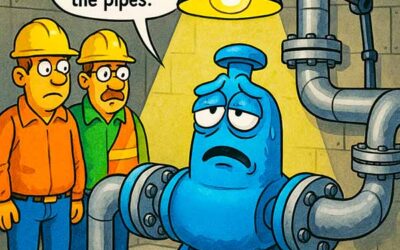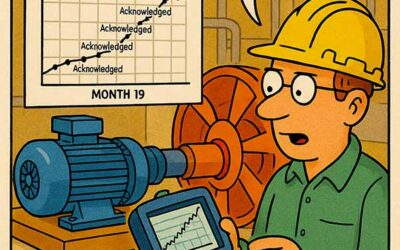


In the cartoon, the technician beams proudly at his glowing digital twin while an older, dust-covered motor sulks in the background. It’s a funny exaggeration, but it captures a serious truth: the industrial world has found its new “favorite child.” The digital twin in predictive maintenance represents the next frontier of reliability, a living, breathing digital reflection of physical assets that’s transforming maintenance from reactive firefighting into predictive intelligence.
A true digital twin doesn’t just detect problems – it understands the story your machine is telling and predicts its next chapter.
For years, maintenance professionals have been working toward smarter, data-informed decision-making. But digital twins finally close the loop. They combine real-time sensor data, historical performance patterns, and engineering simulation models into a unified, dynamic system that understands your machines as well as your best technician, sometimes better.
1. Understanding the Role of Digital Twin in Predictive Maintenance
A digital twin in predictive maintenance is a high-fidelity replica that evolves alongside its physical counterpart. It continuously ingests live sensor inputs: vibration, temperature, current draw, oil particle counts, and more, and updates its internal model to mirror the real-world state of the asset. The twin becomes a sandbox for testing scenarios: “What happens if we extend bearing lubrication intervals by 20%?” or “How would vibration amplitude change if we adjust operating speed?”
This is where the concept goes far beyond conventional condition monitoring. Instead of merely detecting anomalies, the twin interprets them in the context of how the machine behaves and interacts with surrounding systems. It doesn’t just say something’s wrong; it tells you why it’s bad, what might happen next, and how to fix it before it escalates.
Unlike a traditional CMMS or historian dashboard, a digital twin isn’t passive; it’s predictive, adaptive, and even prescriptive. When paired with AI-driven analytics, the twin can identify degradation trends invisible to the naked eye. That’s why more plants are integrating digital twin architecture into their reliability strategy, using it as a virtual lab for both maintenance optimization and process improvement.
2. From Reactive to Predictive to Prescriptive: A Step Change in Maintenance Strategy
Before the digital twin in predictive maintenance, plants relied on intuition, experience, and lagging indicators such as downtime reports and vibration spikes. Now, the maintenance strategy can be fully proactive and even self-improving.
The evolution looks like this:
- Reactive Maintenance: Fix it when it breaks.
- Preventive Maintenance: Replace it on schedule.
- Predictive Maintenance: Replace it based on data trends.
- Prescriptive Maintenance: Let the system recommend the optimal intervention.
A digital twin enables that last stage. It leverages real-time analytics and what-if modeling to propose specific corrective actions and forecast their impact. For instance, simulating thermal stress on a motor winding might suggest derating the load or adjusting the cooling cycle, well before any physical signs of failure appear.
Plants using digital twin in predictive maintenance report not just fewer failures, but more innovative asset management overall. Downtime reduction often reaches 30–50%, energy efficiency rises, and parts inventory becomes leaner. The maintenance team no longer operates in reaction mode; they become analysts, strategists, and system architects.
3. Why Emotional Intelligence Still Matters in a Digital Twin World
The cartoon’s humor lies in human bias: we favor the shiny, new, connected asset while neglecting the “old faithful” machines that still drive production. This mirrors a real challenge in digital transformation: technology can create unintended imbalance.
Even in a world built on digital twin in predictive maintenance, emotional intelligence (EQ) remains vital. The best technicians interpret data through a human context. A temperature spike might indicate a process upset rather than a bearing fault. A sudden vibration anomaly might result from a change in load dynamics rather than equipment degradation.
The most innovative maintenance programs pair digital insight with human intuition – because data needs discernment to become wisdom.
In this sense, the digital twin amplifies human expertise rather than replacing it. It offers transparency, but it’s still the reliability engineer’s judgment that translates data into action. This hybrid approach – part machine learning, part human reasoning – defines the most successful maintenance cultures.
Think of the digital twin as an apprentice who never forgets a reading, never misses a trend, and never sleeps, but still needs a mentor who understands the bigger picture. The synergy between data and intuition is what prevents “parental bias” from undermining older assets and keeps the entire operation in balance.
4. How to Build and Sustain a Digital Twin Program that Works
Deploying a digital twin in predictive maintenance isn’t plug-and-play. Success depends on building a structured ecosystem that spans IT, operations, and reliability teams.
Key success steps:
- Prioritize high-value assets. Begin with equipment where failure risk or downtime cost is highest: turbines, compressors, gearboxes, or high-speed bearings.
- Define measurable outcomes. Set ROI expectations in terms of downtime reduction, mean time between failure (MTBF) improvement, and maintenance cost savings.
- Integrate cross-functional data. Link IoT sensors, historians, maintenance logs, and engineering models to form a unified source of truth.
- Maintain model fidelity. Continuously recalibrate the digital twin so its virtual behavior matches reality. This includes updating algorithms and sensor mappings.
- Train the team. Ensure technicians understand how to interpret and act on twin insights. Don’t let data become noise; make it actionable.
- Close the feedback loop. Every intervention should feed back into the model, refining its predictive accuracy over time.
When implemented correctly, digital twins evolve into living systems of reliability. They connect engineering with operations, and maintenance with design. OEMs can even use twin data to improve future equipment generations, completing the intelligence cycle from factory floor to factory design.
5. Overcoming Common Challenges
Adoption barriers exist. Cost, complexity, and cultural resistance are the biggest. Many plants struggle with incomplete sensor networks or fragmented data systems. Integration between legacy control systems and new analytics platforms can be messy.
The solution lies in scalability: start small, learn fast, and expand deliberately. Pilot a digital twin on one production line or equipment cluster. Prove the ROI with measurable performance improvements. Then roll out across similar assets, standardizing the data model and governance structure.
Equally important is leadership alignment. A digital twin initiative thrives when reliability, operations, and IT see themselves as partners in digital transformation. Without that shared ownership, even the best models become underused toys for “the favorite child.”
6. The Future: Predictive Maintenance Meets Autonomous Optimization
The next evolution of digital twin in predictive maintenance will merge AI with closed-loop automation. Twins will not only predict failures, they’ll automatically adjust process parameters or maintenance schedules to prevent them.
Imagine a pump that detects cavitation onset and autonomously throttles flow to maintain safe conditions. Or a bearing twin that communicates with procurement software to reorder grease cartridges before inventory runs out. This isn’t distant speculation; it’s already emerging in advanced industrial IoT systems and edge computing frameworks.
Ultimately, the goal isn’t to make machines more intelligent than people. It’s to make people more capable through smarter machines.
Balancing Innovation and Empathy
Yes, the digital twin may be the “favorite child,” but reliability excellence demands equal attention to all assets, new and old, connected and analog. The promise of digital twin in predictive maintenance isn’t just efficiency; it’s empathy through insight, a way to understand machines deeply enough to prevent their pain before it starts.
The plants that master this balance – blending predictive technology with human intuition – won’t just prevent failures. They’ll redefine what it means to be reliable in an Industry 4.0 world.