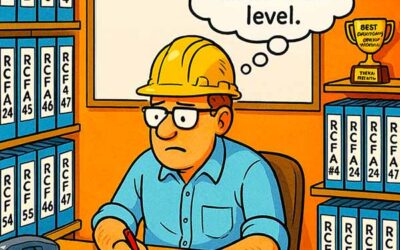
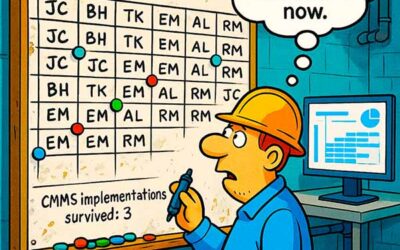
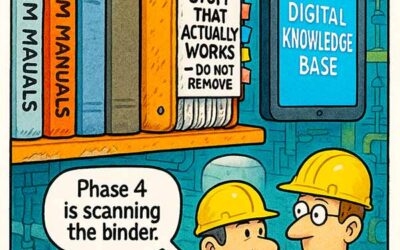
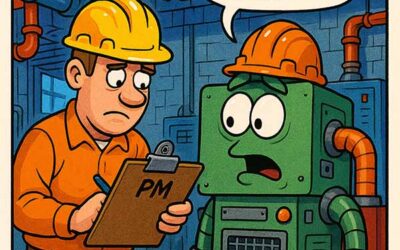
The cartoon is funny because it’s painfully accurate. Three maintenance technicians dash past a smoking motor, eyes locked on the real “emergency”: the coffee machine. The caption “Priorities: perfectly calibrated” captures a truth every maintenance manager recognizes.
In many plants, priorities are driven by perception rather than impact. What gets fixed first isn’t always what matters most. That’s where asset criticality ranking comes in. It replaces gut instinct and firefighting with structured logic, helping maintenance leaders deploy resources where failure would hurt most.
Without an asset criticality ranking, maintenance isn’t managed; it’s triaged under pressure.
This isn’t bureaucracy; it’s survival. Without a ranking system, maintenance becomes reactive chaos. With it, teams gain clarity, balance, and control.
The Cost of Misaligned Priorities
Maintenance teams rarely lack effort. They suffer from misdirected effort. When priorities are based on whoever shouts loudest, urgent work dominates, and preventive work dies quietly in the background.
The effects are predictable:
- Rising unplanned downtime because critical equipment gets deferred.
- Increased costs as reactive repairs replace planned interventions.
- Technician burnout as constant firefighting erodes morale.
Without an asset criticality ranking, maintenance planning becomes guesswork. A smoking pump and a squealing conveyor compete equally for attention because no one has quantified their real impact.
Smart plants recognize that urgency doesn’t always equal importance. They treat prioritization as a data problem. One solved with structure, not adrenaline.
What Asset Criticality Ranking Really Does
Asset criticality ranking is more than a spreadsheet exercise. It’s the foundation for every maintenance decision. The method evaluates each asset against measurable criteria like safety risk, production impact, repair cost, and downtime duration.
Each factor receives a weighted score, creating a hierarchy of importance. Assets at the top get more frequent inspections, condition monitoring, and faster response times. Those at the bottom may only need reactive attention or extended maintenance intervals.
A simple ranking matrix might look like this:

Multiply these scores by weighting factors that reflect your organization’s values (for example, safety ×3, production ×2, cost ×1). The resulting total determines each asset’s rank: an objective, repeatable foundation for maintenance prioritization.
This structure eliminates debates about which job should come first. The data does the talking, freeing teams to focus on execution instead of politics.
Building a Living System, Not a One-Time Chart
The most common mistake with asset criticality ranking is treating it as a one-and-done project. Plants build an impressive matrix, file it away, and never revisit it. The problem is that production priorities evolve, equipment ages, and processes change.
A criticality ranking must evolve, too. Review it at least annually, or whenever major shifts occur in production, safety standards, or equipment configuration. As new assets enter service or older ones are replaced, recalibrate rankings to reflect their current consequence of failure.
Then, embed the data directly into your CMMS. Every work order, inspection, or emergency response should be tagged with its criticality score. This ensures planners can filter and assign work intelligently:
- Critical assets: highest priority, most skilled technicians.
- Medium assets: proactive work with planned intervals.
- Low assets: reactive or deferred until resources allow.
Over time, this system becomes self-correcting. As performance metrics improve, you can validate whether your asset criticality ranking aligns with actual downtime and failure trends.
Linking Criticality to Maintenance Strategy
A ranking system only adds value if it changes behavior. Use it to guide every part of your maintenance program:
- Preventive Maintenance (PM): Prioritize PM tasks by asset rank, adjusting intervals for critical equipment and removing unnecessary work on noncritical items.
- Predictive Maintenance (PdM): Deploy sensors and analytics where they’ll yield the highest return—on assets that represent the top 20% of risk or cost.
- Spare Parts Management: Stock critical spares for high-ranking assets; use lead-time management for lower-priority components.
- Training and Skill Allocation: Assign your most experienced technicians to the assets where errors have the most significant consequences.
This integration creates alignment across departments. Production understands why certain work orders take precedence. Purchasing knows which spares justify investment. Maintenance supervisors can defend priorities with data, not opinion.
When asset criticality ranking drives the conversation, the plant transitions from “fixing what’s loud” to “protecting what’s vital.”
From Chaos to Control: Real-World Benefits
Plants that apply asset criticality ranking consistently report measurable improvements:
- 30–50% reduction in unplanned downtime due to focused preventive work.
- Lower maintenance backlog volatility, since work is filtered by consequence.
- Better collaboration between operations and maintenance, as priorities are transparent.
- Fewer emotional decisions, since urgency is weighed against structured impact.
These benefits ripple outward. Planners stop firefighting and start strategizing. Technicians feel empowered instead of reactive. Production trusts that maintenance work aligns with throughput goals.
The espresso machine might still break, but now everyone knows it can wait.
Structure Breeds Stability
Every maintenance department has limited people, time, and tools. Without structure, those resources scatter under pressure. With the asset criticality ranking, they align with the purpose.
When downtime occurs, no one needs to ask, “Which job comes first?” The answer is built into the system. That’s the quiet power of discipline. It transforms chaos into predictability.
The plants that master criticality don’t just fix problems faster; they prevent the wrong ones from happening at all. They understand that maintenance isn’t about reacting to the next emergency; it’s about protecting what truly matters most.