

Reducing slip accidents in factories remains a persistent challenge across manufacturing, processing, and industrial environments. Despite safety briefings, signage, and training, slips continue to occur – often in the exact locations, under the same conditions, and for the same reasons. The disconnect lies in how the problem is framed. Slips are commonly treated as behavioral failures when, in reality, they are mechanical events governed by physics.
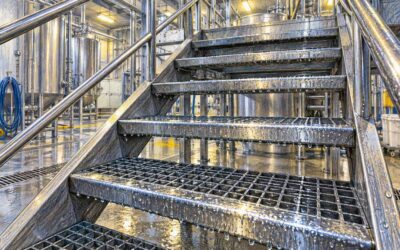
Factories are filled with steel stairs, elevated walkways, grated platforms, and transitional surfaces exposed to moisture, oil mist, condensation, and process residues. When traction is insufficient, no amount of caution can compensate. Effective progress in reducing slip accidents in factories begins by addressing surface performance, not human behavior.
Why Reducing Slip Accidents in Factories Requires Engineering Controls
A slip occurs when the friction between footwear and the walking surface is lower than the friction required for movement. This relationship is not subjective. Every step requires horizontal shear forces to control balance, deceleration, and weight transfer. If the surface cannot supply those forces, the foot slides.
From a safety engineering perspective, this makes slips a design issue. Warning signs, toolbox talks, and “be careful” messaging do not increase friction. They simply transfer risk to the individual.
Slips don’t happen because people aren’t careful – they happen when surfaces can’t deliver the friction physics demands.
Steel surfaces are particularly unforgiving. Smooth steel offers little inherent traction, and even open grating can become hazardous when contaminants fill surface voids. In these conditions, reducing slip accidents in factories requires engineered solutions that raise the available coefficient of friction under real operating conditions.
The Role of Surface Conditions in Factory Slip Incidents
Factory environments are dynamic. Temperature changes drive condensation. Washdowns leave residual moisture. Leaks, misting, and overspray introduce lubricating films. Dust and fine particulates further degrade traction.

Crucially, walking speed does not eliminate these risks. Slowing down does not reduce the fundamental need for friction. In some cases, slower movement can increase instability by extending the time a foot remains in contact with a low-friction surface.
This is why successful initiatives to reduce slip accidents in factories focus on controlling surface conditions rather than on gait or awareness.
Practical Engineering Strategies That Reduce Slip Risk
The most effective controls follow the hierarchy of controls, prioritizing physical changes over administrative measures.
1. Surface Traction Enhancement
Adding durable traction to steel stairs, ladder rungs, and walkways directly increases available friction. These solutions must withstand abrasion, chemicals, temperature extremes, and heavy foot traffic.
2. Drainage and Moisture Control
Standing water and condensation should be treated as design flaws. Improved drainage, insulation, and shielding reduce the formation of slippery films before they become hazards.
3. Consistent Surface Design
Transitions between surfaces, such as concrete-to-steel or indoor-to-outdoor, are high-risk zones. Standardizing traction performance across these areas helps stabilize movement.
Each of these measures directly supports reducing slip accidents in factories by increasing the margin between available and required friction.
Why Administrative Controls Have Limited Impact
Training and procedures are necessary, but they are inherently fragile. They rely on perfect compliance, consistent attention, and ideal conditions – none of which are realistic in production environments.
Human balance systems operate reflexively. When traction is lost, recovery time is measured in milliseconds. By the time a worker perceives a hazard, physics has already taken over.
This is why organizations that meaningfully reduce slip accidents in factories treat walking surfaces as safety-critical assets, subject to the same level of scrutiny as machines, guards, and process controls.
A Structured Approach to Reducing Slip Accidents in Factories
A repeatable, defensible approach includes:
1. Identify High-Exposure Areas
Focus on steel stairs, exterior platforms, washdown zones, process-adjacent walkways, and elevation changes.
2. Evaluate Real Conditions
Assess traction under wet, oily, icy, and dirty states – not just during inspections.
3. Apply Engineered Traction Solutions
Use permanent or mechanically attached traction systems designed for industrial service.
4. Inspect and Sustain
Include traction devices and surfaces in routine inspections to verify ongoing performance.
This approach aligns with accepted safety engineering practice and removes reliance on behavioral perfection.
Where Targeted Hardware Solutions Fit
In many factories, replacing steel stairs or platforms is impractical. Retrofit traction solutions provide a scalable alternative. Mechanically fastened systems, such as Titan Safety Anti-Slip Clips, are designed specifically for industrial stairs and grates, adding hardened traction points at critical foot-contact areas.

Because these devices are installed directly onto existing structures, they deliver immediate friction improvement without major shutdowns or redesign. In environments where moisture, frost, or oil exposure is unavoidable, this type of solution helps reduce slip accidents in factories by addressing the root cause: insufficient traction.
The Bottom Line
Slips are not judgment failures. They are traction failures. Organizations that continue to rely on reminders and warnings will continue to see incidents. Those who engineer walking surfaces for real-world conditions create environments where safe movement is the default.
When reducing slip accidents in factories becomes an engineering objective rather than a behavioral expectation, measurable improvement follows.