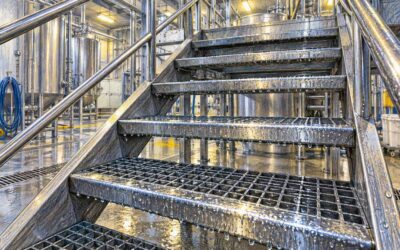


Most slip and fall incidents in industrial facilities are treated as behavioral failures. Someone moved too fast. Someone ignored the signage. Someone wore the wrong footwear. While those factors may contribute, they are rarely the root cause. Industrial slip and fall prevention succeeds or fails long before a person ever steps onto a walking surface. It begins with how traction is engineered, specified, and maintained.
Walkways, platforms, stairs, and elevated surfaces operate under conditions that change constantly. Water, oil, dust, temperature swings, and vibration all influence friction. Assuming that a surface will remain safe because it once met a specification is one of the most common and costly mistakes in industrial design.
The Engineering Foundations of Industrial Slip and Fall Prevention
Effective industrial slip and fall prevention relies on physics, not warnings. The fundamental variable is friction – specifically, the coefficient of friction between footwear and surface under real operating conditions.

Dry, clean surfaces may exhibit acceptable friction values in controlled tests. Introduce moisture or hydrocarbons, and those values can drop sharply. Thin fluid films are particularly dangerous because they are often invisible yet can eliminate traction.
Engineering controls must therefore account for worst-case conditions, not average ones. This includes:
- Surface geometry that interrupts fluid films
- Materials that resist polishing and wear
- Drainage paths that prevent pooling
- Traction features are placed where foot contact actually occurs
Designing for ideal conditions creates latent hazards that only reveal themselves after an incident.
Common System-Level Failures That Undermine Prevention Efforts
Many facilities invest heavily in training while leaving the underlying system unchanged. The result is repeated incidents despite increased awareness.
- Assuming All Walking Surfaces Are Equivalent
Different areas experience different levels of contamination, traffic patterns, and exposure durations. Applying a single traction strategy across an entire site ignores localized risk.
- Relying on Visual Cues Instead of Physical Controls
Painted warnings and signage do not increase friction. They merely acknowledge risk without reducing it.
- Treating Slip Resistance as Permanent
Wear, corrosion, and contamination steadily degrade traction. Without inspection and verification, degradation goes unnoticed.
- Addressing Incidents Instead of Precursors
Near misses, process changes, and housekeeping challenges are often ignored until an injury forces action.
Industrial slip and fall prevention requires shifting focus from response to system resilience.
Engineering Controls That Strengthen Industrial Slip and Fall Prevention
The most reliable facilities prioritize controls that remove dependence on human behavior.
- Surface Geometry and Traction Design
Raised patterns, serrations, and abrasive features increase friction by disrupting sliding motion. Geometry matters more than material alone.
- Drainage and Fluid Management
Surfaces must shed liquids quickly. Standing fluids create hydroplaning conditions even on textured floors.
- Strategic Placement of High-Traction Zones
Not all areas require the same level of protection. Transitions, turns, access points, and task locations deserve priority.
- Verification Through Testing
Slip resistance should be verified under expected contaminants using recognized test methods. Assumptions are not controls.
These measures convert slip prevention from a policy into a physical property of the workplace.
Where Retrofit Solutions Fit Into Industrial Slip and Fall Prevention
Full replacement of walkways or platforms is not always feasible. Shutdown constraints, cost, and structural limitations often delay ideal solutions. That gap is where engineered retrofits play an essential role in industrial slip and fall prevention.
Clip-on traction devices and mechanically fastened anti-slip elements can introduce consistent, high-friction contact points without altering load capacity or drainage. When installed correctly, they localize traction exactly where foot placement occurs, even in oily or wet environments. Retrofit solutions are not shortcuts – they are targeted engineering controls designed to reduce exposure when replacement is impractical.

Example of anti-slip clips. Courtesy Titan Safety, LLC.
Used strategically, they allow facilities to address risk immediately rather than waiting for capital projects, closing a common vulnerability window where incidents occur.
Maintaining Industrial Slip and Fall Prevention Over Time
Slip resistance is not a “set and forget” feature. Maintaining industrial slip and fall prevention requires periodic verification.
- Routine Surface Inspections
Look for wear patterns, polishing, corrosion, or missing traction elements.
- Contamination Trend Tracking
Identify areas where fluids or debris consistently accumulate and adjust controls accordingly.
- Post-Change Reviews
Process changes often introduce new slip risks. Prevention systems must evolve with operations.
- Incident Data as Feedback
Use near misses and minor slips as signals, not statistics, to minimize.
Sustainable prevention comes from treating walking surfaces as engineered assets, not passive infrastructure.
Why Assumed Traction Fails
Most slips do not happen because no one cares. They occur because traction was assumed instead of engineered. Industrial slip and fall prevention succeeds when friction is designed into the system, verified under real conditions, and maintained as those conditions change.
When traction is treated as a performance requirement—no different than load rating or structural integrity—slips become predictable, preventable events rather than unavoidable costs of doing business.