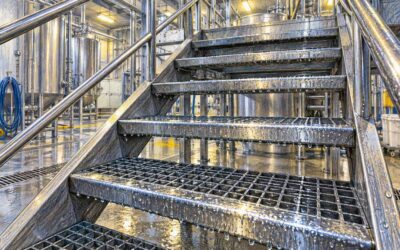


Ask a chemical plant safety manager to name their biggest hazard and you’ll hear about reactive chemistry, confined spaces, or pressure vessels. All valid. All heavily engineered against.
The thing that actually puts workers on the ground gets almost none of that attention: the floor they walk on.
Slips, trips, and falls account for a large share of lost-time injuries at chemical facilities, and most of them happen on surfaces that looked fine during the last walkthrough. The hazard is real precisely because it’s invisible until someone’s boot loses grip.
Why Walking Surfaces Get Overlooked
Walking surfaces don’t fail dramatically. A corroded stair tread doesn’t explode. A slick section of grating doesn’t trigger an alarm. So it sits.
There’s also a familiarity problem. People walk the same route 40 times a day and stop seeing it. The stairway that’s been “a little slick when it rains” for three years becomes background noise, right up until someone takes a hard fall on it.
A corroded stair tread doesn’t explode. A slick section of grating doesn’t trigger an alarm. So it sits.
Chemical environments make all of this worse. You’ve got washdown water, product spills, caustic and acid exposure that eats at metal, and outdoor units exposed to weather year-round. Every one of those degrades traction over time.
And the degradation is gradual, which is exactly why nobody catches it. The surface that was safe when it was installed loses grip a few percent a year until it crosses a line nobody was watching for.
The Zones Where It Actually Happens
Not all walking surfaces carry the same risk. In a chemical plant, the hazard concentrates in a few predictable places.
Bar grating is the common thread. It’s on process structures, exterior stairs, loading racks, and platforms throughout the facility, and its flat bearing bars turn slick fast when they’re wet, oily, or coated in product residue.
Where the Traction Problem Concentrates
Exterior stairways are the worst offenders. They collect rain, ice, and algae, and the corrosion from chemical exposure rounds off whatever slip resistance the original serrated edge provided.

Photo courtesy Titan Safety
Fixing this doesn’t have to mean replacing grating or scheduling hot work. Clip-on anti-slip cleats, like the Titan Safety anti-slip clips, knock directly onto standard bar grating with no tools, welding, or permits, and the corrosion-resistant composite versions hold up in the caustic and acid environments where painted steel breaks down. A technician can cover a full stairway in under an hour, and the safety-yellow finish adds step definition on treads at the same time.
Loading and unloading racks are close behind. Product transfer means drips, and hose connections leak. The grating around a transfer point is wet more often than it’s dry.
Process area grating sits in a category of its own. Standing product, routine washdown, and the occasional spill keep those surfaces slick most of the working day.
Mapping Your Facility’s Risk
The chart below breaks down where chemical plant slip risk concentrates and what drives it. Use it as a starting template for a focused walking surface audit (your facility’s layout will shift the priorities).
|
Walking Surface Zone |
Slip Risk |
Primary Cause |
|
Process area grating (wet/chemical) |
Very High |
Standing product, washdown, spills |
|
Exterior stairways |
High |
Rain, ice, algae, corrosion |
|
Loading/unloading racks |
High |
Product transfer, hose drips |
|
Elevated platforms/mezzanines |
Medium |
Dust, condensation, foot traffic |
|
Pump and compressor pads |
Medium |
Oil mist, seal leaks |
|
Control room transitions |
Low |
Tracked-in moisture |
The pattern is consistent across most facilities: the highest risk lives where liquid meets metal on a surface people walk across every shift. Process grating and exterior stairs top almost every list.
What a Real Walking Surface Audit Covers
Look at Traction, Not Just Structure
Most safety walks check whether a stairway is structurally sound. Far fewer check whether it’s actually slip-resistant.
A proper walking surface audit grades traction under the conditions the surface sees in real operation, which means checking it wet, not just dry. A stair tread that grips fine on a dry Tuesday morning tells you nothing about how it performs during a washdown.
The audit should cover:
- Every grated stair and walkway, graded for slip resistance under wet conditions
- Exterior surfaces exposed to weather, ice, and algae growth
- Grating near transfer points, pumps, and seals where leaks are routine
- Corrosion on stair nosings and tread edges, where serration wears off first
- Drainage patterns that leave standing liquid on walking surfaces
Two people with a checklist can cover most units in a day. The output is a prioritized fix list with cost estimates attached.
Check it wet, not just dry. A tread that grips fine on a dry morning tells you nothing about how it performs during a washdown.
Match the Fix to the Environment
The right traction solution depends on what the surface is exposed to. Painted steel add-ons corrode in acid service. Adhesive-backed tape peels under constant washdown.
For chemical environments, the material matters as much as the fix itself:
- Composite or corrosion-resistant clips for caustic and acid exposure zones
- Galvanized or powder-coated traction products for general industrial areas
- High-visibility finishes on stair treads to solve traction and step definition together
- Drainage improvements where standing liquid is the root cause
Getting the material right is what separates a fix that lasts five years from one you’re redoing next quarter.
The Cost of Ignoring It
A single OSHA-recordable slip or fall at a chemical facility runs $40,000 to $60,000 once you add up medical, lost time, investigation, and citation exposure. A fall from an elevated platform can push past $150,000.
Compare that to the cost of fixing the surface: a few hundred dollars in materials and an hour of labor for most stairways. The economics aren’t close.
There’s a regulatory dimension too. OSHA’s walking-working surfaces standard (29 CFR 1910 Subpart D) puts the obligation on the employer to keep surfaces in a condition that prevents slips and falls. A documented hazard you didn’t act on is a citation waiting to happen.
Start Where the Liquid Is
If you do nothing else this quarter, walk your exterior stairways and your process grating during or right after a washdown. That’s when the hazard shows itself.
Bring someone who doesn’t walk those routes every day. Fresh eyes catch the slick tread that the regular crew stopped seeing years ago.
The floor is the one hazard in a chemical plant that touches every single worker, every single shift. It’s worth more than the passing glance it usually gets.
Fix the grating. Grade the stairs. The workers walking them will never know you did (which is exactly the point).