
Turnarounds are expensive. Every hour of downtime costs money, and every task on the punch list competes for a finite window of access. So it makes sense that safety upgrades often get deprioritized in favor of mechanical repairs, inspections, and capital projects that directly affect throughput.
That’s a mistake.
The average cost of a single OSHA-recordable slip, trip, or fall in a manufacturing environment runs between $40,000 and $60,000 when you factor in medical costs, lost productivity, investigation time, and potential citations. A serious fall from elevation can exceed $150,000. Compare that to the cost of most safety retrofits – many of which can be installed in minutes with no specialized labor – and the math isn’t even close.
Here are seven safety upgrades that belong on every turnaround punch list. They’re fast, they’re affordable, and most of them don’t require hot work permits, scaffolding, or engineering approval.
1. Emergency Shower and Eyewash Station Testing
ANSI Z358.1 requires weekly activation testing for emergency showers and eyewash stations, but anyone who’s worked in a plant knows that testing frequency often slips – especially on units that are running hard. Turnarounds give you access to every station with the system in a safe state.
Go beyond simple flow checks. Flush lines to clear sediment and biofilm. Verify water temperature is within the tepid range (60–90°F). Check supply valves for corrosion. Replace any signage that’s faded or missing. Confirm sight lines so workers can locate the nearest station from any point on the unit. This takes a day with a small crew and costs almost nothing, but the liability exposure of a non-functional eyewash station during a chemical exposure event is enormous.
2. Guardrail and Handrail Repairs
Bent, corroded, or missing guardrails are one of the most commonly cited OSHA violations under the walking-working surfaces standard (29 CFR 1910.28). They’re also one of the easiest to overlook during normal operations because operators walk past damaged railings every day without reporting them.
Use the turnaround as an opportunity to do a full guardrail survey. Walk every elevated platform, mezzanine, and stairway. Check for loose connections, missing mid-rails, corroded bases, and any railing that deflects more than it should under a firm push. Document everything. Fix what you can during the window and schedule the rest for the next outage.
If you’re replacing sections of handrail, consider upgrading to high-visibility coatings. Color-coded railings at stairway entries and platform edges are a low-cost addition that improves hazard recognition in low-light areas.
3. Anti-Slip Clips on Grated Walkways and Stairs
Every plant with bar grating – which is virtually every industrial facility in North America – has this problem hiding in plain sight.
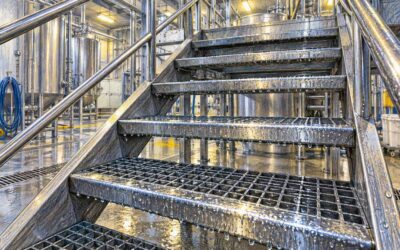
Standard bar grating gets slippery. It doesn’t matter how new it is. Add water, oil mist, dust, or condensation, and the flat bearing bars become a slip hazard. The traditional fixes – replacing the grating entirely or welding on traction plates – are expensive, time-consuming, and, in many facilities, require a hot-work permit that’s hard to justify during a turnaround.

Example of anti-slip clips. Courtesy Titan Safety, LLC.
Clip-on anti-slip grating cleats solve this in minutes. Products like the Titan Safety anti slip clips knock directly onto standard bar grating with no tools, no welding, no drilling, and no hot work. A single technician can outfit an entire stairway during a break. The clips are available in powder-coated galvanized steel for heavy industrial environments or corrosion-resistant composite for marine, food & beverage, and chemical processing facilities.
The high-visibility safety yellow finish also creates immediate step definition on stairs – addressing both traction and visibility in one install. At a few dollars per clip with volume pricing, this is the highest-ROI safety upgrade most plants will ever make.
Here’s the thing: unlike most items on this list, anti-slip clips don’t actually require a turnaround to install. No hot work, no confined space entry, no lockout/tagout, no downtime. You could have a technician outfit an entire staircase on a Tuesday afternoon without writing a single permit. So while they absolutely belong on your turnaround punch list, don’t let the next scheduled outage be your excuse to wait. If your grating is slippery today, this is a fix you can deploy tomorrow.
4. Lighting Upgrades in Stairways and Access Points
Poor lighting is a contributing factor in roughly 30% of industrial slip-and-fall incidents, yet it’s rarely the first thing plants address when incident rates climb. Turnarounds are the ideal time to assess and upgrade lighting in critical areas: stairways, ladder cages, transition points between indoor and outdoor areas, and any walkway where shadows create uneven visibility.
LED retrofits have dropped in cost dramatically. Replacing aging HPS or fluorescent fixtures with high-output LEDs in key locations can be done in hours, improves visibility immediately, and reduces energy costs going forward. Prioritize stairways, platform edges, and any area where workers transition between light zones.
5. Ladder Rung and Cage Inspections
Fixed ladders get used hard and inspected infrequently. Corrosion, worn rung surfaces, and loose cage sections are common in outdoor installations, especially in coastal or humid environments. The turnaround window gives you access to every fixed ladder on the unit without competing with operators climbing them during normal shifts.
Inspect every rung for structural integrity and surface condition. Smooth, polished rungs – even if structurally sound – are a slip hazard when wet or oily. Anti-slip ladder rung covers can be retrofitted using adhesive bonding, adding both traction and rung protection without replacing the ladder. Check cage bolts, hoop spacing, and rest platforms while you’re at it. Document your findings for the asset management system so the next inspection interval is data-driven, not calendar-driven.
6. Floor Marking and Pedestrian Routing
Floor markings fade. It’s not a question of if – it’s a question of how fast, depending on traffic, chemical exposure, and cleaning frequency. Turnarounds are the time to refresh every pedestrian lane, hazard boundary, equipment exclusion zone, and emergency egress route on the unit.

Courtesy Floor Marking Tape
Don’t just repaint what was there before. Review your pedestrian routing against current traffic patterns. Has new equipment changed how people move through the space? Are there pinch points where forklifts and foot traffic converge that didn’t exist during the last outage? This is a chance to redesign, not just repaint. Use durable floor tape or epoxy coatings rated for your environment. Cheap paint in a chemical environment is a waste of turnaround time.
7. Safety Signage Audit and Replacement
Signs fade, get covered by equipment, or become obsolete when processes change. A turnaround is the best time to walk the entire facility and audit every piece of safety signage against current OSHA requirements (29 CFR 1910.145) and your own site-specific standards.
Look for chemical hazard labels that no longer match current SDS information, faded exit signs, missing PPE requirement postings, and any warning signage that’s been rendered invisible by dust, grime, or equipment placement. Replacing a $15 sign is meaningless in the turnaround budget but critical for compliance and hazard communication.
The Bottom Line
None of these upgrades requires major capital approval. None of them takes more than a few hours of labor. And none of them should lose the priority battle to a pump rebuild or a heat exchanger pull.
The facilities that consistently outperform on safety metrics aren’t doing anything exotic. They’re just disciplined about using every turnaround window to close the small gaps – the worn grating, the dim stairway, the faded floor markings—that accumulate into recordable incidents.
Build these seven items into your next turnaround scope. The total cost is a rounding error compared to the cost of one lost-time injury. The total install time is measured in hours. And the total impact on your safety culture is immediate and visible.
Your workers will notice. Your auditors will notice. Your incident rate will be noticed.