
Knowing how to justify reliability program investment is one of the most underdeveloped skills in maintenance leadership. The technical knowledge exists. The business case exists. What’s often missing is the translation layer between the two: the ability to present a multi-year reliability strategy in the financial language that boards and senior executives actually use to make decisions.
Most reliability professionals can explain why condition monitoring catches failures early, why precision maintenance extends equipment life, and why root cause analysis prevents repeat breakdowns. But none of that matters in a boardroom if the message doesn’t connect to the metrics executives watch.
Why Reliability Programs Struggle to Get Funded
The fundamental mismatch is time horizon. Many executives are pressured by 12-month budget cycles and quarterly reporting periods. Reliability improvements compound over 3 to 5 years. A condition monitoring program might cost $250,000 in year one and save $1.2 million by year three, but the year-one spreadsheet shows a $250,000 expense with no offsetting savings.
That’s a hard sell against competing capital requests that promise faster returns: a new production line, a software upgrade, an acquisition. Reliability investments are competing for the same pool of capital, and they need to be presented with the same rigor.
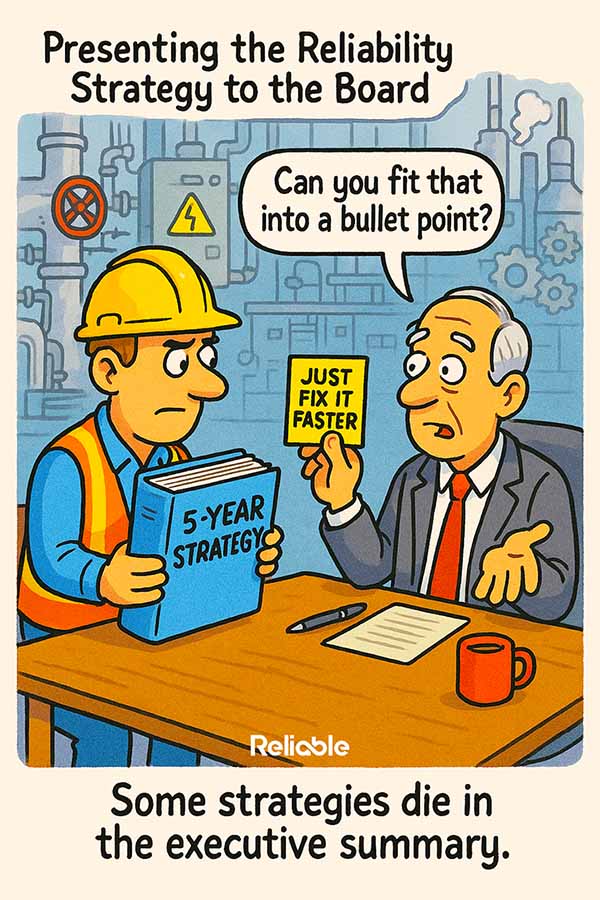
A five-year reliability strategy that can’t survive a fifteen-minute budget review was never designed for its audience.
The second challenge is the visibility problem. Reliability’s greatest successes are invisible: the failures that didn’t happen, the production hours that weren’t lost, the safety incidents that were avoided. Executives have difficulty valuing events that never occurred, especially when they’re presented as hypothetical scenarios rather than quantified risks.
Maintenance leaders who successfully justify maintenance budget increases share a common trait. They present the investment in terms of what the organization gains (or avoids losing), denominated in dollars, rather than in technical performance metrics.
Another barrier is credibility erosion from previous proposals. If the maintenance department has submitted budget requests in the past with vague ROI estimates or projected savings that never materialized in the reporting, executives learn to discount future proposals regardless of their quality. Rebuilding that trust takes precise data, conservative projections, and a willingness to report honestly when results fall short of forecasts.
How to Justify Reliability Program Investment With Financial Data
The most effective reliability business cases use three financial frameworks that executive teams already understand: cost avoidance, risk-adjusted returns, and asset performance metrics. Each one speaks to a different aspect of the value proposition, and together they build a case that’s difficult to dismiss.
Cost Avoidance: Quantifying What You Prevent
Cost avoidance is the most intuitive argument. It answers a straightforward question: what does it cost when equipment fails, and how much of that cost does the reliability program eliminate?
Building a credible cost avoidance model requires data from three sources:
- Maintenance cost records: the direct repair costs (parts, labor, contractor charges) for each failure event over the past 24 months.
- Production loss records: the revenue impact per hour of unplanned downtime for each major asset or production line. Operations and finance usually have this number, even if maintenance doesn’t.
- Consequential costs: environmental cleanup, regulatory fines, warranty claims, customer penalties, and expedited shipping charges that result from unplanned outages.
Sum these across your top 20 failure events from the past two years. The total is your addressable cost of unreliability. A well-designed reliability program may be able to target a meaningful portion of that total within three years, depending on failure modes, funding, operating discipline, and baseline maturity. That projected savings, minus program costs, is the net financial benefit.
Executives fund programs that prevent losses they can measure. Give them the measurement, and the funding conversation changes completely.
The key word is “credible.” Overstating potential savings destroys trust. Use conservative assumptions, cite your data sources, and present a range (best case, expected case, worst case) rather than a single optimistic number. Finance teams will stress-test your assumptions. Give them numbers that hold up under scrutiny.
Risk-Adjusted Returns
Some reliability investments are harder to justify on pure cost avoidance because the failure they prevent is low-probability but catastrophic. A turbine failure, a pressure vessel failure, or a transformer explosion may be rare, but when it happens, the consequence can be severe.
Risk-adjusted analysis handles this by multiplying the probability of failure by the financial consequence. For example, a 5% annual probability of a $10 million event represents $500,000 in annualized risk exposure. If a $150,000 reliability investment credibly reduces that probability to 1%, the annualized risk drops to $100,000: a net reduction of $400,000 per year before considering implementation cost, confidence level, and time horizon.
Once you frame reliability as risk management, leadership stops asking “can we afford this?” and starts asking “what happens if we don’t?”
CFOs and risk managers understand this framework because it’s the same logic behind insurance decisions and capital allocation models. Present reliability investments as risk mitigation, and the conversation shifts from cost justification to risk tolerance.
For organizations that track return on net assets, reliability investments have a compounding effect. Extending asset life and reducing unplanned capital replacements can improve return on net assets by protecting the numerator through steadier production while reducing avoidable capital deployment over time. Over a five-year horizon, this compounding effect can produce measurable RONA improvement on critical asset classes when the assumptions are tied to actual production, maintenance, and capital data.
Asset Performance Metrics That Executives Watch
Technical metrics like MTBF and P-F interval often mean little to a board unless they are translated into financial or operational outcomes. Financial and operational metrics do. When building the case to justify reliability program investment, tie your program outcomes to the indicators your executive team already reviews:
- Overall Equipment Effectiveness (OEE): most manufacturing executives track this. In constrained production environments, even a 2-point improvement in OEE can translate to significant throughput gains. If your facility has a baseline OEE of 72% and the reliability program moves it to 76%, that’s a 5.5% increase in effective capacity with zero capital expansion.
- Maintenance cost as a percentage of replacement asset value (RAV): strong performers are often closer to the low single digits, though the right target depends heavily on industry, asset intensity, and lifecycle stage. If you’re at 5%, the gap represents a quantifiable improvement opportunity. Calculate OEE alongside RAV to give leadership a complete picture of how asset performance connects to financial outcomes.
- Unplanned downtime hours per month: simple, trackable, and directly convertible to lost revenue. Set a baseline, project the reduction curve, and report against it quarterly.
The critical detail is linking program activities to metric improvements with a realistic timeline. A predictive maintenance rollout might take 9 months to fully deploy and another 6 to show statistically meaningful improvement in OEE. Set those expectations in the proposal, and report progress honestly. Early wins (quick condition monitoring catches on critical equipment, for example) can demonstrate value while the broader program ramps up.
Structuring the Proposal for Executive Audiences
A reliability investment proposal that runs 40 pages with technical appendices will lose its audience by page three. Executive presentations should lead with the financial summary, provide supporting evidence in concise form, and offer detail only for those who request it.
A structure that works:
- Executive summary (one page): the investment amount, the expected return, the payback period, and the top three risks of doing nothing.
- Financial analysis (two pages): cost avoidance projections, risk-adjusted returns, and asset performance metric targets with timelines.
- Implementation overview (one page): major milestones, resource requirements, and key dependencies. The detailed project plan lives in a separate document for the implementation team.
The one-page executive summary should answer four questions: What are we investing? What do we get back? When do we see results? What happens if we don’t act?
Leadership will read one page with full attention, skim two more, and set the rest aside. Structure your proposal accordingly.
Avoid jargon entirely. “P-F interval optimization” means nothing to a CFO. “Catching equipment problems 6 months before failure, so we repair on our schedule instead of in a crisis” communicates the same concept in language that connects. Every core sentence in the executive summary should be understandable to someone who has never set foot on a plant floor.
Common Mistakes That Kill Reliability Proposals
Three patterns consistently undermine otherwise solid reliability business cases.
The first is presenting reliability as a cost center instead of a value driver. If the proposal reads as “we need more money for maintenance,” it will lose to every revenue-generating alternative. Frame the investment as protecting and improving asset throughput, reducing operating risk, and extending capital asset life.
The second is failing to present alternatives. Executives want choices. Offering three options (minimum viable investment, recommended program, and comprehensive approach) with corresponding risk profiles lets leadership feel ownership of the decision. A single take-it-or-leave-it proposal triggers resistance.
The third is ignoring the competition for capital. Every dollar your reliability program receives is a dollar that didn’t go to marketing, R&D, or facility expansion. Acknowledge that trade-off directly and show how your proposal’s risk-adjusted return compares favorably. If it doesn’t compare well, refine the scope until it does.
Learning how to justify reliability program investment is ultimately about meeting decision-makers in their own context. Technical correctness matters, but financial translation is what secures the budget. The organizations that consistently fund long-term reliability work are the ones where maintenance leaders built the business case in the same language their executives already speak.