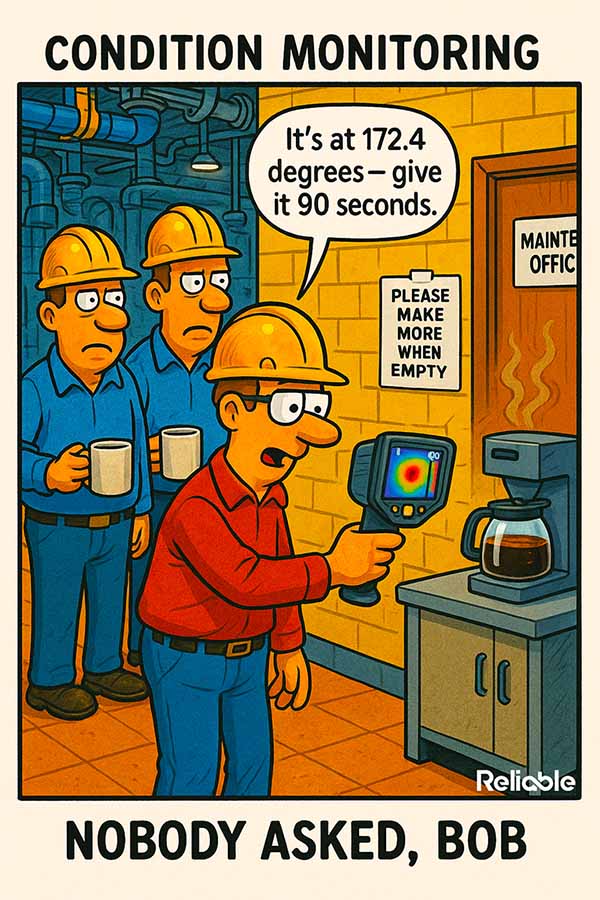

Most plants have at least one person who walks around with a thermal camera, checks a few bearings, and calls it condition monitoring. That person may be doing good work. But a solo effort with a handheld tool and no structured program to back it will plateau quickly. Knowing how to start a condition monitoring program means building something systematic: clear objectives, the right technologies matched to the right assets, trained people, and a decision-making process that turns data into action.
The payoff for getting this right is substantial. Plants with mature condition monitoring programs often report significant reductions in unplanned downtime, with some studies and case histories citing improvements in the 30 to 50 percent range. The catch is that “mature” takes time, and most programs stall in the first eighteen months because they try to monitor everything at once or fail to connect the data to maintenance decisions.
How to Start a Condition Monitoring Program: Define the Scope First
The first mistake is trying to cover every asset on day one. A new program should start with a focused pilot: 20 to 30 critical assets where unplanned failure carries the highest cost in downtime, safety risk, or production loss.
Identify those assets using your existing data. Pull the last two years of work orders and sort by total maintenance cost, number of failures, and downtime hours. The assets at the top of all three lists are your pilot candidates.
This step also reveals what failure modes you’re actually dealing with. A pump that fails from bearing wear needs vibration analysis. A transformer at risk of insulation breakdown may benefit from oil analysis, dissolved gas analysis (DGA), and thermal scanning. Matching the technology to the failure mode prevents the common trap of buying equipment nobody knows how to use for problems it can’t detect.
Risk ranking frameworks like FMEA or RCM can formalize this asset selection process. Even a simplified criticality ranking (high, medium, low) based on safety, environmental, production, and cost impact gives the team a defensible basis for deciding which assets enter the program first and which wait.
The fastest way to kill a condition monitoring program is to monitor everything and act on nothing. Start narrow, prove value, then expand.
A well-scoped pilot also makes budget conversations easier. Instead of asking for capital to cover the whole plant, you’re proposing a defined trial with measurable outcomes on specific assets. Finance teams respond better to a request for $50,000 to monitor 25 critical pumps than to a vague proposal for a plant-wide initiative.
Choosing the Right Technologies for Your Program
Condition monitoring covers a broad set of technologies, and each one detects different failure mechanisms. The core four for most industrial applications are vibration analysis, infrared thermography, oil analysis, and ultrasound.
Vibration Analysis
Vibration analysis remains the workhorse of most programs. It detects imbalances, misalignments, bearing defects, looseness, and gear-mesh problems in rotating equipment. For plants with large populations of pumps, motors, fans, and compressors, this is typically where the program starts.
The investment ranges from handheld route-based collectors (lower cost, requires a trained analyst walking routes) to permanently installed online vibration monitoring sensors (higher cost, continuous data, immediate alerts). Most programs begin with route-based collection and add online sensors to their most critical assets over time.
Infrared Thermography
Thermal cameras detect temperature anomalies in electrical connections, mechanical equipment, steam systems, and refractory linings. Electrical thermography can help identify conditions that may lead to fires, arc flash incidents, and unplanned outages by catching loose connections and overloaded circuits before they fail.
The barrier to entry is lower than vibration analysis. A quality thermal camera, a Level I thermography certification, and a structured route can produce results within weeks. Many plants assign thermography to an electrician who already understands the systems, which shortens the learning curve considerably.
Start with the technology that matches your most expensive failure modes. A perfect vibration program means nothing if your biggest losses come from electrical faults.
Oil Analysis and Ultrasound
Oil analysis can reveal wear metals, contamination, and lubricant degradation in gearboxes, hydraulic systems, and lubricated bearings. It’s especially valuable for slow-speed equipment where vibration analysis loses sensitivity.
Airborne ultrasound is commonly used to detect compressed-air leaks, steam-trap failures, and early-stage bearing defects. Leak detection programs can deliver substantial annual savings in compressed air costs, particularly in larger facilities.
Staffing and Training: The Human Side of Condition Monitoring
Technology alone produces data. People produce decisions. Every condition-monitoring program needs at least one dedicated analyst who owns the data, identifies emerging problems, and translates findings into work requests.
For vibration analysis, the industry standard is ISO 18436-2 certification (Category I through IV). A Category I analyst can collect data and identify basic faults. Category II can diagnose most common problems and recommend corrective actions. Most plants need at least one Category II analyst to run an effective program.
The training investment extends beyond the analyst. Key roles that need condition monitoring awareness include:
- Maintenance planners, who need to understand what a condition monitoring work request looks like and how to prioritize it against other backlog items.
- Frontline supervisors, who need to trust the data enough to pull equipment for repair before it fails, even when the machine still appears to run fine.
- Operations teams, who need to accommodate monitoring routes, support equipment access during production, and report changes in machine behavior.
A condition-monitoring program with advanced technology and no trained analyst is an expensive data-collection hobby. The analyst is the program.
This training path connects to broader reliability engineering competencies. Condition monitoring works best when the analyst understands the physical failure mechanisms, the operating context, and the maintenance strategy for each monitored asset.
Building Momentum After You Start Your Condition Monitoring Program
The first six months of a condition monitoring program are fragile. Early wins build credibility. Early failures (or worse, early indifference) can bury the effort before it matures.
Prioritize quick victories. Find the compressed air leaks, catch the loose electrical connection, and identify the misaligned coupling. Document every save with the cost of the prevented failure and circulate it. A one-page summary showing that a $200 vibration reading prevented a $40,000 bearing replacement speaks louder than any presentation about program strategy.
Build a reporting cadence. Monthly summaries of assets monitored, defects found, work orders generated, and saves achieved keep leadership engaged and justify ongoing investment. Without reporting, the program becomes invisible, and invisible programs get cut when budgets tighten.
Common pitfalls to watch for as the program matures:
- Collecting data on a schedule but never analyzing it. Routes become a checkbox exercise instead of a diagnostic process.
- Identifying problems but failing to generate work orders. Condition monitoring without maintenance follow-through just documents the decline.
- Over-relying on a single technology. Each method has blind spots, and a comprehensive program layers multiple technologies based on the failure modes present in each asset class.
- Losing the analyst to promotion, retirement, or another role without a succession plan. Single points of failure apply to staffing, too.
Document every save, every prevented failure, every dollar not spent on emergency repairs. These stories are the program’s survival currency.
Integration with the CMMS is another critical success factor. Condition monitoring findings should generate work orders through an automated or streamlined workflow. If the analyst has to walk a paper form to the planning office, findings get lost, delayed, or deprioritized. Modern CMMS platforms support condition-based work order triggers that keep the pipeline moving from detection to correction.
Scaling from Pilot to Plant-Wide Coverage
Once the pilot proves value (typically after 12 to 18 months of consistent data collection and demonstrated saves), expansion follows a natural path. Add the next tier of critical assets, introduce additional monitoring technologies, and consider online sensors for assets where route-based collection can’t keep up with the failure progression rate.
Scaling also means formalizing what started as a pilot. Written procedures for data collection, analysis, and reporting replace informal practices. Defined alarm thresholds based on baseline data, industry standards, and operating experience replace gut-feel assessments. A technology roadmap aligned with capital planning cycles replaces ad hoc equipment requests.
Benchmark the program against itself. Track metrics such as the percentage of monitored assets, the ratio of condition-based work orders to total corrective work orders, and the average lead time from defect detection to repair completion. These numbers show whether the program is maturing or coasting.
The plants that succeed long-term treat condition monitoring as a core maintenance function, funding and staffing it like any other critical activity. The ones that struggle treat it as an add-on, staffed by whoever has bandwidth and funded year-to-year with discretionary budget. The difference often shows up in uptime performance, maintenance costs, and backlog health.