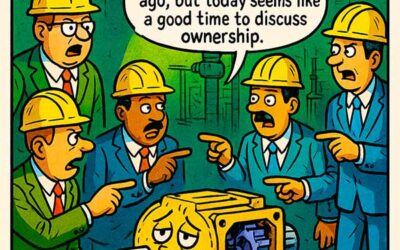

Every plant has an OEE number. The question worth asking is whether that number reflects reality. Understanding how to improve OEE accuracy starts with a hard look at how data gets collected, categorized, and (too often) quietly adjusted before it reaches a dashboard.
OEE multiplies three factors: availability, performance, and quality. The math is simple. The politics surrounding the inputs can get complicated fast.
Where OEE Accuracy Breaks Down
The most common accuracy failures have nothing to do with sensors, software, or calculation errors. They start with people under pressure to hit a target number who discover that reclassifying downtime is faster than fixing equipment.
A 40-minute unplanned stop becomes “scheduled maintenance” in the log. A speed reduction gets categorized as a “quality hold” and shuffled to a different bucket. The number climbs. The production line stays exactly as broken as it was before someone touched the spreadsheet.
When the incentive structure rewards higher OEE, the path of least resistance runs straight through the loss category definitions.
This pattern shows up across industries, from food processing to heavy manufacturing. The pressure to report improving numbers creates incentives that reward creative classification over genuine equipment improvement.
Warning Signs of Inflated OEE
A few red flags signal that OEE data has drifted from reality:
- Unplanned downtime categories shrinking quarter over quarter while total downtime stays flat
- “Excluded time” growing as a percentage of the production schedule
- OEE trending upward while output volume, scrap rates, and customer complaints remain unchanged
- A gap between reported availability and what maintenance work orders actually show
If OEE went from 62% to 78% over six months without a capital project, process change, or major reliability initiative to explain the jump, the numbers deserve scrutiny.
How to Improve OEE Accuracy with Better Data Practices
Fixing the measurement problem requires structural changes. Three areas matter most.
Define and Lock Your Loss Categories
Write a plant standard that specifies exactly what qualifies as planned downtime, unplanned downtime, reduced speed, and quality loss. Document the criteria. Make the standard difficult to modify without a formal review.
Separation of duties matters here as much as it does in accounting. The operators running the equipment shouldn’t also be the ones deciding how to classify the stops. A reliability engineer or planner should own the category definitions.
When you calculate OEE with locked categories, the resulting number becomes a stable baseline. Changes in that number actually mean something.
Automate Data Collection
Manual data entry at the end of a shift is a reconstruction project. Operators write down what they remember, and memory favors the version that keeps supervisors comfortable.
Automated data collection from PLCs, sensors, and machine interfaces captures events in real time, categorized by machine state. The data arrives without editorial input. It removes the opportunity (and the temptation) to round in a favorable direction.
Plants that switch from manual to automated OEE tracking typically see their reported numbers drop by 10 to 15 percentage points in the first month. That drop represents the gap between the story and the reality.
Plants that switch from manual to automated OEE tracking typically see reported numbers drop 10 to 15 points. That drop is the most useful data they’ve generated in years.
That honesty, uncomfortable as it is, creates the foundation for every improvement that follows.
Disconnect OEE from Individual Performance Reviews
This is the structural reform most plants resist. When a supervisor’s quarterly review hinges on OEE, that supervisor has every reason to massage the inputs. When a maintenance planner’s bonus depends on availability numbers, reclassifying unplanned stops becomes rational self-interest.
OEE works as a diagnostic tool for identifying where losses concentrate. It breaks down when organizations use it as a scorecard for the people who collect the data. Separate the measurement from the reward, and watch how fast the measurement gets honest.
Standardize Across Shifts and Lines
OEE accuracy also erodes when different shifts or lines use different interpretations of the same categories. The night shift calls a 20-minute conveyor jam “minor stoppage.” The day shift logs the same event as “unplanned downtime.” Both are technically defensible under vague definitions. Both make cross-shift comparisons meaningless.
Effective standardization includes:
- Written examples for every loss category, drawn from the plant’s own equipment history
- A decision tree or flowchart that operators can reference during data entry
- Monthly cross-shift calibration reviews where borderline events are discussed and resolved
What Accurate OEE Data Makes Possible
Honest OEE data gives root cause failure analysis something real to work with. Reliability teams can see exactly which equipment, shifts, and loss categories account for the biggest gaps.
A plant running at a verified 58% OEE with clear, consistent loss categories can improve faster than a plant reporting an inflated 82% with no reliable picture of where the real problems sit.
Accurate data also changes the conversation between maintenance and production. When both teams trust the numbers, arguments about downtime responsibility give way to joint problem-solving. The weekly production meeting becomes a planning session instead of a blame session.
Accurate data changes the conversation between maintenance and production. Arguments about downtime responsibility give way to joint problem-solving.
When trust in the data exists, the improvement work becomes significantly more focused and productive.
Building a Foundation for Reliable OEE
Improving OEE accuracy takes consistent effort across several months:
- Audit one production line first. Compare reported OEE against actual output, downtime logs, and scrap records. Where the numbers diverge, you’ve found the reclassification problem.
- Train operators on loss category definitions with concrete examples from their own equipment.
- Review OEE data weekly with cross-functional teams. Include maintenance planning leads who can validate whether logged downtime matches work order records.
- Publish the data and methodology openly. Transparency builds trust.
The goal is a number everyone believes, even when that number is lower than anyone wants.
The Long Game on OEE Accuracy
Accurate OEE demands discipline from the shop floor to the executive suite. The plants that get this right protect their data from the pressure to perform and use what it reveals to drive genuine operational improvement.
The discipline of honest OEE measurement compounds over time. Year-over-year comparisons become meaningful. Improvement projects can demonstrate verified gains. The OEE number transforms from a political liability into a tool that teams actually trust enough to use.
Getting serious about how to improve OEE accuracy starts with one uncomfortable admission: the current number might be wrong. That admission, as painful as it feels in a quarterly review, opens the door to a metric worth acting on.