
Every manufacturer knows downtime hurts. Few know exactly how much. The cost of unplanned downtime in manufacturing now averages $260,000 per hour across all sectors, according to Aberdeen Research. For automotive plants, that figure climbs past $2.3 million per hour. And it’s getting worse: each hour of unplanned downtime costs roughly 50% more today than it did in 2019.
Those numbers aren’t theoretical. They represent lost production, idle crews, emergency parts at premium prices, missed shipments, and strained customer relationships. The question for reliability and maintenance leaders isn’t whether downtime is expensive. It’s whether you actually know what it’s costing your specific plant, right now, in real dollars.
This guide breaks down the true cost of unplanned downtime in manufacturing, gives you a formula to calculate your own losses, identifies the biggest causes, and lays out proven strategies to cut those losses. We’ll also cover what most articles on this topic miss: the ripple effects that turn a four-hour stoppage into a six-figure problem.
How Much Does Unplanned Downtime Actually Cost?
The short answer: more than most plants realize. The Siemens True Cost of Downtime 2024 report found that Fortune Global 500 companies lose a combined $1.4 trillion per year to unplanned equipment downtime. That’s 11% of their total revenues, up from 8% ($864 billion) in 2019 and 2020.
Across U.S. manufacturing alone, unplanned downtime costs an estimated $50 billion annually, according to Aberdeen Research. The average large manufacturing operation loses roughly $260,000 for every hour a critical line sits idle.
Fortune Global 500 companies lose $1.4 trillion per year to unplanned downtime, representing 11% of total revenues. (Siemens True Cost of Downtime, 2024)
But averages obscure the real picture. A small job shop making custom parts might lose $5,000 per hour of downtime. A semiconductor fab or pharmaceutical cleanroom can lose millions. The variation depends on production value per hour, labor costs, contractual penalties, and how quickly you can recover.
Two-thirds of plants surveyed by Siemens and Senseye reported experiencing unplanned downtime at least once a month. Among companies that tracked their outages, 82% reported events lasting an average of four hours, costing roughly $2 million per incident.
The Hidden Costs Most Plants Miss
When maintenance teams report downtime costs, they typically count lost production output and repair expenses. Those are the visible costs. The hidden costs often exceed them by two to three times.
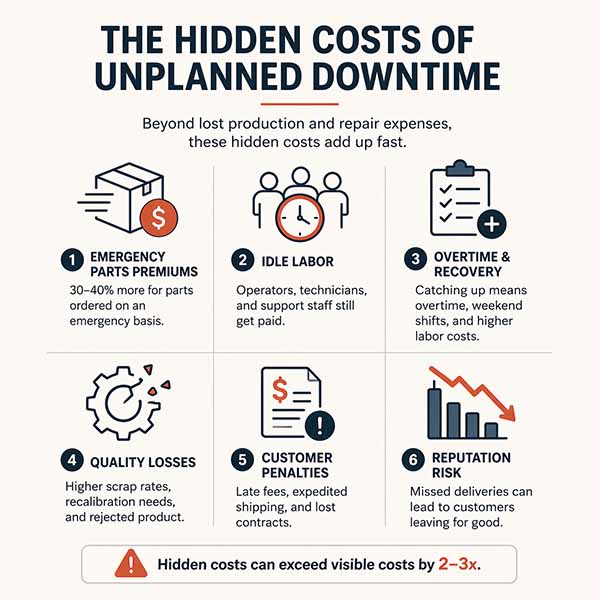
Here’s what gets overlooked:
- Emergency parts premiums: Replacement parts ordered on an emergency basis cost 30% to 40% more than planned purchases, according to industry benchmarks. Expedited shipping adds another layer.
- Idle labor: Every operator, technician, and support worker standing idle during an unplanned stop still draws full wages and benefits. For a plant running three shifts, that adds up fast.
- Overtime and recovery: Once the line restarts, catching up on lost production usually means overtime at 1.5x to 2x labor rates. Weekend shifts may be required.
- Quality losses: Startup after an unplanned stop produces higher scrap rates. Equipment that went down hard often needs recalibration, and the first batches off the line may not meet spec.
- Customer penalties: Late deliveries trigger contractual penalties, expedited shipping to customers at your expense, and in some cases, lost contracts entirely.
Then there’s the cost nobody puts on a spreadsheet: reputation. A plant that misses delivery dates repeatedly won’t stay on preferred supplier lists. The revenue you lose from a customer switching to a competitor doesn’t show up in any downtime calculation, but it’s often the most expensive consequence of all.
Cost of Unplanned Downtime by Industry Sector
Downtime costs vary dramatically across manufacturing sectors. The table below shows approximate hourly costs based on data from the Siemens True Cost of Downtime 2024 report, Aberdeen Research, and industry surveys.
| Industry Sector | Avg. Cost per Hour | Avg. Annual Loss per Plant |
|---|---|---|
| Automotive | $2.3 million | $129 million+ |
| Oil & Gas / Refining | $500,000+ | $87 million |
| Food & Beverage | $30,000 to $50,000 | $7 million to $12 million |
| Discrete Manufacturing | $10,000 to $50,000 | $3 million to $15 million |
| Heavy Industry | $187,500 | $45 million |
| Pharmaceuticals | $500,000+ | $50 million+ |
Table 1: Approximate unplanned downtime costs by manufacturing sector. Sources: Siemens True Cost of Downtime 2024, Aberdeen Research, industry surveys.
Your plant’s actual cost depends on production throughput, product margins, labor rates, and how many downstream processes depend on the affected line. Even within the same sector, a high-mix, low-volume shop will see different numbers than a high-volume continuous process line.
What Causes Unplanned Downtime in Manufacturing?
Understanding where downtime comes from is the first step toward reducing it. Industry data consistently points to the same root causes:
- Equipment failure accounts for 42% of all unplanned downtime incidents, according to multiple industry surveys. Bearings, seals, motors, and drives are the usual suspects. The Plant Engineering 2021 Report found that over 60% of unplanned failures stem from aging assets and deferred maintenance.
- Human error causes roughly 23% of unplanned stops. That includes operator mistakes, misconfigured machines, and skipped procedures. Training gaps are almost always a factor.
- Process issues (material variations, quality deviations, tooling problems) account for about 15%.
- Supply chain disruptions (missing materials, late deliveries) cause roughly 12%.
- IT and software failures make up the remaining 8%, a category that’s growing as plants digitize operations.
Equipment failure drives 42% of all unplanned downtime, and over 60% of those failures trace back to aging assets and deferred maintenance.
The pattern is clear. Most unplanned downtime is preventable. Equipment failure, the leading cause, is exactly what predictive and preventive maintenance programs are designed to catch before it shuts you down. Human error shrinks with better training and standardized procedures. The question is whether your organization invests in prevention or keeps paying the premium for reactive repairs.
How to Calculate Your Plant’s Downtime Cost
Generic industry averages are useful for benchmarking, but they won’t help you build a business case for your plant manager or CFO. You need your own number. Here’s a practical formula that captures both the obvious and hidden costs.
Total Downtime Cost = (Lost Production Value + Idle Labor Cost + Recovery Costs + Hidden Costs) x Downtime Hours
Break each component down:
- Lost Production Value: Units per hour x gross margin per unit. Use the margin of the specific product running on the affected line, not a plant average.
- Idle Labor Cost: Fully loaded hourly rate (wages + benefits + overhead) x number of workers idled. Include operators, material handlers, quality techs, and anyone else who can’t do productive work while the line is down.
- Recovery Costs: Emergency parts (remember the 30% to 40% premium), maintenance labor for the repair, overtime hours needed to catch up, startup scrap, and any expedited shipping to customers.
- Hidden Costs: Contractual penalties for late delivery, customer goodwill damage (estimate conservatively), energy costs for restart cycles, and quality holds on product produced just before or after the event.
Run this calculation for your last three to five unplanned downtime events. You’ll likely find your actual cost per hour is significantly higher than what your maintenance reports have been showing. Most plants that go through this exercise discover costs 2x to 3x higher than their previous estimates.
The Ripple Effect: How One Stop Cascades Through Your Operation
Here’s what most downtime cost articles don’t cover: the cascade. A single unplanned stop doesn’t just affect one line. It sends shockwaves through the entire operation.
When a critical upstream process goes down, every downstream operation starves for material. Packaging lines sit idle. Warehousing crews have nothing to load. Shipping schedules collapse. If you’re running just-in-time delivery to a major customer (and most Tier 1 automotive suppliers are), a four-hour stoppage can trigger expedited freight charges, premium air shipments, or even a line-down charge from the OEM.
Most plants that perform a thorough downtime cost audit discover their actual losses are 2x to 3x higher than what their maintenance reports have been showing.
The ripple extends beyond your four walls. Suppliers who held inventory for your scheduled pull now have storage costs. Customers who can’t get your components may need to source emergency alternatives. If your downtime causes their line to stop, the financial and relationship damage compounds.
This cascading effect is why sophisticated manufacturers track downtime impact across the full value chain, not just at the point of failure. It’s also why the true cost of unplanned downtime is almost always higher than the number on the maintenance report.
Proven Strategies to Reduce Unplanned Downtime Costs
Reducing unplanned downtime doesn’t require a massive capital investment. The highest-ROI strategies focus on catching failures before they happen and building organizational discipline around maintenance execution. That discipline is the core of good maintenance management.
Implement Condition-Based Maintenance
Condition monitoring technologies (vibration analysis, oil analysis, thermography, ultrasonic testing) detect developing faults weeks or months before catastrophic failure. Plants with mature condition monitoring programs reduce unplanned breakdowns by 70% to 75%, according to industry benchmarks. The investment pays for itself within the first prevented failure on a critical asset. For the full cost-benefit case, see our piece on whether predictive maintenance is worth the investment.
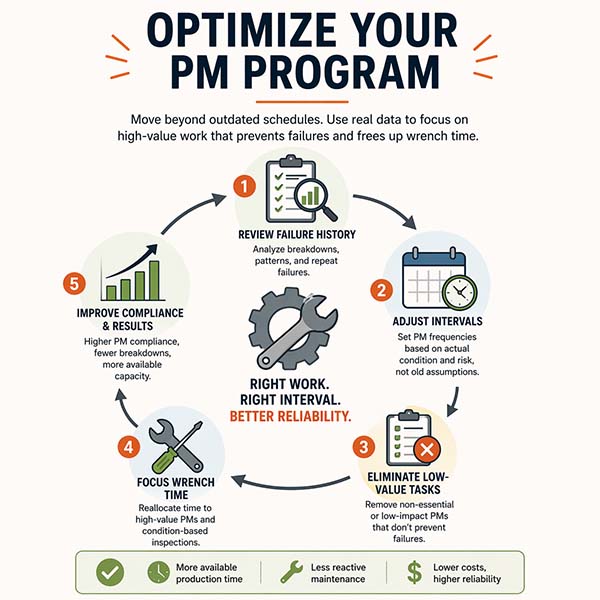
Optimize Your PM Program
Many plants run preventive maintenance schedules based on OEM recommendations that haven’t been updated since commissioning. PM optimization (reviewing failure history, adjusting intervals based on actual equipment condition, eliminating low-value tasks) can improve schedule compliance and free up wrench time for work that actually prevents failures. More about PM Optimization.
Invest in Operator Training
With 23% of unplanned downtime caused by human error, training is one of the cheapest interventions available. Autonomous maintenance (training operators to perform basic inspections, lubrication, and cleaning) catches problems early and builds ownership of equipment condition.
Deploy a CMMS That Your Team Actually Uses
A CMMS that tracks work orders, parts inventory, and failure codes gives you the data to spot patterns and make smarter decisions. But only if technicians actually use it. The best CMMS in the world is worthless if work orders are completed on paper and entered three days late. Focus on adoption, not features. More about CMMS Implementation.
Track and Analyze Every Downtime Event
You can’t reduce what you don’t measure. Every unplanned stop should be logged with duration, root cause, affected equipment, and estimated cost. Monthly analysis of this data reveals the chronic offenders (the small group of assets driving most of your downtime) and directs your improvement efforts where they’ll have the most impact.
Run Your Own Downtime Cost Audit
If you’ve never calculated the true cost of downtime for your plant, start with a focused audit. This process typically takes two to three weeks and produces a number your leadership team will find hard to ignore.
- Pull 12 months of downtime records. Use your CMMS, shift logs, or production reports. List every unplanned stop with duration, affected line, and cause.
- Calculate lost production for each event. Use actual production rates and margins for the product that was running at the time.
- Add labor, parts, and recovery costs. Include overtime, emergency parts premiums, and startup scrap.
- Identify downstream impacts. Check for expedited shipping charges, customer penalties, and any production schedule changes that resulted from each event.
- Total and rank by cost. Rank your assets and failure modes by total annual downtime cost. This ranking becomes your improvement priority list.
The result is a defensible, data-backed cost figure you can present to leadership alongside specific recommendations for reducing it. In our experience, the number is always larger than anyone expected, which makes the case for investment considerably easier. Our guide to winning ROI approval for maintenance initiatives shows how to turn that number into a funded project.
Frequently Asked Questions
How much does unplanned downtime cost per hour in manufacturing?
The average cost across all manufacturing sectors is approximately $260,000 per hour, according to Aberdeen Research. Costs range widely: discrete manufacturers may lose $10,000 to $50,000 per hour, while automotive plants can lose $2.3 million per hour (Siemens True Cost of Downtime, 2024).
What is the difference between planned and unplanned downtime?
Planned downtime is scheduled in advance for maintenance, changeovers, or upgrades. It’s budgeted and managed. Unplanned downtime occurs without warning due to equipment failure, human error, or process breakdowns. Unplanned downtime costs significantly more because it involves emergency repairs, idle labor, and disrupted schedules.
What are the most common causes of unplanned downtime?
Equipment failure leads the list at 42% of all incidents, followed by human error (23%), process issues (15%), supply chain disruptions (12%), and IT or software failures (8%). Aging assets and deferred maintenance are underlying factors in the majority of equipment failures.
How can manufacturers reduce unplanned downtime?
The most effective strategies include implementing condition monitoring programs (vibration analysis, oil analysis, thermography), optimizing preventive maintenance schedules, investing in operator training, deploying a CMMS with high adoption rates, and systematically analyzing every downtime event to identify chronic problem assets.
How do you calculate the total cost of a downtime event?
Add lost production value (units per hour x margin), idle labor costs (fully loaded rates x workers affected), recovery costs (emergency parts, overtime, scrap), and hidden costs (customer penalties, expedited shipping, reputation damage). Multiply by the total hours of the event. Most plants find actual costs are 2x to 3x higher than initial estimates.